Why FEMA Watches South Alabama’s Waffle Houses After a Storm
South Alabama's 35 Waffle House locations play an unlikely role in disaster response, giving federal officials a quick read on storm damage.
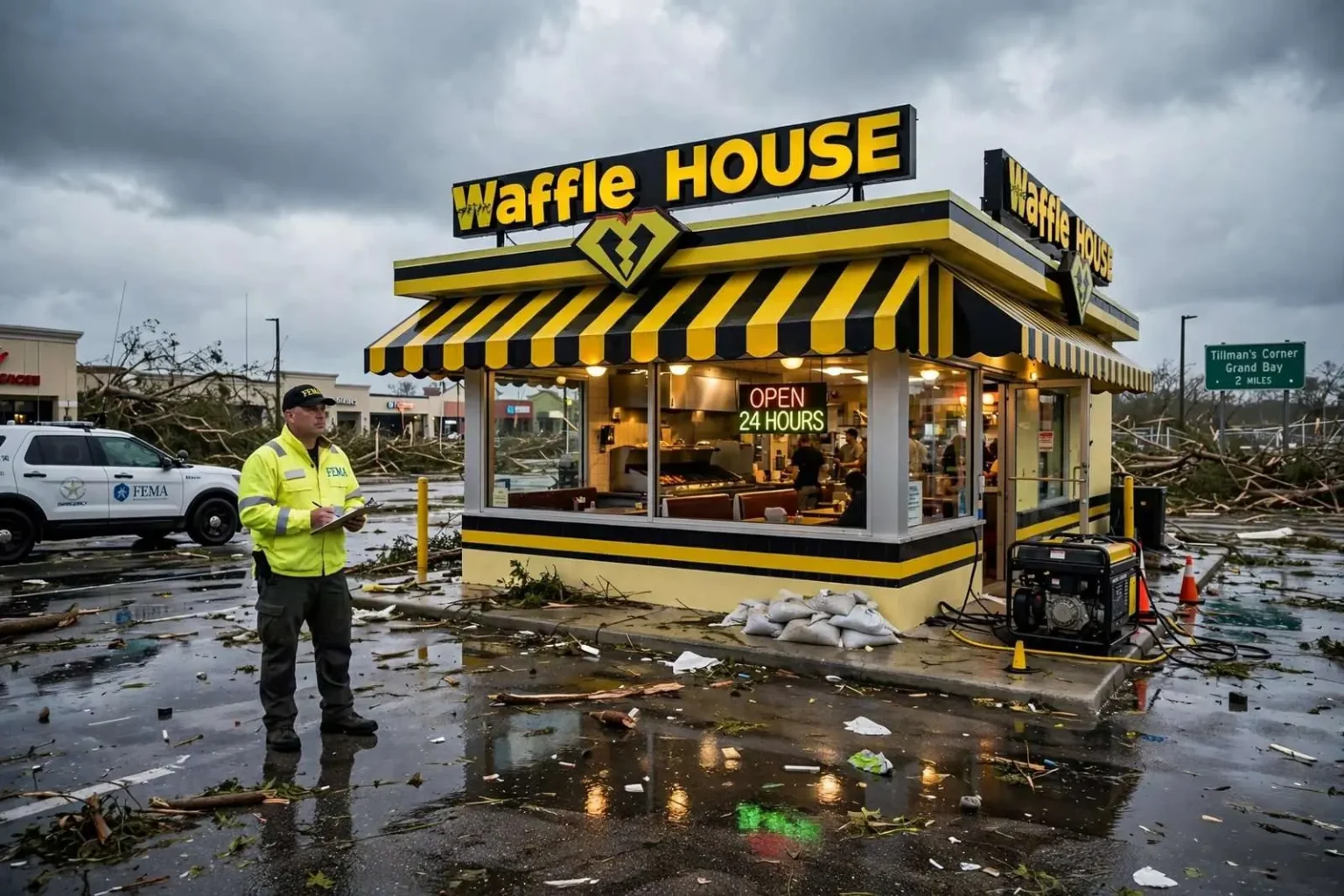
For John and Debbie Simpson of Grand Bay, the Waffle House off Tillman’s Corner is practically a second home. The retired shrimp boat captain and his wife eat there at least once a week, rain or shine — and they kept coming even in the chaotic days after Hurricane Katrina. Some habits survive a hurricane; this one seems built to outlast anything the Gulf can send.
“I like to joke that those are my girlfriends,” John, 78, said of the restaurant’s cooks. “We’ll come out here whether it’s snowing, rain or shine.”
That kind of loyalty is common across South Alabama’s 35 Waffle House locations, many of which have built a reputation for staying open, or reopening almost immediately, after hurricanes, ice storms and other disasters. It’s a pattern federal emergency officials have come to rely on — reliable enough that the chain’s kitchen lights have become an informal gauge of how badly a community has been hit.
“You don’t close a Waffle House,” said Lars Powell, director of the Alabama Center for Insurance Information and Research at the University of Alabama’s Culverhouse College of Commerce. “As everyone is getting out of town, they are trying to get in to prepare a hot meal. They put considerable resources into their own risk management where they send additional personnel and supplies to their restaurants.”
Why the Waffle House Never Closes
The company’s storm posture is not an accident of stubbornness but a deliberate business strategy. Waffle House, founded in the 1950s in Georgia and built almost entirely across the Southeast, has always located its restaurants along the hurricane belt — the same geography that makes the Gulf Coast both profitable and perilous. Closing for every near-miss would cost the company an enormous share of its annual revenue, so instead the chain built a playbook for riding storms out and reopening fast.
That playbook starts before the weather arrives. When a hurricane is still days offshore, the company positions extra food, fuel and employees inland of the forecast track, prepping its own relief convoy the way utilities preposition line crews. Restaurants in the path stock up on items that do not require full power, and managers know which grills can run on gas, how long refrigerated inventory will hold and which staff members can reach the building after the roads clear.
The design of the restaurants themselves helps. Waffle Houses are small buildings with relatively few windows, simple kitchens and equipment that can operate on generators or propane — nothing like the cavernous, all-electric kitchens of casual dining chains. A restaurant that can cook hash browns with the lights half out is, in disaster terms, a small, redundant piece of infrastructure scattered along every interstate and coastal highway in the region.
The university-based research center Powell leads exists precisely to study questions like this — how risk is priced, communicated and managed across the state, and what businesses and homeowners can learn from the entities that survive disasters best. A restaurant chain’s storm manual may sound like an odd subject for academic attention, but as a case study in operational resilience, few companies in the country offer a better one.
The Waffle House Index
Mobile’s director of public safety, Richard Landolt, said local emergency officials pay attention to the chain’s status after a storm passes through. “Their logistic train is so precise that if you see them open quickly, that is a very good sign,” Landolt said. “It’s an indicator that shows we are well on the way to recovery.”
The pattern became formalized as the so-called “Waffle House Index,” a term coined in 2011 by then-FEMA Administrator Craig Fugate. The informal scale uses a stoplight system: green means a location is serving its full menu and utilities are largely intact; yellow means a limited menu, often running on generator power or low supplies; red means the restaurant is closed, typically signaling severe nearby damage.
The index works because it compresses a dozen separate data streams into one glance. A green Waffle House implies electricity, working water and sewer, passable roads, a supply chain still delivering and employees who can get to work — conditions a damage-assessment team might otherwise need hours of aerial surveying to establish. Fugate’s insight was that a private company, motivated by profit and unmatched at logistics, had already solved the problem of rapid local damage assessment; FEMA just had to read the sign.
Mary Hudak, a spokeswoman for FEMA’s Southeast Region, said the agency leans on situational awareness from private-sector partners like Waffle House to gauge a storm’s real impact on the ground. “If we hear from a Waffle House that it is open, then that tells us there is power, their employees can get to work and the transportation distribution network is working,” she said. “If it’s closed, it tells us we need to ask more questions.”
The chain’s labor model is part of the formula too. Waffle House units are staffed around the clock as a matter of routine, so reopening after a storm is a scheduling exercise rather than a recall operation. Managers know which employees live nearby, the stores maintain cross-trained crews from sister locations, and the company’s practice of moving workers in from outside the disaster zone — sometimes with portable housing — has become part of the chain’s storm lore.
Menu flexibility matters as much as logistics. The yellow tier of the index — limited menu, generator power — is not a degradation but a plan: the restaurants can keep cooking on gas grills, and the inventory mix can stretch for days when deliveries are delayed. Customers who find only a portion of the menu available understand intuitively what FEMA understands: partial service means the building, the block and the supply line are wounded but working.
Eyes and Ears Locally
Fairhope author Joe Formichella, whose 2014 novel “Waffle House Rules” is set against the backdrop of one of the chain’s restaurants, said the index makes intuitive sense to anyone who has spent time in a South Alabama Waffle House during a storm. “It’s a serious matter and not some urban legend,” he said. “FEMA needs some eyes and ears locally, and it doesn’t surprise me the best set of eyes and ears is the nearest Waffle House.”
Formichella’s point gets at why the index endures as folklore as well as federal practice. In small towns across the Gulf South, the Waffle House is one of the few establishments that is simultaneously always open, centrally located, and open to everyone — shift workers at 3 a.m., church groups after Sunday service, road-trippers, cops on break. It functions as informal civic infrastructure, and everyone in town knows where it is and what it looks like when it is busy.
The restaurants also serve practical roles during recovery that have nothing to do with government indexes. Crews coming in to restore power line up for hot meals; insurance adjusters and roofing contractors use the parking lots as staging points; displaced families charge phones and trade information over coffee. In the days after a major hurricane, when most kitchens in a county are dark, a lit Waffle House sign is often the only reliable one on the highway.
The Gulf Coast’s Storm Education
South Alabama has had plenty of chances to test all of this. The region has taken direct hits and near-misses from major hurricanes repeatedly over the decades — storms that knocked out power for weeks, scattered debris across the same Tillman’s Corner intersections the Simpsons still visit, and turned disaster response into a local skill set. Generations of coastal residents have learned to read their own recovery the same way FEMA does: by which businesses reopen, in what order, and how quickly.
That experience shapes the way locals talk about storms. Insurance researchers like Powell watch how businesses manage risk because it predicts how communities recover; public safety officials like Landolt watch because a reopening business means roads, power and supply lines are functioning. The ordinary routines of commerce — grills firing, trucks unloading, staff showing up — double as the region’s most honest damage report.
Tillman’s Corner, where the Simpsons do their weekly eating, is itself a case study in the geography of recovery. The commercial crossroads south of Mobile sits astride the routes that tie the bay’s communities together, dense with restaurants, groceries and hardware stores — the kinds of everyday businesses whose reopening schedules tell residents more about a storm’s true severity than any official briefing. When the grills at the corner Waffle House light up, the whole neighborhood reads the signal.
A Hot Meal and a Familiar Face
For families like the Simpsons, the value is simpler: a hot meal and a familiar face when the power is still out everywhere else. After Katrina, when south Mobile County was littered with debris and thousands of homes were dark, the couple kept their weekly trip, a small act of normalcy in a landscape that had lost almost all of it.
There is a reason disaster sociology keeps returning to routines like that. Recovery is measured in months of insurance claims and construction, but it is carried by days — by people finding somewhere to eat, someone they know, some piece of the week that still works. A restaurant chain that refuses to close, staffed by cooks who know their regulars by name, turns out to be exactly the kind of institution that carries a coastline through the worst weeks of its year.
The Waffle House Index began as a joke about hash browns and became a fixture of federal storm response, but on the Gulf Coast it was never really news. Residents knew what the lights meant long before Washington coined a term for it — and they kept coming, rain or shine, for the waffles as much as for the reassurance.