Where to Recycle Your Christmas Tree in Mobile and Baldwin Counties
Free tree recycling programs across Mobile and Baldwin counties turn used Christmas trees into mulch, with drop-off sites open through late December and January.
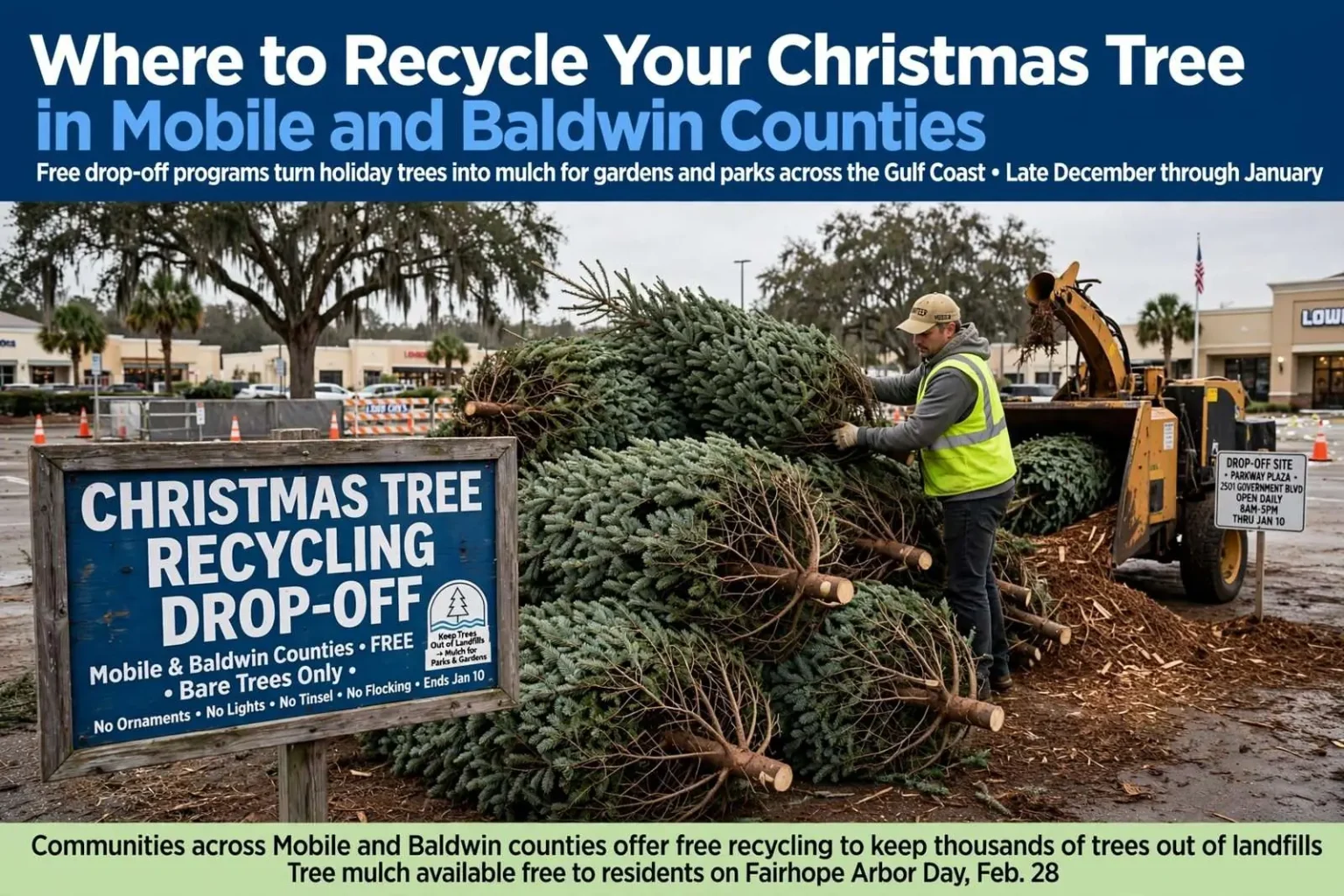
Once the holidays wind down, that once-festive Christmas tree does not have to end up in a landfill. Communities across Mobile and Baldwin counties offer free recycling programs that turn used trees into mulch and other useful material, and residents have several drop-off options in late December and January. The programs have become a fixture of the post-holiday calendar along the Gulf Coast, an easy piece of environmental housekeeping that keeps tons of organic material out of the region’s landfills and returns it to gardens and parks across both counties.
Before recycling a tree, officials remind residents to strip off all ornaments, lights, tinsel and other decorations. Only the bare tree should be dropped off. Artificial trees and flocked trees are generally not accepted. The rules exist for practical reasons: tinsel, hooks, and wire wound through a tree can jam or damage chipping equipment, and flocking — the sprayed-on snow effect — introduces material that cannot be composted or safely chipped. A tree that arrives undecorated can move straight into the grinder; one that arrives with decorations on it becomes somebody’s problem to strip by hand or reject outright.
Where to Recycle in Mobile
In the city of Mobile, tree collection was available at seven sites through Jan. 10, with volunteers on hand to help unload on Jan. 3 and Jan. 4. Drop-off spots included Parkway Plaza on Dauphin Island Parkway, a lot at 2501 Government Boulevard next to Whataburger, the Wildwood Shopping Center on Cottage Hill west of Azalea, a site behind the BP station at Airport and University, the Lowe’s at Airport and Schillinger, the MAWSS Park Forest Center on Moffett Road, and Cloverleaf Plaza in Tillman’s Corner. For details, residents could call 251-208-6029 or visit the city’s website. The spread of sites — one in nearly every quadrant of the city — is deliberate, designed so that no household is more than a short drive from a drop-off point.
The volunteer unloading weekends are a small tradition of their own, turning a chore into a community event as scouts, civic groups, and neighbors lend hands hauling trees from car trunks to the pile. For the city’s public services crews, the volunteer help concentrates what would otherwise be weeks of straggling drop-offs into a manageable collection cycle.
The Mobile Zoo also welcomes trees, which its animals enjoy. Residents can drop off firs at the side gate during normal business hours, though cypress trees are not accepted. It is a recycling option with an audience: the zoo’s animals treat donated trees as enrichment — something to rub against, nibble, and explore — so a Christmas tree that ends up at the zoo gets a second career as entertainment for its residents rather than a trip through a chipper.
Baldwin County Options
Across the bay, Baldwin County communities run their own versions of the program. In Daphne, trees left at the curb are collected with regular trash and recycled. Residents can also drop them off anytime near Daphne High School on Champions Way, at the Al Trione Sports Complex on Whispering Pines Road, or at the Dr. Albert Corte Jr. Animal Shelter on Johnson Road. The anytime format removes the calendar pressure that curbside collection imposes — a resident finishing the decorations on Jan. 8 can still get the tree out of the house without waiting on a trash day.
Fairhope collects trees on regular trash days through Feb. 23 and turns them into mulch, which is offered free to residents on Arbor Day, Feb. 28, from 9 a.m. to noon at the Public Works Warehouse on South Section Street. Questions can be directed to 251-990-0192. The Fairhope arrangement is the most complete version of the cycle: the tree comes back to the same residents who set it out, converted into mulch they can carry home for their flower beds, timed to the city’s Arbor Day observances — a fitting calendar for the community that calls itself the city of flowers.
Baldwin County provides numerous additional drop-off points for residents across the region. Locations included the Bay Minette Transfer Station and other sites serving communities from the delta to the coast, giving residents of the county’s smaller municipalities a practical alternative to a trip across the bay or a slow decay cycle in a backyard. County-level collection points matter in Baldwin in particular because of its geography: the county is large, and its unincorporated communities depend on transfer stations and convenience sites for much of their waste handling already, making those facilities the natural collection points for trees.
Why Tree Recycling Matters
The environmental arithmetic behind these programs is straightforward. A Christmas tree is organic material — a few years of growth on a farm, cut for a few weeks in a living room. Chipped into mulch, it returns to the soil slowly, feeding beds, suppressing weeds, and holding moisture through Gulf Coast summers. Buried in a landfill instead, it decomposes without oxygen, producing methane, a greenhouse gas far more potent than carbon dioxide. Multiply one tree by the thousands of households that put one up each December across the two counties and the difference between a chipper and a dump becomes measurable.
The mulch end-product has steady local demand. Gardeners across the Gulf Coast use mulch year-round to manage the region’s heat, humidity, and torrential rains, and municipal mulch — free or cheap, produced from local trees — is a popular alternative to bagged commercial products. Programs like Fairhope’s Arbor Day giveaway put that material back into circulation at the exact moment residents are planning their spring gardens, closing a loop that runs from a tree farm in another state to a flower bed on Section Street.
Officials note a few practical tips that apply everywhere. Trees should be free of stands and bags as well as decorations, since steel stands and plastic wrap are as unwelcome at the chipper as tinsel. Trees cut for disposal should not be left at unauthorized sites — vacant lots, roadside ditches, park edges — where they become litter and, in a dry winter, fire hazard. And residents who miss the collection windows still have options, since the zoo’s standing offer and county convenience sites extend the season beyond the formal programs.
A Gulf Coast Tradition
Christmas tree recycling has grown along with the region’s environmental consciousness over recent decades, evolving from scattered municipal efforts into coordinated programs with volunteers, corporate partners like the retailers hosting collection lots, and dedicated audiences at facilities like the Mobile Zoo. Each January, the region’s trees travel a short, practical journey from living room to drop-off lot to grinder to garden — a modest cycle, but one that both counties have built the habits and infrastructure to sustain.
The practical effect for residents is simple: there is no good reason for a natural Christmas tree in Mobile or Baldwin counties to reach a landfill. Whether the tree goes over the Daphne curb, onto the pile at a Mobile shopping center, through the side gate at the zoo, or into the line at the Fairhope Public Works Warehouse, it ends its holiday serving a purpose — sheltering an animal, dressing a garden bed, or shading a spring planting — long after the ornaments are boxed and the lights are coiled for next December.
The collection programs also reflect the particular character of the two counties. Mobile’s sites track the city’s commercial geography — the shopping centers and intersections where residents already run errands, from Parkway Plaza in the south to Cloverleaf Plaza in Tillman’s Corner — which keeps participation convenient. Baldwin’s approach leans on its municipalities and county facilities, where small-town public works departments run programs scaled to their own communities. Neither model requires a resident to travel far, and both are free, which program coordinators cite as the decisive factor in participation rates.
For households with real trees, the choice between disposal options can be reduced to a few questions. City of Mobile residents should check the seven-site list and the city’s information line at 251-208-6029. Daphne residents can simply drag the tree to the curb, or use one of the three permanent drop-off points if the timing is wrong for trash day. Fairhope residents have the longest window, with curbside collection running through Feb. 23 and the Arbor Day mulch giveaway on Feb. 28 as the payoff. Elsewhere in Baldwin County, the transfer station and county drop-off sites stand ready. And animal lovers anywhere in the region can take a tree to the Mobile Zoo, where the side gate and business hours make it easy — just leave the cypress at home.
The final instruction bears repeating because it is the one rule that trips up every season’s first-timers: bare trees only. Every strand of tinsel, every ornament hook, every ribbon left on a tree slows down a system built to move quickly through thousands of trees in a few weeks. Stripping the tree takes minutes at home and saves hours at the collection site — and it ensures the tree that decorated a living room through Christmas becomes, by spring, mulch under the azaleas rather than a problem at the chipper.