Mobile City Council Approves Police Body Cameras, Tackles Wide-Ranging Agenda
The Mobile City Council approved a $480,775 contract for police body cameras and tasers, part of a broader five-year, $1.96 million equipment deal.
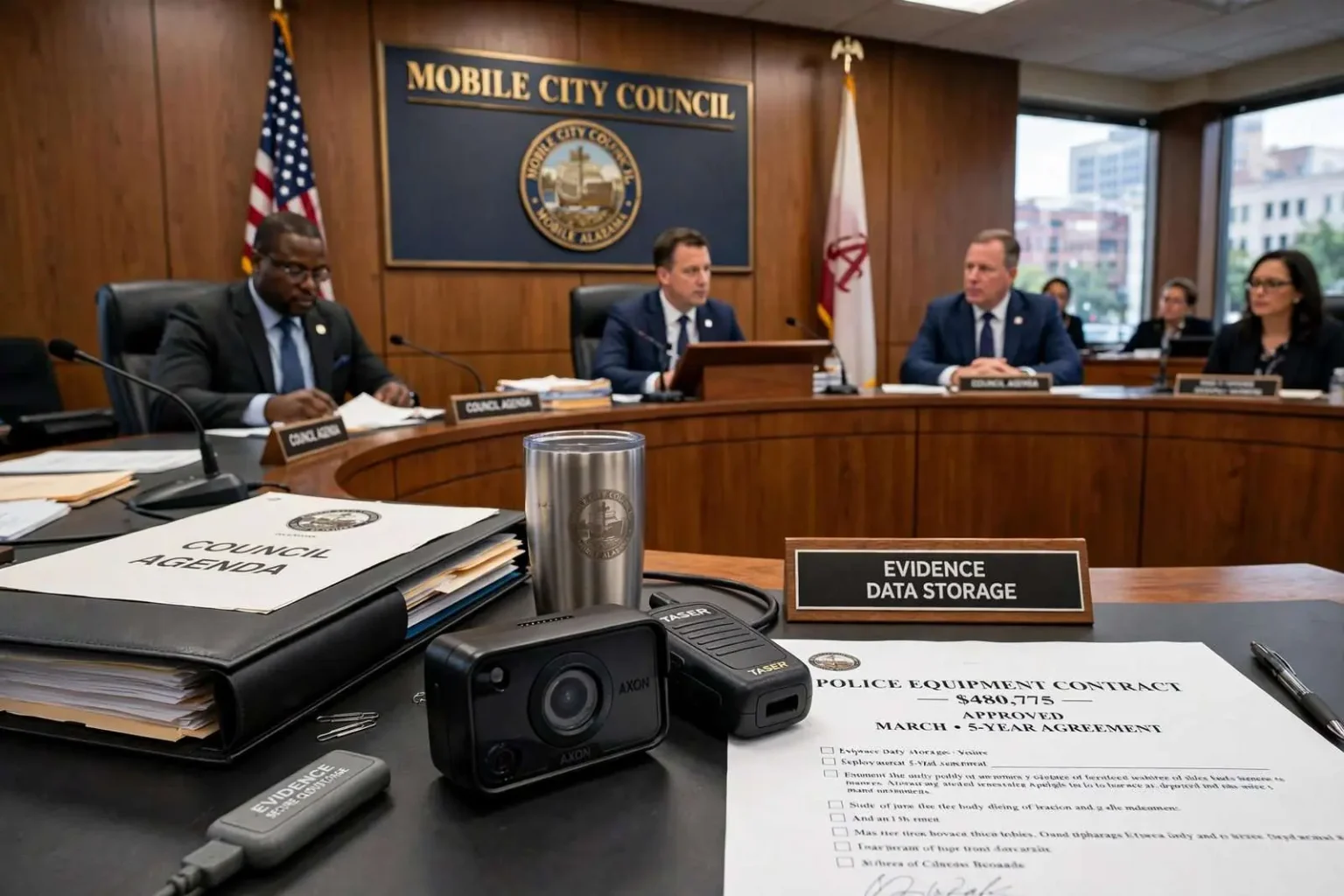
The Mobile City Council voted unanimously this week to approve a $480,775 contract with TASER International covering the purchase and maintenance of body cameras, tasers and related data storage services for the Mobile Police Department, a decision that puts one of the most closely watched equipment programs in modern policing on a firm footing in Alabama’s third-largest city.
Public Safety Director Richard Landolt said the approval represents the first year of a five-year agreement that will bring the total contract value to roughly $1.96 million. The deal includes provisions for the company to replace broken equipment and provide upgrades as needed throughout the contract term, an arrangement that shifts the burden of keeping hardware current onto the vendor rather than requiring the city to budget separately for repairs and obsolescence.
Landolt said the item was added to the agenda at the last minute after officials determined the city could realize significant savings by placing the order before the end of March, though the exact savings figure had not yet been finalized. The compressed timeline meant council members had less lead time than usual to review the contract, but the unanimous vote signaled broad agreement that the opportunity to lock in better pricing was worth taking.
The vote builds on groundwork the council laid in February, when it approved a resolution to transfer nearly $3.4 million in economic development incentive funds toward police and fire vehicle purchases, along with 300 Taser Axon Flex body cameras for law enforcement officers. Together, the two actions represent a substantial reinvestment in public safety equipment at a time when departments across the country were facing intense scrutiny of how officers interact with the public and how those interactions are documented.
Why Body Cameras Matter
Body-worn cameras have become one of the most discussed tools in American policing, credited with providing objective records of encounters between officers and residents and with discouraging misconduct on both sides of an incident. For a department the size of Mobile’s, which patrols a port city of roughly 195,000 residents spread across neighborhoods from downtown to West Mobile, the cameras create a documentary trail that can be decisive in resolving complaints, defending officers against false accusations and building public confidence in the police department.
Equipment of this kind is only as useful as the data infrastructure behind it. Body cameras generate enormous volumes of video, and that footage must be stored securely, indexed for retrieval and retained according to evidence and public records rules. The data storage component of the TASER International contract addresses that need, pairing the cameras themselves with the backend systems that make the footage accessible to investigators, prosecutors and, in appropriate cases, the public.
Council Members Weigh In
District 3 Councilman C.J. Small called the decision a milestone moment for the city, saying the cameras would help resolve the ambiguity that often surrounds complaints filed against both officers and the public he has heard about frequently since joining the council. His comments reflected a recurring frustration for councils in cities across the country: when a dispute between a resident and an officer comes down to one account against another, neither side gets a fair hearing, and the community’s trust suffers regardless of who is telling the truth.
District 4 Councilman John Williams echoed that sentiment, calling the equipment purchase an important step forward even though it arrived as a late addition to the agenda. His acknowledgment of the rushed timeline was a nod to a common tension in municipal government, where urgent purchasing windows can collide with the deliberative pace that residents expect from their elected representatives.
Deployment Timeline and Training
Landolt said the cameras are expected to be fully deployed and operational within the department by mid-summer, with training and logistics preparation beginning immediately. That timeline gives department leadership a window to work through the practical questions that determine whether a camera program succeeds: how officers activate and tag recordings, how supervisors review footage, how video is matched to case numbers, and how the department communicates its policies to the public.
Training is a particular focus for departments rolling out body cameras. Officers need to understand not only the mechanics of the devices but the circumstances that require recording, the rules for reviewing footage before writing reports, and the consequences of failing to record. The months between purchase and full deployment give the Mobile Police Department room to build those habits before every encounter on the street is being captured.
The tasers included in the contract are part of the same officer-safety equation. Conductive electrical weapons give officers a less-lethal option between verbal commands and firearms, and maintaining a modern, reliable inventory of the devices is a standing requirement for departments of Mobile’s size. Bundling the tasers, cameras and data storage into a single vendor agreement simplified procurement and gave the city leverage on price and service terms.
Beyond the Cameras: A Busy Council Agenda
The council also worked through a lengthy list of other business during the meeting. Members approved the reallocation of $1.6 million in surplus park funds toward turf improvements at Herndon Park, commonly known as Sage Park, setting the stage for a future request to fund three artificial turf fields at the site. The investment targets one of the city’s most heavily used recreational complexes, where natural grass fields wear down quickly under the volume of youth leagues, practices and tournaments that cycle through the property.
Artificial turf has become an increasingly popular answer for municipalities facing that problem. Synthetic fields can absorb far more playing hours than grass, require less water and maintenance, and remain usable in the wet weather that regularly sweeps through the Gulf Coast. For families who depend on youth sports programs, the difference between a well-drained synthetic field and a churned-up grass one in a rainy season is the difference between a full schedule and a season of cancellations.
The park funding vote illustrated the mix of sources cities use to fund recreation. Surplus park funds, set aside when earlier projects came in under budget or were completed with leftover money, can be redirected by the council toward new priorities, and members weighed the turf project against other potential uses before approving the transfer.
The Broader Fiscal Picture
Taken together, the body camera contract, the vehicle purchases and the park improvements show a city government managing multiple capital needs at once. Public safety equipment and vehicles wear out on predictable schedules, and deferred purchases tend to cost more in the long run as maintenance bills mount and replacement prices rise. The economic development incentive funds redirected in February gave the council a source of money for those needs that did not require raising taxes or cutting services elsewhere.
For residents, the practical effects are visible on several fronts. Police officers will be equipped with cameras that document their work, patrol vehicles will be newer and more reliable, and athletes at Sage Park will eventually play on fields built to withstand the demand placed on them. Each purchase carries its own maintenance obligations, and future councils will inherit the responsibility of funding the years two through five of the camera contract as well as the upkeep of everything else approved this week.
The unanimous votes also reflect a degree of consensus about priorities that has not always characterized debate over public safety spending. With the contracts approved and the ordering window closing at the end of March, the city’s attention now shifts to execution: getting hardware into officers’ hands, training completed, and the promised savings realized on the city’s ledgers.
A Regional and National Shift
Mobile’s move came during a period when departments across Alabama and the Gulf Coast were weighing similar purchases. Municipal police agencies from Huntsville to the Florida line were evaluating body camera programs as prices fell, storage solutions matured and the technology proved itself in daily use. Departments that adopted early faced a learning curve with little precedent to guide them; cities like Mobile that moved after the first wave benefited from clearer standards for retention, release and officer review.
For TASER International, the contract extended a business model that had grown well beyond the conductive electrical weapons that made the company’s name. The Scottsdale, Arizona-based firm repositioned itself as a full-service provider of evidence technology, pairing hardware with cloud-based storage and management platforms designed specifically for police work. Multi-year agreements like Mobile’s gave the company predictable revenue while giving cities locked-in service commitments, and the arrangement became a common template for mid-sized departments.
How the Program Affects Residents
For everyday residents, the arrival of body cameras changes the dynamic of police encounters in ways both large and small. A recorded interaction protects a resident who is treated improperly, and it protects an officer who is falsely accused. Either way, the availability of footage moves disputes from the realm of competing recollections toward an evidentiary footing that complaint investigators and, when necessary, courts can work with.
Residents who wish to file a complaint about a police encounter will interact with a process that now has a documentary backbone. The department’s internal affairs function reviews complaints against officers, and footage gathered under the camera program becomes part of that review. The same footage can exonerate an officer quickly when an allegation does not match the record, sparing both the officer and the complainant a prolonged uncertainty.
There are limits worth understanding. Not every encounter generates footage, cameras can be obstructed or fail, and retention rules determine how long any given recording survives in storage. The contract’s five-year term anticipates those realities by committing the vendor to replace broken equipment and provide upgrades, so that the program’s coverage does not erode as devices wear out.
What Comes Next
The measure of the program will be its execution over the coming months. Full deployment by mid-summer requires the department to complete equipment fitting, policy training and data management setup across patrol divisions, a logistical exercise touching hundreds of officers and thousands of scheduled shifts. Departments that have completed similar rollouts describe the first year as the critical period, when habits form and policy questions surface in real encounters.
The council, for its part, will revisit the cost curve as the contract progresses. The first-year payment of $480,775 is the entry point on a roughly $1.96 million five-year commitment, and future budget cycles will need to accommodate the remaining years. The savings realized by ordering before the end of March will help, and the council’s finance deliberations in coming years will show whether the projection held.
Meanwhile, work continues on the other items approved alongside the camera contract, from the fleet purchases funded in February to the turf project at Sage Park. Together they mark an unusually productive stretch for a council that has balanced public safety investment with neighborhood recreation, and they set a benchmark for how the city evaluates and funds capital needs going forward.