
Psychquinox Returns to Portal Studio With Film, Music and Fire
Portal Studio's quarterly arts celebration Psychquinox returns March 20 in downtown Mobile with film, live music, fire performers and a drum circle.
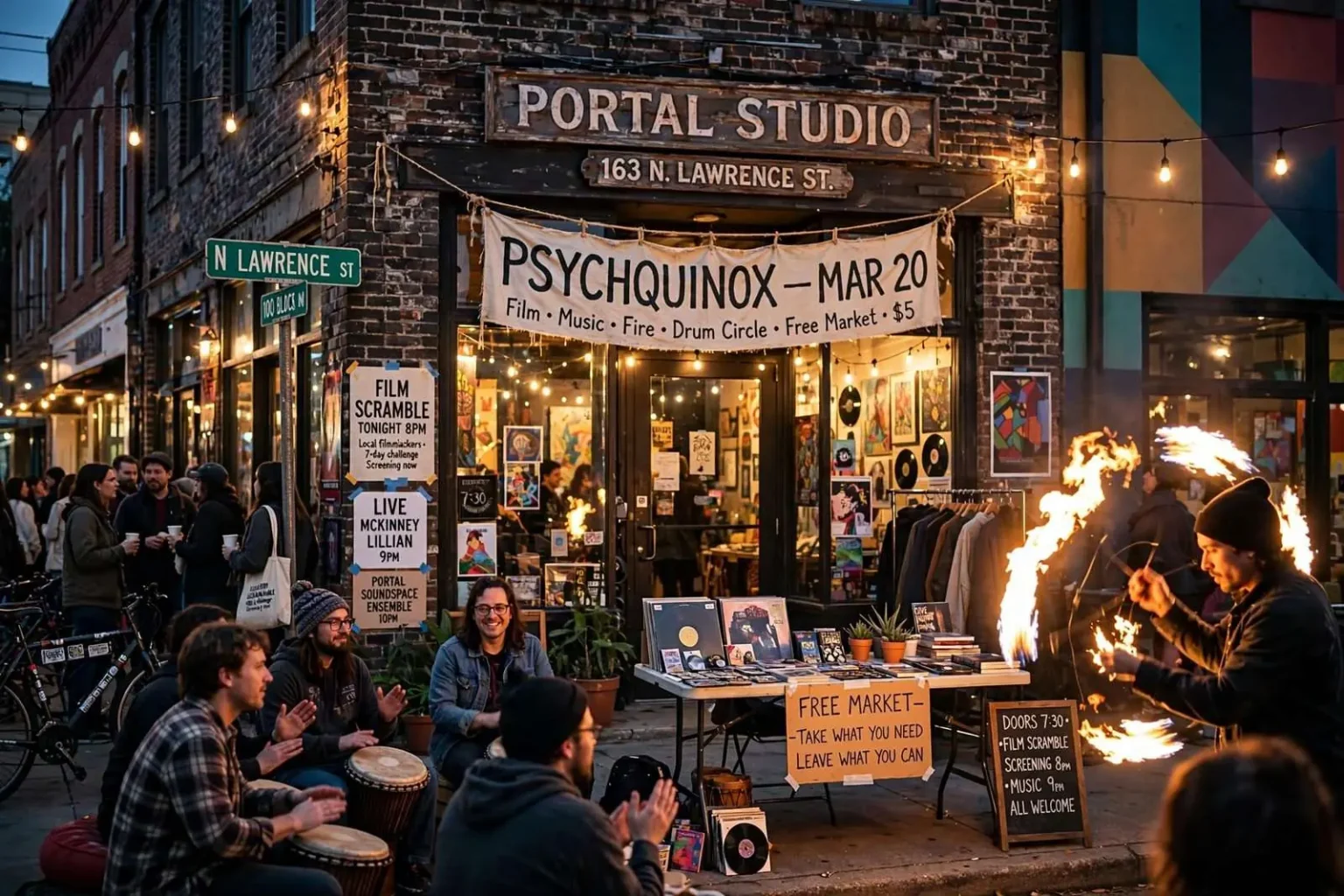
Portal Studio’s quarterly celebration of the arts, Psychquinox, returns Friday, March 20, at 163 N. Lawrence St. in downtown Mobile. The evening mixes a Film Scramble screening, live music, performance art, fire performers, a drum circle and a free market, with a $5 donation at the door and light refreshments.
The studio occupies a spot just off Dauphin Street in the heart of the LoDa arts district, the stretch of downtown Mobile where galleries, studios and performance spaces cluster around the city’s monthly Artwalk. Events like Psychquinox have become part of the rhythm of that district, filling the nights between the big monthly crowds with programming that leans experimental, participatory and deliberately unpolished in the best sense — a place where artists try things they could not try anywhere else.
The name itself signals the event’s character, borrowing the equinox — the twice-yearly moment when day and night balance — and pairing it with the psychedelic sensibility that runs through much of the studio’s programming. Held quarterly, each edition assembles a different mix of film, music and performance, built around whatever the local creative community brings to the table that season.
Film Scramble
The event caps the studio’s second Film Scramble, a competition that challenges teams to make short films under a set of constraints revealed at the start. Teams registered during LoDa Artwalk on March 13, between 6 and 8 p.m., giving them roughly a week to write, shoot and edit their entries before the public screening.
Film scrambles follow a format familiar to independent filmmakers everywhere: every team receives the same restrictions — required elements, a maximum runtime, a tight deadline — and the results are judged or simply screened back to back, so audiences can see how differently each crew interpreted the identical assignment. The constraints are the point. They strip away the endless deliberation that stalls independent projects and force teams to make something finished, start to end, in days rather than months.
For Mobile’s filmmaking community, the scramble offers something the city otherwise lacks between its larger festivals: a low-stakes, high-energy reason to pick up a camera. Teams are typically cobbled together from friends, coworkers and strangers who sign up individually, and many participants come from adjacent creative worlds — musicians, photographers, graphic designers — for whom the scramble is a first step behind a camera rather than an extension of existing work.
How the scramble works
The constraints handed to teams at registration are kept secret until the last moment, a design choice that prevents pre-production and keeps the field level. Previous scrambles in other cities have required a specific line of dialogue, a prop, a location or a genre twist, and Mobile’s edition followed the same playbook — elements announced at registration that every film must include, checked before a team’s entry is accepted for screening.
The week between registration and screening is the scramble’s hidden drama. Teams juggle work schedules, weather and the ordinary chaos of amateur production, shooting on whatever cameras they own and editing late into the night in kitchens and bedrooms across the city. The films that emerge range from polished mini-shorts to gloriously rough experiments, and the audience at Psychquinox sees the full spectrum without knowing which is which until the lights come up.
The screening begins at 8 p.m., giving the scramble teams their audience. Each finished film plays in turn, and the crowd’s reaction to the inventive — and inevitable — interpretations of the constraints is part of the night’s entertainment. Recognition and inside jokes ripple through the room as viewers spot the required elements, some disguised with more wit than others.
Music, fire and the late-night film
Live music follows the films, with McKinney Lillian taking the stage at 9 p.m. The band’s slot bridges the structured first half of the evening and the freewheeling hours that follow, playing as the studio’s lighting shifts and the crowd settles in for the night.
At 10 p.m., the evening turns to cinema history with a showing of 20,000 Leagues Under the Sea, the classic screen adaptation of Jules Verne’s novel of Captain Nemo and the Nautilus. Screening a vintage adventure film inside an art studio, late at night, is exactly the kind of programming choice that distinguishes Psychquinox from a conventional venue’s calendar — the film becomes part of the atmosphere rather than the event’s centerpiece, playing to a crowd that has come for the whole evening’s experience.
The Portal SoundSpace Ensemble rounds out the night. The group, an extension of the studio’s own experimental music wing, closes the event with the kind of improvisatory performance that gives Psychquinox its signature texture — sound as a living thing, shaped in the moment rather than reproduced from a setlist.
Between the scheduled performances, the event’s other elements keep the studio in constant motion. Fire performers work outside, drawing the crowd into the street for displays that transform the block into an impromptu amphitheater. Inside, the drum circle invites anyone with rhythm — or the willingness to try — to join in, blurring the line between performer and audience. And the free market, a fixture of the event’s format, operates on the simplest of economies: bring what you no longer need, take what you can use, and leave money out of it entirely.
A night built on participation
What sets the evening apart from a standard concert or film night is how much of it depends on the audience doing rather than watching. The drum circle only works if people sit down and play. The free market only works if people bring things to give. The scramble screening lands differently when half the room knows someone who spent the week making one of the films. Every element is designed to convert spectators into participants over the course of a few hours.
That design reflects the studio’s broader philosophy. Portal Studio has positioned itself as a workshop as much as a venue, a place where the boundary between artist and audience is treated as a starting point to be crossed rather than a wall to be maintained. Events that invite the crowd to make music, trade goods and watch their neighbors’ films reinforce that identity with every edition.
Keeping LoDa active between Artwalks
Psychquinox is one of several recurring events that keep Mobile’s LoDa arts district active beyond the monthly Artwalk. The monthly walk draws the biggest crowds, but the district’s studios and galleries have learned that survival depends on the nights in between — programming that gives people reasons to come downtown when there is no organized crowd to join them.
The $5 donation at the door reflects that economics. Events like this one are not moneymakers in any conventional sense; the donation covers costs, the refreshments are light, and the performers are paid in exposure, community and the occasional passing hat. What the nights produce instead is infrastructure: a network of artists who know each other, audiences who know where to go, and a venue that has proven it can put on an ambitious evening without institutional funding.
For attendees, the practical advice is simple. The donation gets you in the door at 163 N. Lawrence St., the night runs from the 8 p.m. film screening through the ensemble’s late set, and the mix of fire, drums, film and free goods rewards anyone willing to stay for the whole arc rather than dropping in for a single act. Psychquinox has built its reputation on exactly that: an evening that unfolds, rather than a show that ends.
The equinox timing gives the event a natural theme as well. Falling near the moment when daylight and darkness stand equal, the March edition of Psychquinox has an inherent poetry to it — a night of fire and drums arriving as winter gives way to spring, staged in a district that has spent two decades rebuilding itself around art, music and late-night energy.
North Lawrence Street sits within easy walking distance of the district’s galleries and bars, and event-goers typically string together a full evening downtown: dinner nearby, a gallery opening or Artwalk preview, then the walk to Portal Studio as the scheduled programming begins. That foot traffic is the quiet engine of the LoDa district, where each venue’s event feeds the next door neighbor’s crowd and the neighborhood as a whole becomes the attraction.
Who shows up
The crowd at events like this one defies easy description. Students from the area’s universities mix with working musicians, tattoo artists, families with teenagers drawn by the fire performance, and longtime downtown residents who treat the studio’s calendar as part of their social routine. The $5 door donation keeps the barrier low enough that no one is priced out, which is central to the event’s character.
Artists, meanwhile, treat the night as both audience and opportunity. A filmmaker screens a scramble short, a drummer joins the circle, a painter watches the fire performers and starts planning a piece. Conversations started at Psychquinox have a way of becoming collaborations — a score for the next scramble film, a joint booth at the next free market, a new act for the next quarter’s lineup.
Doors open with the $5 donation at 163 N. Lawrence St., the screening begins at 8 p.m., McKinney Lillian plays at 9, the classic film screens at 10, and the Portal SoundSpace Ensemble carries the night toward its close. Between and around all of it: fire on the sidewalk, drums in the corner, and a room full of Mobile’s creative community trading goods, ideas and one long evening together.


