Mobile’s New Innovation Team Director Reignites Debate Over Where City Leaders Live
Joan Dunlap's hire to lead Mobile's new Innovation Team has renewed debate over how many of Mayor Sandy Stimpson's top staff live outside the city.
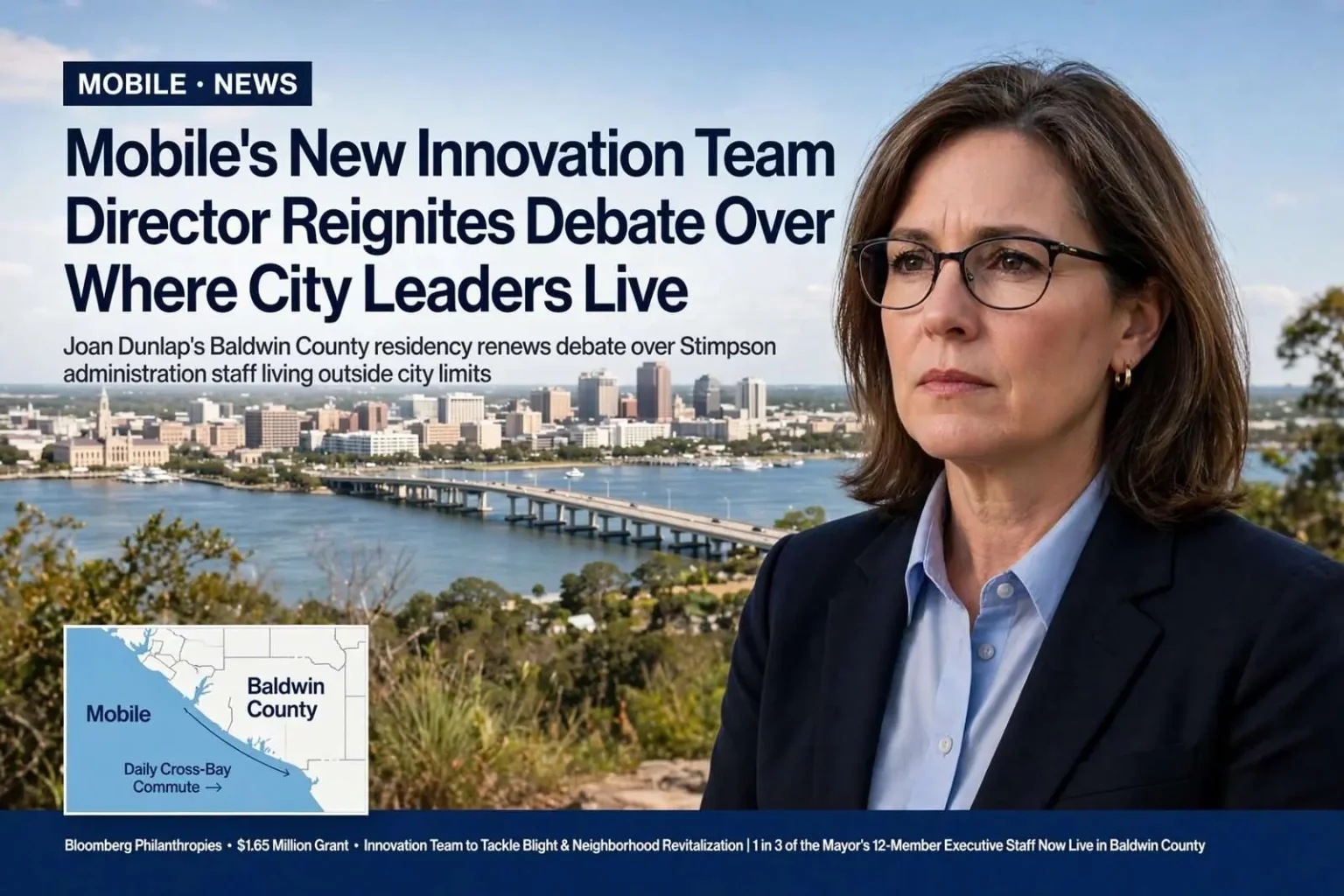
The appointment of Joan Dunlap as executive director of Mobile’s new Innovation Team has reignited a long-running debate over how many of Mayor Sandy Stimpson’s top staff members live outside the city they help run. Dunlap, who grew up in Mobile and graduated from a local high school before returning to lead the newly formed team, lives in Baldwin County — and her hire has given new fuel to a question that has followed the Stimpson administration since its earliest months in office.
Her hire pushes the share of Stimpson’s 12-member executive staff living in Baldwin County to exactly one-third, according to Colby Cooper, the mayor’s chief of staff. Cooper himself lives in Baldwin County, along with City Attorney Ricardo Woods and city spokesman George Talbot. Of the remaining eight members of the mayor’s executive team, five live within Mobile’s city limits and three live elsewhere in Mobile County. Mobile operates under a mayor-council form of government, with a seven-member council and a strong mayor who appoints the department heads and executive staff that run the city’s daily operations, which is why the makeup of that appointed team draws such close attention.
Cooper noted that the residency split among executive staff roughly mirrors the broader city workforce, with about one-third of the city’s total payroll — more than 800 employees — living outside Mobile County altogether. City jobs in Mobile pay competitively for the region, and the daily commute across Mobile Bay has grown commonplace as Baldwin County’s population has climbed. The Eastern Shore communities of Daphne, Fairhope and Spanish Fort have grown into bedroom communities for thousands of workers who cross the Bayway each morning, and city government has not been immune to that pattern.
A Recurring Flashpoint
The debate over where city leaders choose to live is not new for the Stimpson administration. In February 2014, District 1 Councilman Fred Richardson pushed back on the mayor’s recommendation to appoint Baldwin County developer Michael Pierce, a former chairman of the Mobile Area Chamber of Commerce, to the Mobile Airport Authority board. Richardson ultimately voted in favor of the appointment but said at the time he had grown frustrated with what he saw as a pattern of Baldwin County residents filling key city roles. The Airport Authority oversees Mobile’s aviation facilities and its board seats carry influence over decisions worth millions of dollars to the city.
Months later, Richardson again raised concerns after Stimpson proposed giving more spending authority to the Community Foundation of South Alabama, led by a Fairhope resident. The episode cemented residency as a recurring theme in council negotiations, with Richardson — one of the council’s longest-serving members — repeatedly pressing the argument that people who make decisions about Mobile should have a personal stake in the city. Similar debates play out in municipalities across the country, where some cities require executives to reside within limits and others leave the choice entirely to employees.
Supporters of out-of-city hires argue the administration should prioritize qualifications over zip codes, pointing out that Mobile competes with Baldwin County and beyond for talent just like any other employer. Critics contend that top officials shaping the city’s future should have a direct stake in living there — paying city taxes, sending children to city schools and experiencing firsthand the services and streets their decisions affect.
The Bloomberg Grant Behind the Job
Dunlap’s new role is tied to a three-year, $1.65 million grant from Bloomberg Philanthropies announced in December, aimed at creating an in-house consulting team to tackle blight and neighborhood revitalization citywide. Most of that funding will go toward staffing the Innovation Team, which Dunlap will help build out through additional hiring decisions in the coming months. Bloomberg Philanthropies, the charitable foundation of former New York City Mayor Michael Bloomberg, launched its Innovation Teams program after city hall’s own in-house delivery unit showed results in New York, and the program has funded similar teams in cities across the country to attack persistent municipal problems with data-driven methods.
In Mobile’s case, the team’s early mandate centers on blight — a challenge that touches hundreds of vacant and overgrown properties across the city’s neighborhoods. Blight drives down property values, strains code enforcement resources and, city officials have argued for years, feeds the cycle of crime and disinvestment in struggling areas. An in-house consulting team is meant to approach the problem the way a private consultancy would: mapping the scope of the issue, testing new approaches in targeted neighborhoods, and measuring results before scaling what works.
Cooper confirmed Dunlap’s annual salary in the role will be $110,000 — a figure that will itself draw scrutiny given the residency debate, though it falls in line with pay for comparable grant-funded positions in cities of Mobile’s size. Because the position is funded through the philanthropic grant for three years, the city’s long-term commitment to the team, and to the salary, becomes a question only when the grant period ends.
Dunlap’s Role and What Comes Next
She began her new duties this week and was scheduled to travel to New York later in March alongside the city’s director of planning and development for orientation with Bloomberg Philanthropies staff. The orientation is standard for cities joining the program, giving team leads a crash course in the methods the foundation’s other Innovation Teams have used — from rapid prototyping of policy ideas to resident interviews and tight data collection timelines. Dunlap will return with a playbook for structuring Mobile’s team and its first projects.
Her hiring decisions in the months ahead will shape not just the Innovation Team but the residency debate itself. Every additional hire adds a data point to the question council members and residents have been asking since early 2014, and city officials expect continued scrutiny over where new staff members choose to call home. If Dunlap’s recruitment follows the pattern of comparable teams elsewhere, the jobs will demand analytical backgrounds that are scarce in any single city, and the administration will have to balance its talent search against the politics of geography on a hire-by-hire basis.
The Case on Both Sides of the Bay
The residency question splits along practical lines that both sides take seriously. Those who defend the pattern, including the mayor’s office, note that Mobile’s metro economy does not stop at the city limits — workers live where housing suits them, and Baldwin County’s rapid growth has made it a magnet for families across the region. From that view, insisting on city residency would shrink the candidate pool for demanding specialized jobs, from finance to planning to the analytical work an Innovation Team requires, and would put Mobile at a disadvantage against larger metros competing for the same professionals.
Critics answer that leadership is different from ordinary employment. District 1 spans some of Mobile’s oldest neighborhoods, and council members who represent such districts argue that executives who commute home to Fairhope or Daphne at day’s end never have to live with the consequences of a pothole ordinance, a blight plan or a budget cut. The argument carries particular weight in neighborhoods that feel neglected, where a decision-maker’s address can read as a symbol of whose city hall answers to whom.
For her part, Dunlap has emphasized her deep family ties to Mobile and her interest in helping revitalize the community where she grew up, even as she continues to reside across Mobile Bay in Baldwin County. Having graduated from a local high school, she returns to a city she knows street by street, and backers of her appointment say that familiarity matters as much as a current address. Whether that satisfies her critics will likely become clear as the team’s blight work reaches specific neighborhoods.
Why the Debate Won’t Fade
The debate is likely to continue as the Innovation Team ramps up hiring in the months ahead. The $1.65 million grant runs three years, and the team is expected to grow well beyond Dunlap herself, with positions for analysts, project managers and community liaisons. Each appointment will add to the roster Cooper tracks, and each will be weighed against the one-third benchmark the executive staff now reflects.
Mobile is hardly alone in wrestling with the issue — growing metros across the Southeast, from Huntsville to Charleston, have seen suburban growth pull public employees across municipal lines. Baldwin County has been one of the fastest-growing counties in Alabama for two decades, adding tens of thousands of residents since 2000, and that growth has redrawn the commuting map for the entire region. But in Mobile, the question has become something of a recurring flashpoint in city politics, resurfacing whenever a key appointment is announced. How Dunlap’s team performs on its central mission — visible progress against blight in the neighborhoods that need it most — may ultimately do more to settle the argument than any address ever could.