Mobile City Council Approves $75,000 for Animal Shelter Expansion
Mobile's City Council approved $75,000 toward a $225,000 partnership to expand the city animal shelter, adding kennel space and a new cat building.
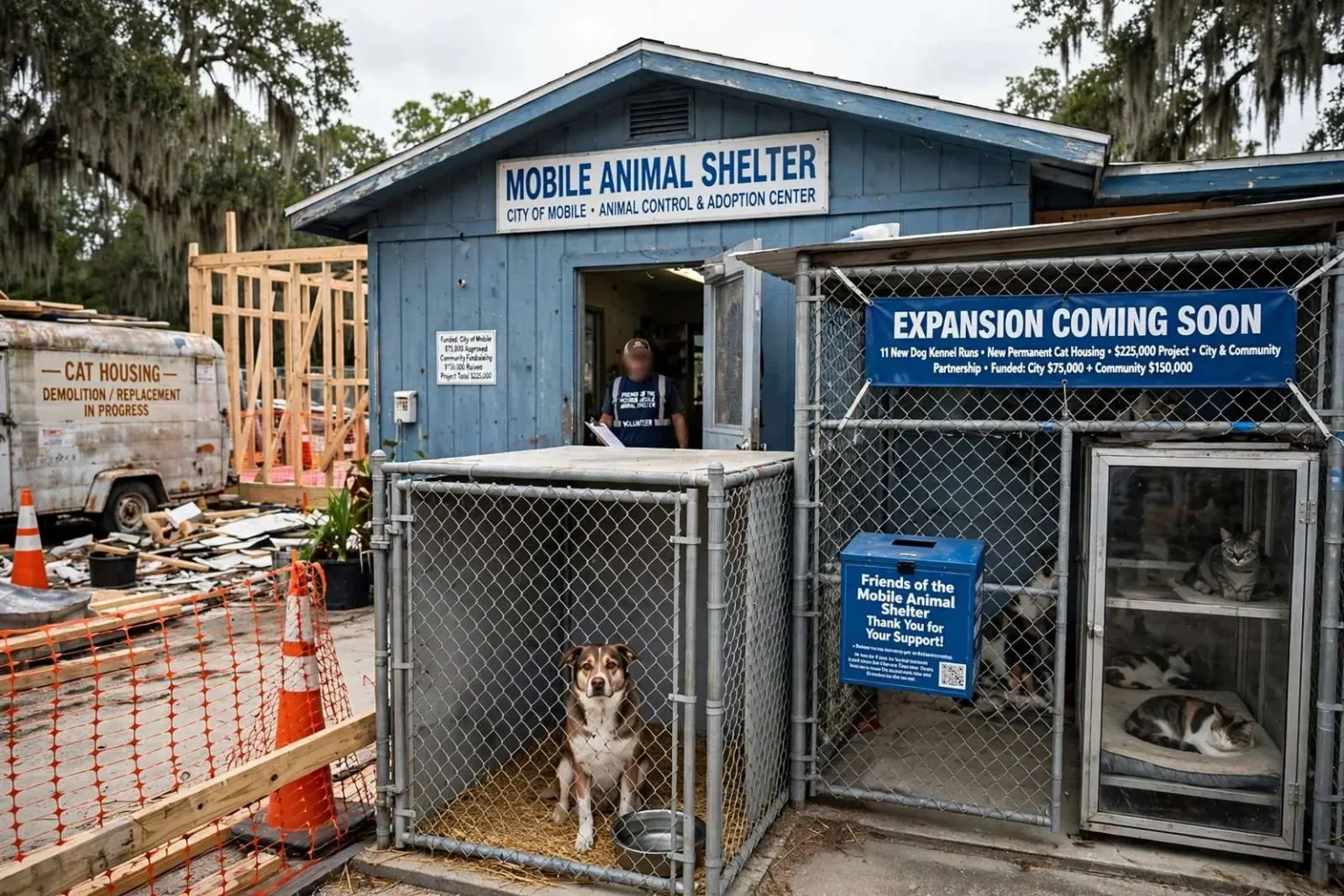
The Mobile City Council voted to commit $75,000 toward expanding the city’s animal shelter, giving a long-running fundraising effort by a local nonprofit the final piece it needed to move forward. The vote concluded years of planning and private fundraising, and it commits the city to a project that supporters say will meaningfully improve conditions for animals taken in from neighborhoods across Mobile. Representatives with Friends of the Mobile Animal Shelter asked the council for the funding during a regular Tuesday meeting, and members approved it as part of a larger public-private partnership. The arrangement pairs municipal money with private donations, a model the city has used for other community improvements when budget resources alone could not cover a project’s full cost.
The $75,000 completes the city’s share of a $225,000 project. Friends of the Mobile Animal Shelter has spent years raising money toward the effort, collecting roughly $150,000 since 2008 to help design and build additional kennel space at the facility, which is owned and operated by the city. The nonprofit’s fundraising campaign has relied on donations from animal lovers across the Mobile area, including individual contributions, memorials and community events, reflecting the deep local attachment residents feel toward the shelter and the animals it houses. Because the city facility serves the entire community, taking in strays picked up by animal control and animals surrendered by owners who can no longer care for them, the expansion is expected to benefit residents in every council district.
With the funding now approved, the project can move ahead on several fronts. Plans call for an 11-run kennel addition, along with the demolition of an aging trailer that has been used to house cats and construction of a permanent building to replace it for adoptable cats awaiting new homes. The 11 additional kennel runs will expand the shelter’s capacity to house dogs in separate, properly sized enclosures, giving staff more flexibility to separate animals by size, temperament and health status. The replacement of the cat trailer with a purpose-built structure addresses a longstanding concern among shelter supporters, since temporary and converted buildings are harder to sanitize, climate-control and maintain over time.
Colby Cooper, chief of staff to Mobile Mayor Sandy Stimpson, said the city’s engineering department will provide oversight to make sure the work meets code and stays on track, but the nonprofit will handle soliciting and awarding construction bids itself. The division of responsibilities is a common structure for public-private projects, allowing the donor organization to control the pace and procurement of construction while the city ensures the finished work meets municipal building standards. Council President Gina Gregory also weighed in during the meeting, noting that the shelter expansion is a separate matter from a proposed update to the city’s animal ordinance that remains under consideration.
Why shelter capacity has been a persistent issue in Mobile
Animal shelter capacity has been a recurring topic for Mobile officials and animal welfare advocates in recent years, as the facility has worked to keep pace with the volume of stray and surrendered animals coming through its doors. Mobile’s size and geography make animal control an ongoing municipal responsibility, with the city’s neighborhoods generating a steady flow of stray dogs and cats that must be housed, fed, medically evaluated and either reunited with owners or placed for adoption. When kennel space runs short, shelters face difficult choices about how to house new arrivals, and overcrowding can increase stress and illness among the animal population, making adoptions harder to achieve.
Supporters of the expansion have argued that additional, better-designed kennel and cat housing space can improve outcomes for animals waiting to be adopted, while easing crowding at the shelter. Better housing conditions reduce the spread of disease among kennelled animals, give adopters a more positive impression of the facility, and allow staff to keep animals in the shelter longer rather than facing pressure from limited space. Animal welfare groups in the Mobile area have consistently identified adequate facilities as one of the foundation pieces of improving live-release rates, alongside spay-and-neuter programs, foster networks and adoption outreach.
The public-private structure of the project also reflects the fiscal reality facing Mobile and other Alabama cities, where municipal budgets must balance streets, drainage, public safety and parks against community facilities. By splitting the cost of the shelter expansion between the nonprofit’s donated funds and the city’s contribution, the project moves forward without requiring the city to shoulder the full $225,000 price tag on its own. City officials have pointed to similar partnerships as a template for future improvements, particularly for facilities that serve broad community needs but compete for limited capital funding.
The shelter project has drawn support from volunteers and donors across the Mobile area who have followed the fundraising campaign since its earliest days, many of them longtime supporters of the facility and its staff.
How the project will be built and paid for
Under the arrangement approved by the council, Friends of the Mobile Animal Shelter will manage the bidding process for construction, soliciting proposals from contractors and awarding the work, while the city’s engineering department reviews the plans and monitors progress to ensure compliance with building codes. That structure gives the nonprofit direct accountability for how its donated dollars are spent, while the city retains oversight authority over a project on city-owned property. The engineering department’s role will also cover inspections during construction, helping prevent delays or disputes over workmanship once the project is underway.
The demolition of the aging cat trailer will be one of the most visible early steps in the project, clearing the way for the permanent cat building that will replace it. Shelter staff and volunteers have long worked around the limitations of the trailer, which was never designed for long-term animal housing. The new structure will provide a stable environment for adoptable cats, with space and fixtures designed around the needs of a busy municipal shelter rather than adapted from another purpose. Construction sequencing will need to account for the shelter remaining in operation throughout the work, since the facility cannot simply close while animals are in its care.
Funding for the city’s share comes as part of the council’s regular budget process, in which members weigh requests from departments and community organizations across the city. The $75,000 commitment positions the shelter project alongside the other capital priorities the council has funded in recent years, and supporters of the expansion had lobbied for the funding across multiple budget cycles before securing the council’s approval. The nonprofit’s roughly $150,000 raised since 2008 demonstrates the scale of private support the project attracted, and that track record of fundraising was a factor in the city’s willingness to complete the funding gap.
The council meeting and the animal ordinance question
The animal shelter item was one of several matters the council took up during Tuesday’s meeting, which also touched on other city business ranging from infrastructure to community facilities. Mobile’s council meetings follow a regular rhythm through the year, with agenda items presented by city staff, nonprofit representatives and residents before the seven-member council votes. The shelter funding request drew attention because of the years of groundwork behind it, but it moved through the same process that governs every appropriation the council approves.
Council President Gina Gregory’s comment separating the shelter expansion from the proposed animal ordinance update addressed a point of confusion that had developed among some residents, who assumed the two efforts were connected. The ordinance update under consideration deals with the city’s rules governing animal ownership, care and enforcement, a regulatory matter distinct from the physical expansion of the shelter facility. Gregory’s clarification signaled that the council intends to treat the two issues on their own merits, with the construction project proceeding even as the broader ordinance review remains in progress.
Animal welfare advocates in Mobile have followed the ordinance review closely, since the city’s animal-related rules shape how animal control responds to complaints, how owners are held accountable for the care of their animals, and how many animals ultimately arrive at the shelter in the first place. Supporters hope that improved facilities and modernized rules together will reduce the strain on the shelter system over time, addressing both the supply of animals coming in and the capacity available to care for them.
Friends of the Mobile Animal Shelter has said it plans to continue working with the city as construction moves forward on the kennel and cat housing additions in the months ahead. The nonprofit’s role will extend beyond fundraising into oversight of the work it has contracted, and its volunteers remain active in supporting day-to-day shelter operations. Once the 11-run kennel addition and the new cat building are complete, the facility will have room to house and prepare more animals for adoption, a milestone that shelter supporters across Mobile have anticipated since the fundraising campaign began in 2008.