First Same-Sex Couples Marry in Mobile After Federal Ruling
Mobile County began issuing same-sex marriage licenses after a federal court order, drawing celebrating couples to the probate office downtown.
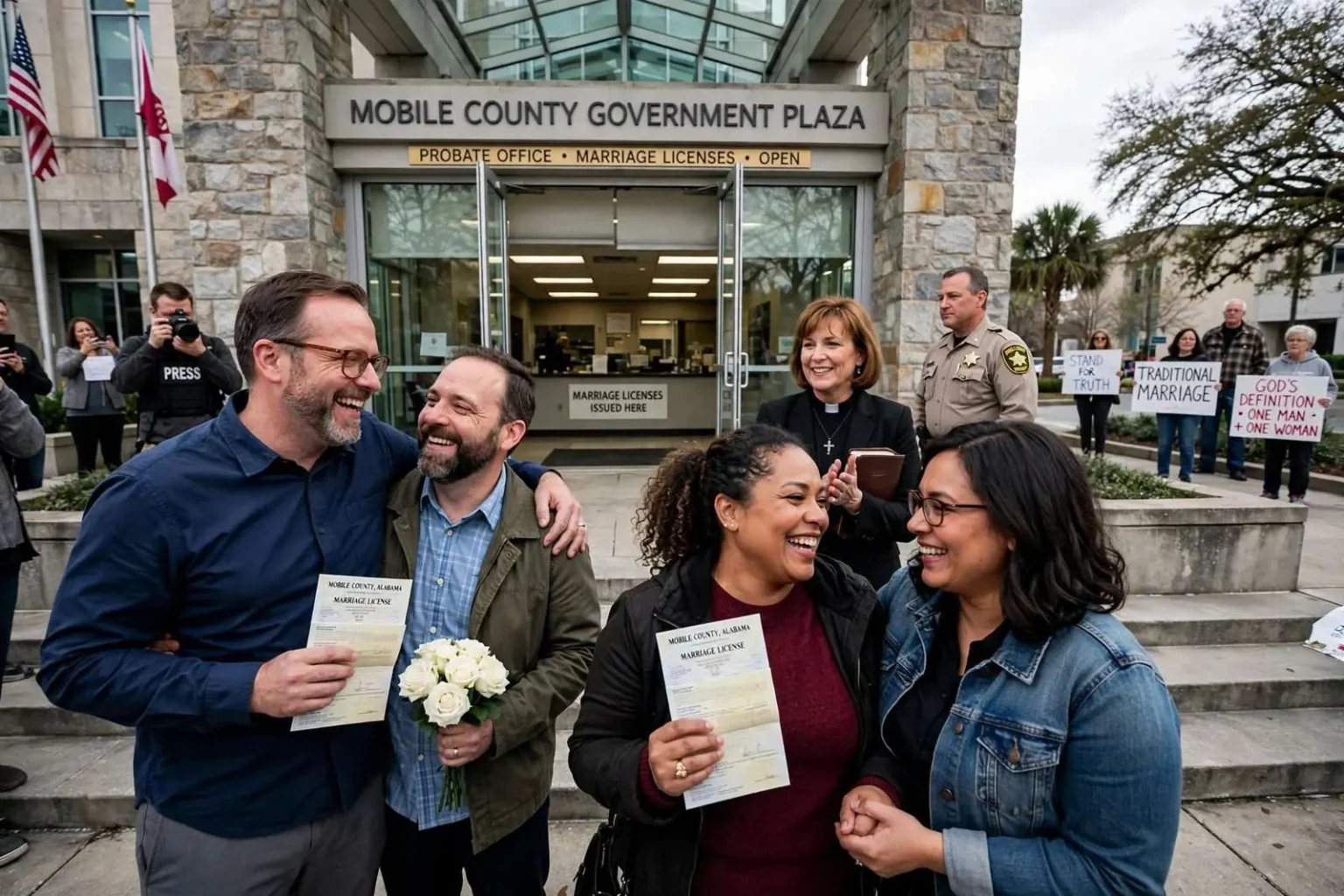
Same-sex couples in Mobile County were able to legally marry for the first time this month after a federal court order forced the county probate office to begin issuing marriage licenses regardless of gender. The change, arriving after years of legal battles and days of confusion at the courthouse, transformed the atrium of downtown Mobile’s Government Plaza into an impromptu wedding venue as couples who had waited decades for legal recognition finally held marriage licenses in their hands.
The Mobile County Probate Office had kept its marriage license counter closed for several days even after a federal judge’s ruling striking down Alabama’s same-sex marriage ban was set to take effect. The county’s probate judge, like many others around the state, had pointed to guidance from Alabama Supreme Court Chief Justice Roy Moore instructing probate judges not to issue licenses to same-sex couples. The result was a standoff between two court systems — a federal district court order requiring licenses and a state supreme court command forbidding them — with couples caught in the middle and county offices unsure which directive would land them in contempt.
The confusion played out at probate offices across Alabama in those days, as judges weighed the competing orders and their own exposure to legal consequences. Some counties opened their counters immediately, others never closed them, and still others shut down licensing altogether rather than decide. In Mobile, the license counter sat closed behind lowered window shades while couples gathered, reporters waited and the clock ran on the federal court’s deadline.
The Shades Go Up
A renewed order from the federal judge overseeing the case ultimately compelled the office to comply, and the shades over the office windows went up in the afternoon, clearing the way for licenses to be issued. Couples who had waited years for the chance began filling out paperwork within the hour. What had been a quiet, shuttered counter became a stream of applications, witnesses and well-wishers moving through the probate office as word spread through Mobile’s community that the wait was over.
One local man, who had been with his partner for nearly two decades, said the moment felt like a long time coming for the state. Another couple who applied for a license said they were relieved the legal uncertainty of the previous week had finally been resolved. For couples who had organized their lives around the absence of legal recognition — powers of attorney drawn up by lawyers, hospital visitation forms kept in glove compartments — a marriage license was not a symbol but a practical document carrying concrete weight in hospitals, courtrooms and tax offices.
The paperwork itself was the same form any couple in Alabama had filled out for generations: names, ages, a fee, a signature. The difference was that the clerk handed it across the counter without qualification, and that the marriage it made legal would be recorded in the same books as every other marriage in the county. County offices that had spent a week in the middle of a constitutional fight resumed being, simply, offices where people get married.
Weddings at Government Plaza
A local pastor performed wedding ceremonies inside the atrium of Mobile Government Plaza shortly after licenses became available, with friends and family gathered to celebrate. The pastor, who leads a Mobile-based congregation, said her church had performed religious union ceremonies for gay and lesbian couples for two decades while hoping the unions would eventually carry full legal recognition. The atrium — the public heart of the building that houses both city and county government — gave the ceremonies a backdrop few courthouses could match, with stone and glass arching over vows that local churches had blessed long before the state recognized them.
The ceremonies drew applause from strangers in the building, some of whom stopped to watch as couples who had been together longer than many of the marriages around them made things official. Several couples married the same day they received their licenses, wearing what they had worn to work, while family members photographed the moment on phones. For a county that had been the last holdout in the region’s largest population centers, the first day of marriages carried the feeling of a dam finally giving way.
Baldwin County Follows
The Baldwin County Probate Office also began issuing licenses to same-sex couples around the same time, following the same federal court order that applied statewide. The move mattered across Mobile Bay, where Baldwin’s bayou towns, Gulf-front communities and rapidly growing suburbs share a media market and family ties with Mobile. Couples who had watched the fight play out on one side of the bay could now marry on either — a small geographic fact with large practical meaning in a region where crossing a county line is part of daily life.
Statewide, the pattern of those days was uneven and unpredictable, with some probate offices issuing licenses within hours of the ruling and others holding out under the chief justice’s directive. Couples in resistant counties drove to neighboring ones, and Mobile and Baldwin — the state’s two coastal counties — drew applicants from across the southern part of the state in the days after their counters opened. The federal order’s reach meant the map could only move in one direction, though how quickly remained, for a while, a county-by-county question.
Protest and Celebration Side by Side
Not every reaction outside the Mobile County offices was celebratory: a small group of protesters gathered nearby with signs objecting to the marriages, though newly married couples largely proceeded past them without incident. The demonstration stayed peaceful, and the scene outside Government Plaza — protesters on the sidewalk, wedding parties on the steps — became an image of the moment itself, two views of marriage holding their ground on the same block of downtown Mobile while deputies kept watch.
The legal story was still unfinished when the first licenses were issued. The state’s challenges continued moving through the courts, and the U.S. Supreme Court would settle the question nationally later that year, ruling that same-sex couples nationwide hold the same constitutional right to marry. But for the couples filling out paperwork in Mobile that afternoon, the ruling that mattered was the one already in effect — the federal order that turned a two-decade wait into a marriage certificate with a Mobile County file number.
The order’s practical effect reached further than the wedding parties. Marriage carries a bundle of legal consequences that accumulate quietly: inheritance rights, medical decision-making authority, parental presumptions, tax filing status, veterans’ and Social Security benefits. For couples in Mobile and Baldwin counties, each of those protections shifted from something they had to engineer through lawyers into something that followed automatically from a license — the ordinary legal machinery of marriage, applied for the first time to their relationships in the place where they had built them.
The first day of legal same-sex marriage in Mobile County ended the way its advocates had imagined for years: with couples walking out of Government Plaza married, protesters still on the sidewalk, and the ordinary business of the courthouse resuming around them. The shades that had covered the license windows for a week stayed up.
How Alabama Reached This Moment
The road to the Mobile County license counter ran through more than a decade of legal and political history. Alabama voters had written a ban on same-sex marriage into the state constitution in 2006, adding it to a statute that already defined marriage as between a man and a woman. For years afterward, the question seemed settled in the state, and couples who wanted legal protection arranged their lives around private documents — wills, powers of attorney, hospital authorizations — that approximated marriage’s legal effects without ever matching them.
The landscape shifted as federal courts around the country began striking down state bans following the U.S. Supreme Court’s decision striking the federal Defense of Marriage Act. When a challenge to Alabama’s ban reached the federal district court in Mobile, the ruling that followed put Alabama at the center of the national question, and the state’s defiant response — led by the chief justice’s instruction to probate judges — turned county license counters into the front line of a constitutional conflict.
For Mobile, the fight carried a particular historical irony. The federal court that forced the county’s hand sits blocks from where the city’s civil rights battles were fought a generation earlier, and the arc from those courtroom fights to this one was not lost on the couples and clergy gathered in the plaza. Churches that had quietly performed union ceremonies for years — including the Mobile congregation whose pastor officiated at the plaza — had kept that history alive in the interim, marrying couples in the eyes of their congregations while the state withheld recognition.
The county probate office’s role in the drama was, in the end, administrative rather than personal. Probate offices across Alabama handle estates, deeds and licenses with small staffs and steady routines, and the judge at the center of Mobile’s counter closure was caught between orders from two court systems, each backed by real consequences. The renewed federal order resolved that bind, and the office did what offices do: it opened the window, took the paperwork and recorded the marriages in the county’s books, one couple at a time.