Attorney General Fights Class-Action Push in Mobile Marriage Case
Alabama's attorney general urged a Mobile federal judge to reject class-action status for a same-sex marriage lawsuit involving Probate Judge Don Davis.
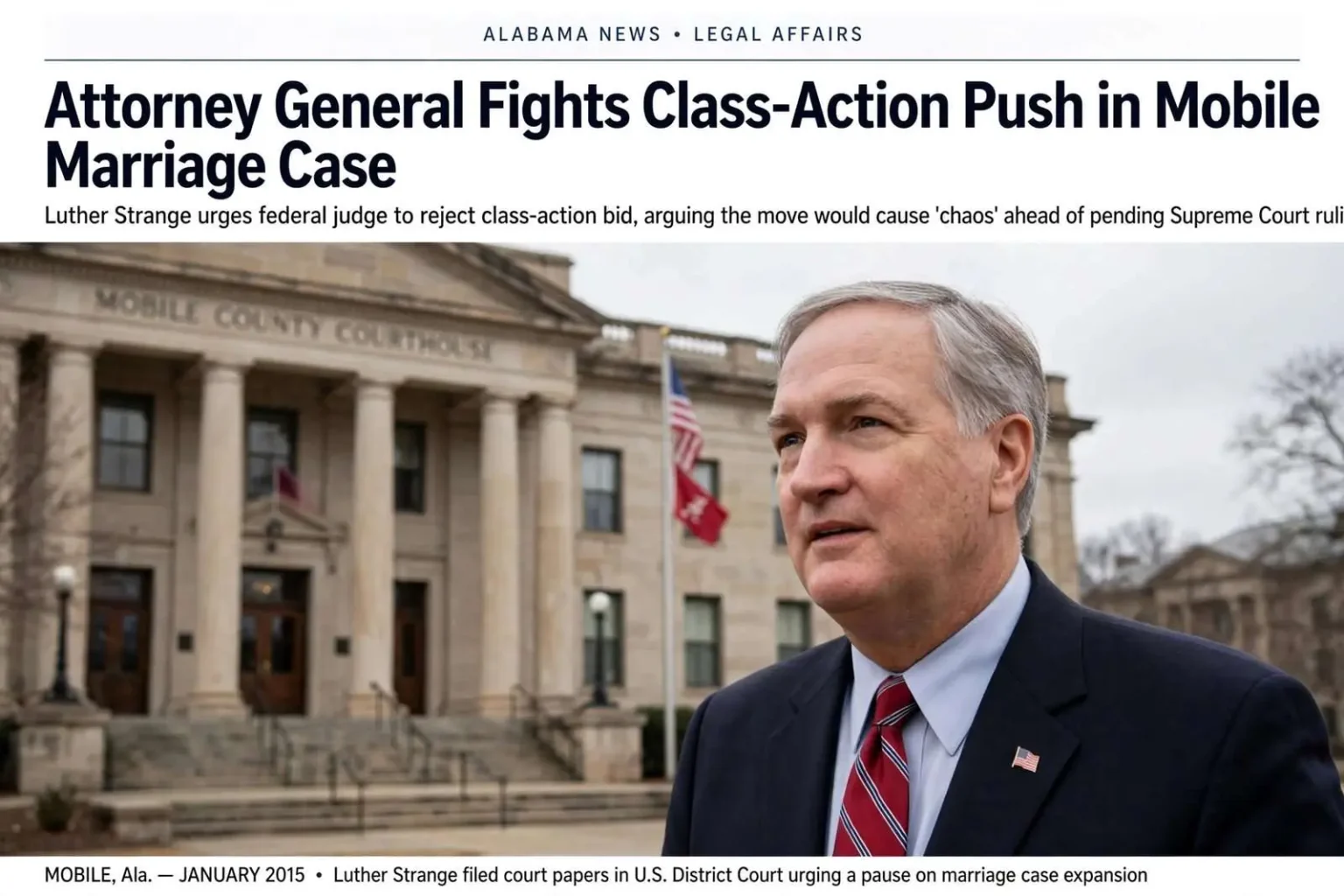
Alabama Attorney General Luther Strange filed court papers urging a federal judge in Mobile to reject a bid to add class-action status to an ongoing same-sex marriage case, arguing the move would create unnecessary chaos ahead of a pending U.S. Supreme Court ruling.
In a filing submitted to the U.S. District Court in Mobile, Strange argued that a “fundamental redefinition of marriage in Alabama without the benefit of full appellate review would lead to chaos, confusion, and additional litigation” that could be avoided if the court simply paused its orders until the nation’s highest court weighed in. The strategy was unmistakable: with the Supreme Court already set to decide the marriage question nationally, the state’s top lawyer wanted every Alabama courtroom holding its breath until the answer arrived.
The filing came in response to a motion filed days earlier by civil rights organizations seeking to expand the case to cover a broader class of plaintiffs. Class certification is the mechanism federal courts use to let one lawsuit resolve claims for many people at once — and in the marriage context, it meant the difference between a ruling that helped the named plaintiffs and one that bound probate offices in all 67 counties.
The attorney general’s arguments
Strange contended that Alabama’s probate judges should be sued individually rather than as a group, and that the proposed class of “all persons in Alabama who wish to obtain a marriage license in order to marry a person of the same sex” was too vague to meet the legal standard for class certification. “A basic tenet of class litigation is that one should be able to identify who is, and who is not, a member of the class,” the filing stated.
The objection leaned on the technical requirements of class actions, which demand that a proposed class be numerous, common in its claims, typical of its representatives and capable of clear definition. Strange’s brief attacked the last of those: a class defined by everyone who might someday want a license, he argued, has no fixed membership and no identifiable boundaries. Underlying the technical argument was a practical one — a certified class would extend any federal injunction far beyond the individual couples whose cases produced it.
For same-sex couples across Alabama, though, the technical fight had concrete stakes. An individual ruling protects the plaintiff in front of the judge; a class ruling protects everyone in the same position, in every county, without each couple having to file separately. That asymmetry — one lawsuit’s reach versus sixty-seven county courthouses — is precisely what both sides understood to be in dispute.
A saga centered on Mobile
The dispute is the latest turn in a legal saga that has centered heavily on Mobile County. The Alabama Supreme Court had recently ordered the state’s probate judges to stop issuing marriage licenses to same-sex couples, a directive that put Mobile County Probate Judge Don Davis in a difficult position.
Davis was told to inform the court whether he considered himself bound by an earlier federal order requiring him to issue the licenses, and he requested an extension to respond. Caught between a state supreme court ordering one thing and a federal court order pointing the other way, Davis occupied the most uncomfortable seat in Alabama’s county government — a judge with obligations to two court systems issuing contradictory commands.
That federal order traced back to a ruling by U.S. District Judge Callie V.S. “Ginny” Granade, who in February directed Davis to begin issuing marriage licenses to same-sex couples. His office started doing so that same afternoon, just days after Granade’s broader ruling striking down Alabama’s ban on same-sex marriage had already led other counties to issue licenses statewide. Mobile County had thus been both the first federal courtroom to rule against the ban and one of the offices actually handing out licenses — until the state’s highest court intervened.
The adoption case intertwined
The case has also touched on a related adoption dispute. Granade postponed a hearing on a request to force Davis to process an adoption petition filed by Cari Searcy, a plaintiff who had won an earlier lawsuit challenging Alabama’s marriage ban. Davis’ attorney had asked the judge to dismiss that adoption case as premature.
The adoption fight shows how marriage litigation ripples into family law. A marriage license is not merely a certificate; it is the gateway to a stack of legal rights — joint parenting presumptions, inheritance, hospital decision-making, and the ability to complete a stepparent adoption. For Searcy’s family, the fight over an adoption petition was the practical, personal consequence of the marriage question that probate offices across the state were still litigating.
Searcy’s attorney, David Kennedy, pushed back on Strange’s characterization of the legal situation, saying Granade’s rulings had been clear and consistent throughout. He suggested any confusion stemmed instead from state officials in Montgomery. The two portraits of the same winter could hardly have differed more: the attorney general describing a legal landscape clouded by judicial orders, and couples’ lawyers describing clear rulings muddied only by resistance to them.
What class certification would have changed
The fight over class status was, in effect, a fight over how the endgame would work. If the Mobile court certified the class, a single injunction could have required probate judges statewide to issue licenses to same-sex couples regardless of what individual county offices chose to do. Without certification, enforcement would remain couple by couple and county by county — slow, uneven, and dependent on each affected family finding a courtroom of its own.
Strange’s pause-until-the-Supreme-Court argument offered a third path: no expansion, no new injunctions, simply a holding pattern until the national ruling arrived. Critics replied that a holding pattern had real costs for real families — adoptions delayed, licenses refused, couples driving across county lines to find a probate office that would serve them. Courts rarely pause constitutional rights merely for administrative tidiness, but the argument reflected how close the state believed the national resolution to be.
The Mobile federal court remained the epicenter of Alabama’s same-sex marriage litigation through the winter of 2015, with rulings from Granade’s courtroom shaping how probate offices across the state, including Mobile County, handled marriage license requests in the months before the Supreme Court’s nationwide ruling later that year. When that ruling came, it resolved the question the class-action fight had been circling — statewide compliance — by a different route entirely, and the arguments about class definitions and judicial pauses became a chapter in the record of how Alabama arrived there.
For the couples who brought the case, the months of filings were never abstract. Every motion over class certification, every request for an extension, every order from Montgomery translated into a concrete answer at a probate counter: a license issued, or a window closed. The Mobile courthouse docket, dense with legal technicalities, was for them simply the slow-motion story of whether they could marry where they lived.
The judges caught in the middle
Whatever the appellate arguments settled, the people administering them were Alabama’s probate judges — county-level officials who in most of the state also serve as the only source of marriage licenses. The state supreme court’s directive told them to stop issuing licenses to same-sex couples; the federal order in Mobile told at least one of them to continue. Judges in counties with no litigation pending had to guess which command carried the greater risk, and most chose the safest reading available: stop, and wait.
That waiting produced the patchwork couples experienced on the ground. Some counties continued to issue licenses, some closed their license counters entirely, and others issued to no one in order to avoid discriminating among applicants. A marriage map of Alabama during those months was less a matter of law than of county-by-county improvisation — exactly the “chaos and confusion” both sides claimed the other’s position would create.
Davis’s request for an extension to respond to the state court reflected that bind precisely. A probate judge cannot obey two contradictory orders at once, and the legal system’s only answer — ask the courts to sort it out — takes time that couples waiting at the counter do not have. His office’s decision to begin issuing licenses the same afternoon Granade’s order arrived, and the subsequent pressure from Montgomery, made Mobile County the clearest example of the collision.
Why Mobile became the center
There were structural reasons the saga ran through Mobile. Granade’s courtroom was the forum where the statewide challenge to Alabama’s ban was decided, which made her orders the ones with the broadest practical reach and made Mobile the venue where every follow-on dispute — licensing, adoption, class certification — naturally landed. Litigation clusters this way: once a judge has ruled on the core question, new filings attach to her docket for consistency’s sake.
Mobile County’s own position amplified the effect. The county office was an actual defendant under actual orders, not a bystander, so each new development had a named official whose compliance was being tested in public. The result was a winter in which probate procedure — usually among the least newsworthy functions of county government — produced headlines daily across the state.
By the time the Supreme Court’s ruling arrived later that year, Alabama’s debate had already generated months of record: a district court striking down the ban, a state supreme court resisting, a probate judge wedged between them, and an attorney general fighting the case’s expansion on procedural grounds. The class-action dispute that Strange’s filing addressed was one front in that longer campaign — less dramatic than the ban itself, but decisive for how, and how quickly, the ruling’s effects would reach couples in every Alabama county.