Mobile Federal Judge Postpones Hearing on Same-Sex Adoption Dispute
A U.S. District Judge in Mobile postponed a hearing over whether Mobile County's probate judge must process a same-sex adoption petition.
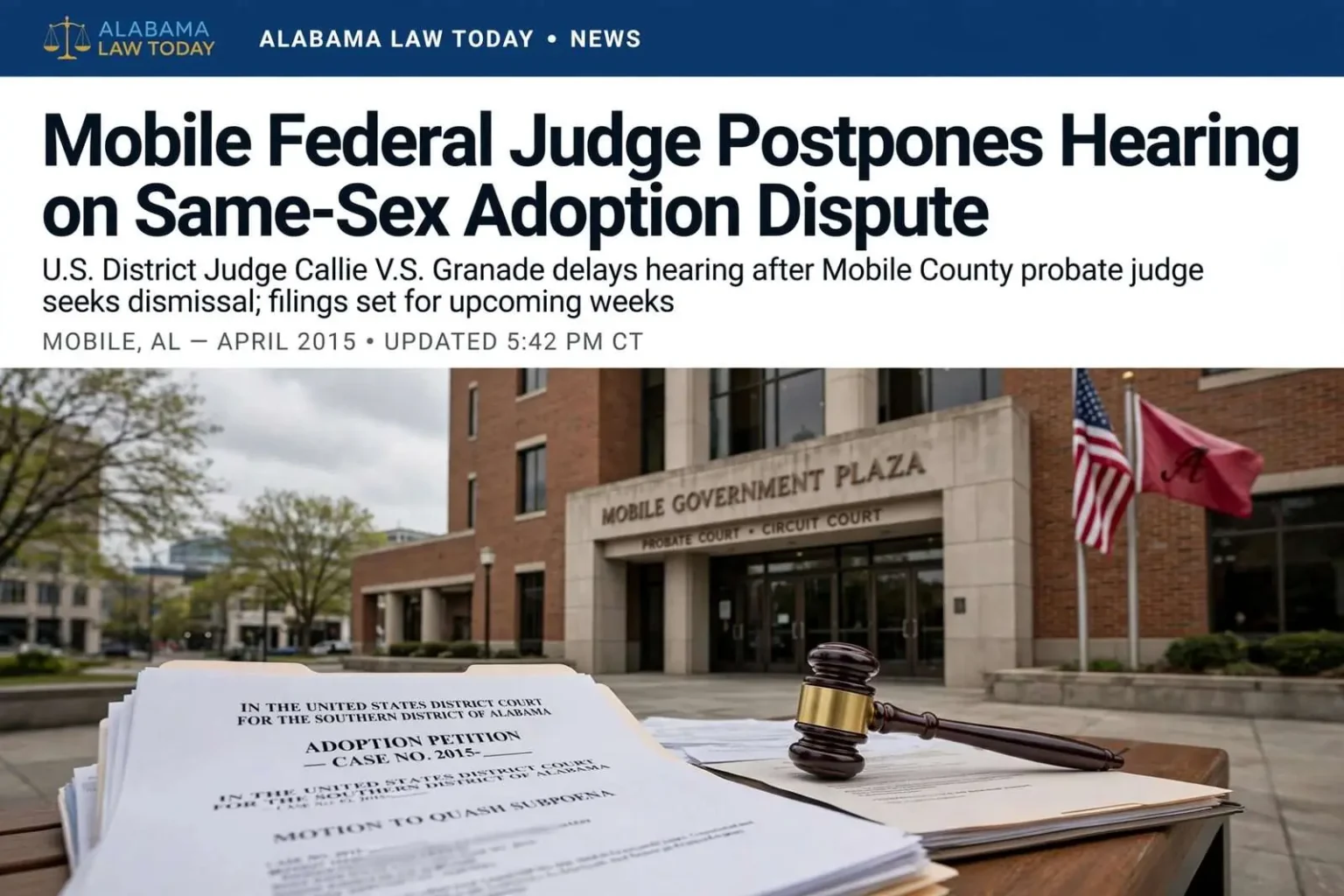
A federal judge in Mobile has postponed a hearing on a request to force Mobile County’s probate judge to immediately process an adoption petition filed by a woman who had previously won a lawsuit challenging Alabama’s ban on same-sex marriage.
U.S. District Judge Callie V.S. Granade, whose Mobile courtroom became a focal point of Alabama’s same-sex marriage litigation, agreed to delay the hearing after attorneys representing Mobile County Probate Judge Don Davis asked her to dismiss the newly filed lawsuit over the adoption issue. Davis’s attorneys argued the case was premature since the probate judge had not yet formally ruled on the underlying adoption petition.
The plaintiff’s attorneys countered that Davis had improperly signaled he would not hold a hearing on the adoption petition until the U.S. Supreme Court weighed in on a separate case expected to resolve the same-sex marriage question nationally. That pending high court decision — widely anticipated to settle whether same-sex couples have a constitutional right to marry — had become a reference point for officials across Alabama who were still adjusting to the federal rulings that struck down the state’s marriage ban earlier in the year.
Davis’s legal team maintained that the probate judge was treating the petition no differently than any filed by opposite-sex couples, and separately sought to block the plaintiff from compelling Davis to testify. The dispute over the subpoena turned a routine adoption matter into a direct clash between a family seeking to complete its legal paperwork and the elected official whose office controls whether that paperwork moves forward.
A new schedule of filings
Judge Granade granted the postponement and set a schedule for further filings, giving the plaintiff’s attorneys until the end of the week to respond to the motion seeking to quash the subpoena for Davis’s testimony, with Davis’s attorneys given roughly another week to reply. No new hearing date was set as of the ruling.
The scheduling order keeps the case moving through the briefing process even as the hearing itself is shelved. In federal litigation of this kind, the written submissions often do as much to frame the dispute as oral argument would, laying out for the court whether an official can be deposed while the underlying matter in his own office remains undecided.
How the case reached this point
At the center of the case is whether the woman can formally complete a second-parent adoption of a child she has raised alongside her spouse since birth. Second-parent adoptions allow a spouse to become a legal parent of a child born into the marriage or relationship without displacing the other parent, and for same-sex couples in states that historically barred their marriages, completing such an adoption has often been the only way to secure both parents’ legal standing — for inheritance, medical decisions, custody and benefits.
The couple, who legally married in California years earlier, filed suit against the state’s marriage ban after Davis cited the law in denying the adoption request. Their marriage in California was recognized nowhere in Alabama’s statutes, and the probate office’s refusal to act on the adoption petition left the family without the legal confirmation of parenthood that opposite-sex married couples receive as a matter of routine.
After Granade struck down Alabama’s ban on same-sex marriage in a landmark ruling, Davis issued an order granting the woman temporary parental rights but held off on making that order permanent. That interim arrangement protected the family in the short term while leaving the underlying adoption unresolved, and it is that unfinished business that brought the matter back into Granade’s courtroom.
The broader fight in Mobile’s federal court
Granade’s earlier ruling striking down Alabama’s marriage ban made the Southern District of Alabama’s Mobile courthouse the center of the state’s same-sex marriage battle. Her decision, issued in January, found that the state’s constitutional amendment and statutes excluding same-sex couples from marriage violated the federal Constitution, and it set off weeks of legal maneuvering as the case moved through appellate courts and the U.S. Supreme Court declined to halt the rulings from taking effect.
Probate offices across Alabama responded unevenly in the weeks that followed, with some counties beginning to issue marriage licenses to same-sex couples and others declining. Mobile County’s probate office was among those caught in the middle, and Davis — an elected official responsible for issuing licenses and processing adoptions and other probate matters — became a named figure in successive rounds of federal litigation.
Chief Justice Roy Moore of the Alabama Supreme Court added to the conflict by ordering probate judges to continue enforcing the state’s marriage ban despite the federal rulings, an order that heightened the legal uncertainty in county offices statewide. The Alabama Supreme Court later weighed in as well, and the tangle of state and federal directives left families in situations like the plaintiffs’ waiting on paperwork that would have been routine in most of the country.
What is at stake for the family
For the couple at the center of the case, the litigation is about the legal architecture of parenthood rather than marriage itself. A completed second-parent adoption would give the non-biological parent a judgment of adoption — a court order recognized in every state — protecting the child regardless of how marriage law evolves or how future courts treat earlier unions.
Family law practitioners note that such judgments matter most in moments of crisis: a hospital emergency, the death of a legal parent, a custody challenge. The temporary order Davis granted gave the family partial protection, but a temporary order is not the same as an adoption decree, and the plaintiffs’ attorneys have pressed for the permanence the adoption would provide.
The dispute over Davis’s testimony also carries implications beyond this family. If the probate judge can be compelled to sit for a deposition about how his office handles petitions from same-sex couples, it creates a record that could support broader claims of unequal treatment; if the subpoena is quashed, the case stays focused narrowly on the single petition.
Waiting on the Supreme Court
The U.S. Supreme Court case the parties referenced was expected to resolve the national marriage question before the end of the term, and everyone involved in the Mobile litigation has been operating in its shadow. A national ruling in favor of marriage equality would simplify much of the dispute, though it would not automatically complete the adoption — that would still require action in the probate office or in Granade’s court.
For now, the procedural schedule stands: the plaintiff’s response on the subpoena question is due by the end of the week, Davis’s reply follows roughly a week later, and the postponed hearing remains unscheduled. The case will move forward on paper while the family that started it continues to wait for the permanence a completed adoption would bring.
The office of probate judge
The Mobile County Probate Court is one of the busiest such offices in Alabama. The probate judge handles a docket that reaches well beyond marriage licenses and adoptions: estate settlements, wills, guardianships, conservatorships, commitments, and a range of administrative duties that touch thousands of families each year. The office sits in the Mobile Government Plaza building downtown, sharing the structure with the city and county courts, and its clerk’s windows process the everyday legal transactions of a county of more than 400,000 people.
Because adoption petitions move through the probate court, the judge’s handling of this family’s request is inescapably an administrative act as well as a legal one. Davis’s attorneys have framed the dispute as a case about process — the judge simply has not ruled yet, they argue, so there is nothing for a federal court to compel. The plaintiff’s attorneys view the same facts through the lens of delay, pointing to the public statements and the pending Supreme Court decision as evidence that the office has effectively decided to wait indefinitely.
Federal courts are generally reluctant to order state judicial officers to rule on pending matters, since doing so raises comity concerns about one branch of government directing another. But plaintiffs in situations like this one have occasionally succeeded by arguing that a nominal “pending” status is a pretext for non-enforcement of federal law. Judge Granade’s resolution of the motion to dismiss will determine which framing controls as the case proceeds.
Second-parent adoption in context
Second-parent adoption has a long history in American family law as the standard mechanism for securing legal parentage in families where one parent lacks a biological or marital link to the child. Courts in many states granted such adoptions for same-sex couples even before marriage became legally available to them, precisely because the underlying question is the child’s welfare rather than the parents’ marital status.
In Alabama, adoptions are governed by the state’s adoption code, and petitions are filed in the probate court of the county where the petitioner resides. The statute directs the court to consider the best interests of the child, and a completed adoption produces a new birth certificate listing the adoptive parent. For a family like the plaintiffs, that means school enrollment forms, insurance coverage, Social Security survivor benefits and emergency medical consent would all finally align with the day-to-day reality of how the family has lived since the child’s birth.
The couple’s underlying lawsuit against the marriage ban produced the temporary parental rights order after Granade’s marriage ruling, but the parties and their attorneys have continued to disagree about what the probate office is obliged to do in the meantime. That disagreement — between a federal right recognized in court and an administrative process still stalled at the clerk’s window — is the practical question sitting underneath all of the briefing now scheduled.
What comes next
The coming weeks will bring the round of briefs Granade ordered: the plaintiff’s opposition to the motion to quash the subpoena, Davis’s reply, and likely a ruling on both the subpoena dispute and the motion to dismiss the case outright. Depending on how she rules, the litigation could move toward a hearing, toward discovery on how the probate office treats such petitions, or toward dismissal with instructions to let the state process play out.
Meanwhile, the Supreme Court’s pending marriage decision looms over every filing. The plaintiffs have acknowledged that a national ruling recognizing same-sex marriage would strengthen their position considerably, removing the argument that their California marriage can be treated as nonexistent under Alabama law and narrowing whatever discretion remains over the adoption petition itself.
Until then, the family remains in the position that prompted the lawsuit in the first place: raising a child with temporary legal protection but without the permanent judgment of adoption that most parents never have to think twice about.