Mobile’s Historic Buick Building Nears Completion of $5 Million Overhaul
A $5 million renovation of Mobile's historic Buick Building on St. Louis Street is on track for summer completion, with two new tenants moving in.
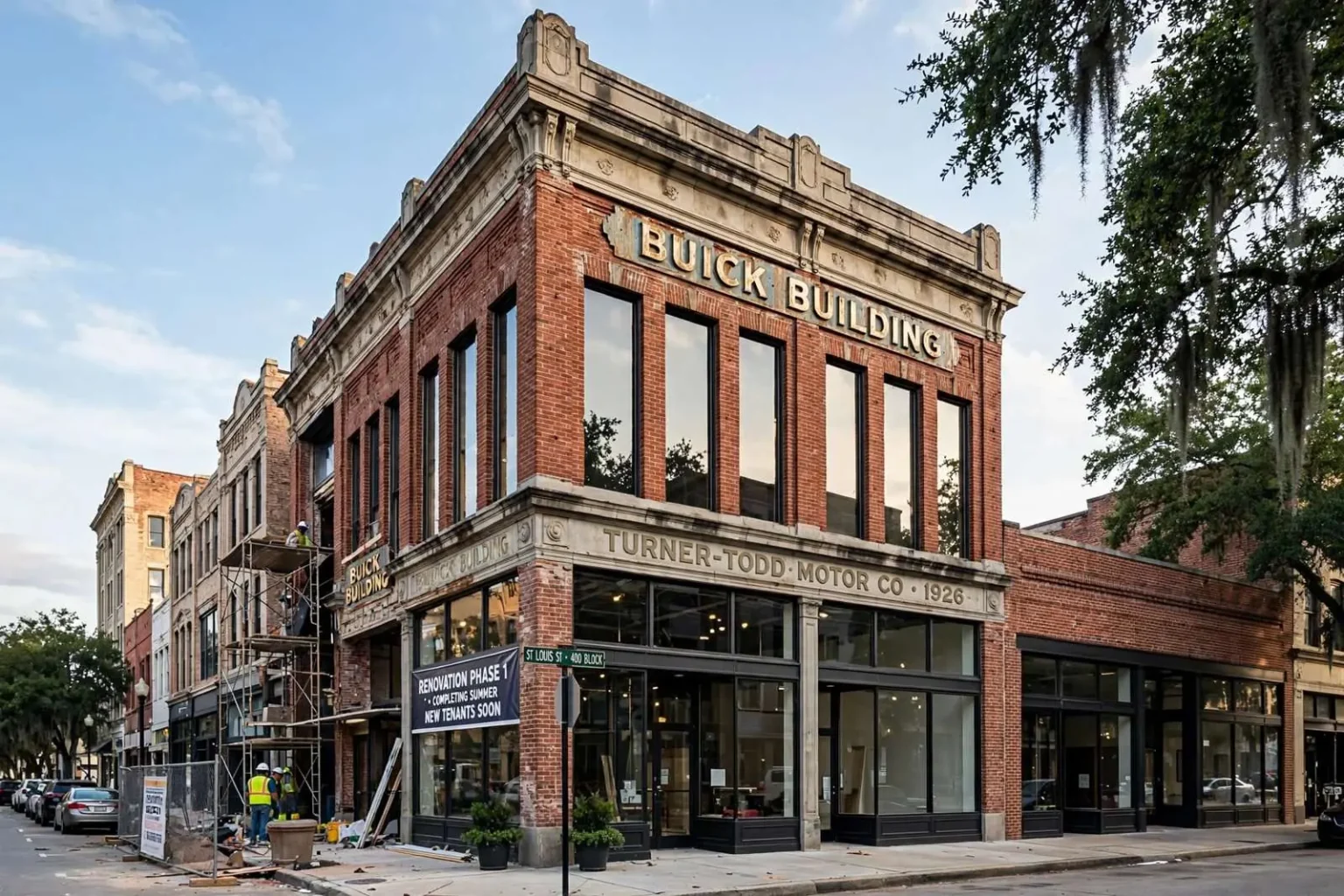
The first phase of a roughly $5 million renovation of Mobile’s historic Buick Building is on track to wrap up this summer, with the property’s new owners set to become its first tenants in more than a decade. The project marks the return to active use of one of downtown Mobile’s most distinctive empty buildings, a structure that has loomed over the St. Louis Street corridor since the Roaring Twenties.
Commercial construction firm Rogers & Willard Inc., which purchased the two-story, 40,000-square-foot building at 455 St. Louis St. in late 2014, plans to move roughly 30 employees into about 6,000 square feet of newly renovated first-floor space. The arrangement makes the developer its own first customer — a vote of confidence builders often make when they believe in a property, and one that puts workers inside the building while the remainder of the renovation is still under way.
Atlanta-based software development firm Rural Sourcing Inc. is expected to follow later in the fall, relocating from temporary space several blocks away into another 9,000 square feet on the building’s ground floor, with plans to eventually grow to around 100 employees at the location. The company has built its business on pairing American-based software development talent with corporate clients looking for domestic alternatives to offshore outsourcing, and its Mobile operation has been part of a deliberate effort to grow a technology workforce in the Gulf Coast region.
Rural Sourcing’s decision to nearly triple its eventual footprint in the Buick Building ranks as the kind of anchor tenancy developers dream about: a growing employer whose payroll arrives daily in the neighborhood and whose hiring plans expand the local tech labor pool. For the St. Louis Street corridor, landing a company whose business model is literally building a high-tech workforce inside a historic shell is a symbolic fit as much as a commercial one.
Despite strong interest in the remaining space, no tenants have yet been secured for the rest of the ground floor or the entirely vacant 17,000 square feet on the second level. Developers say they would welcome a grocery store or deli concept in the remaining first-floor space, citing the nearby De Tonti Square Historic District and steady commuter traffic heading west out of downtown each afternoon.
A prototype dealership with a century of history
Built in 1926, the brick structure, also known as the Turner-Todd Motor Co. building, was originally constructed as a prototype General Motors dealership, a design later replicated in cities across the country. The building’s origins place it in the heyday of the American automobile’s spread through the South, when dealerships were built as showcase structures meant to impress customers arriving from the street.
The Turner-Todd name remains attached to the building in local memory, a reminder of the era when St. Louis Street and the surrounding blocks formed Mobile’s automobile row, lined with showrooms, garages and parts houses serving a city whose port prosperity put it among the South’s most affluent. The large floor plates and tall ground-floor ceilings that made the building a good dealership make it equally suited to the open office layouts and retail concepts today’s tenants seek.
A one-story, 5,600-square-foot addition was added to the building’s east end in 1940. The modest expansion is part of the structure’s documented evolution and has been incorporated into the renovation plans, giving the property a blend of 1920s and pre-war construction that the owners have worked to preserve while modernizing mechanical systems, storefronts and interiors.
The building was listed on the National Register of Historic Places in 2008 but had sat vacant for nearly 13 years before the renovation began. That stretch of emptiness mirrored the broader stagnation of the corridor itself, where several significant historic buildings stood idle even as revitalization climbed up from the waterfront and out along Dauphin Street. National Register listing recognizes the structure’s architectural and historical significance and can support rehabilitation tax credits that help make projects of this scale economically viable.
Renovating a historic commercial building presents a distinctive set of challenges: bringing electrical, plumbing, HVAC and fire protection up to modern standards without stripping away the character that makes the property worth saving, and reconciling current building codes with construction methods from the 1920s. Rogers & Willard’s expertise as a commercial contractor has been applied to navigating those issues as much as to the visible work of restoring facades and finishes.
The St. Louis Street corridor bet
The project sits along St. Louis Street, an area city and business leaders have identified as a prime candidate for redevelopment into a high-tech corridor. The corridor became the focus of a $500,000 grant proposal submitted to the U.S. Economic Development Administration in late 2014, which, if approved, could fund a feasibility study into creating a research park in the area.
The research park concept ties the corridor’s future to the momentum building at the nearby Austal USA shipyard and the growing aerospace presence at the Brookley complex, on the theory that Mobile’s expanding advanced-manufacturing base needs a nearby ecosystem of technology firms, engineering services and research operations. The Buick Building’s renovation, landing a software company and its prospective 100 jobs at the corridor’s doorstep, gives the concept an early proof point before any federal grant money arrives.
Developers point to the corridor’s structural advantages: wide streets, deep lots suited to infill construction, direct visibility from the downtown grid, and proximity to both the central business district and the ports of entry for commuters leaving the city each afternoon. The afternoon commuter traffic heading west out of downtown passes directly by the building, giving any retail or restaurant tenant a daily audience that many downtown side streets cannot match.
The De Tonti Square Historic District just to the north adds a residential dimension to the market. The district’s restored townhouses and cottages have attracted downtown residents over the past two decades, and the neighborhood’s growth has created exactly the kind of nearby customer base that supports urban grocery and deli concepts — a market developers hope will fill the building’s remaining ground-floor space.
What the project means for downtown’s edges
For city officials, the Buick Building’s revival represents the extension of downtown’s revitalization beyond its core entertainment streets into the blocks that have lagged behind. Every major historic building returned to use strengthens the case that Mobile’s inventory of early twentieth-century commercial architecture is an economic asset rather than a liability, and each successful project makes financing easier for the next.
The employment math matters too. With Rogers & Willard’s 30 workers joined by Rural Sourcing’s planned growth toward 100 employees, the building alone will inject more than a hundred daily workers into a stretch of St. Louis Street that for years saw little foot traffic after dark. Those employees patronize nearby lunch spots, contribute to street life, and demonstrate to other technology employers that Mobile can staff knowledge-economy operations locally.
As the summer completion of phase one approaches, attention turns to the fall arrival of Rural Sourcing and the leasing of the remaining space. If the grocery or deli concept materializes and the second floor finds tenants, the roughly $5 million investment will have accomplished what its owners set out to do: prove that the St. Louis Street corridor can support the high-tech, mixed-use future city planners have sketched for it, starting with a 1926 showroom built to sell Chevrolets to a city finding its stride.
Preservation advocates have watched the project closely as a test of whether Mobile’s less-visible historic buildings can attract private capital without direct municipal subsidy. The Buick Building sat vacant long enough that its roof, envelope and systems had begun to deteriorate, and the longer such buildings sit empty, the more expensive rehabilitation becomes. Bringing it back within a year of purchase, supporters say, demonstrates that the market for well-executed historic space in downtown Mobile is real rather than aspirational.
The building’s story also connects to the broader transformation of the blocks between the central business district and the water. Nearby investments have included residential conversions, office restorations and new construction serving the medical, legal and maritime sectors, and the city’s growth as a cruise and convention destination has raised expectations for the appearance of the gateway corridors. A renovated Buick Building removes one of the most conspicuous vacant structures from that landscape.
Rogers & Willard, a firm with deep roots in Mobile’s commercial construction industry, has made the project something of a showcase for its own capabilities, with company craftsmen handling work ranging from structural repairs to the storefront restoration that will define the building’s street presence. The owners have said they intend the renovation to honor the structure’s automotive heritage while positioning it for another century of use, a balance of old and new that mirrors the corridor’s own trajectory from automobile row to technology corridor.