Foley Marks 100th Birthday with Picnic, Pops Concert and Walking Tours
Foley's yearlong centennial celebration continues in April with a picnic, a Baldwin Pops concert, and weekend walking tours of downtown.
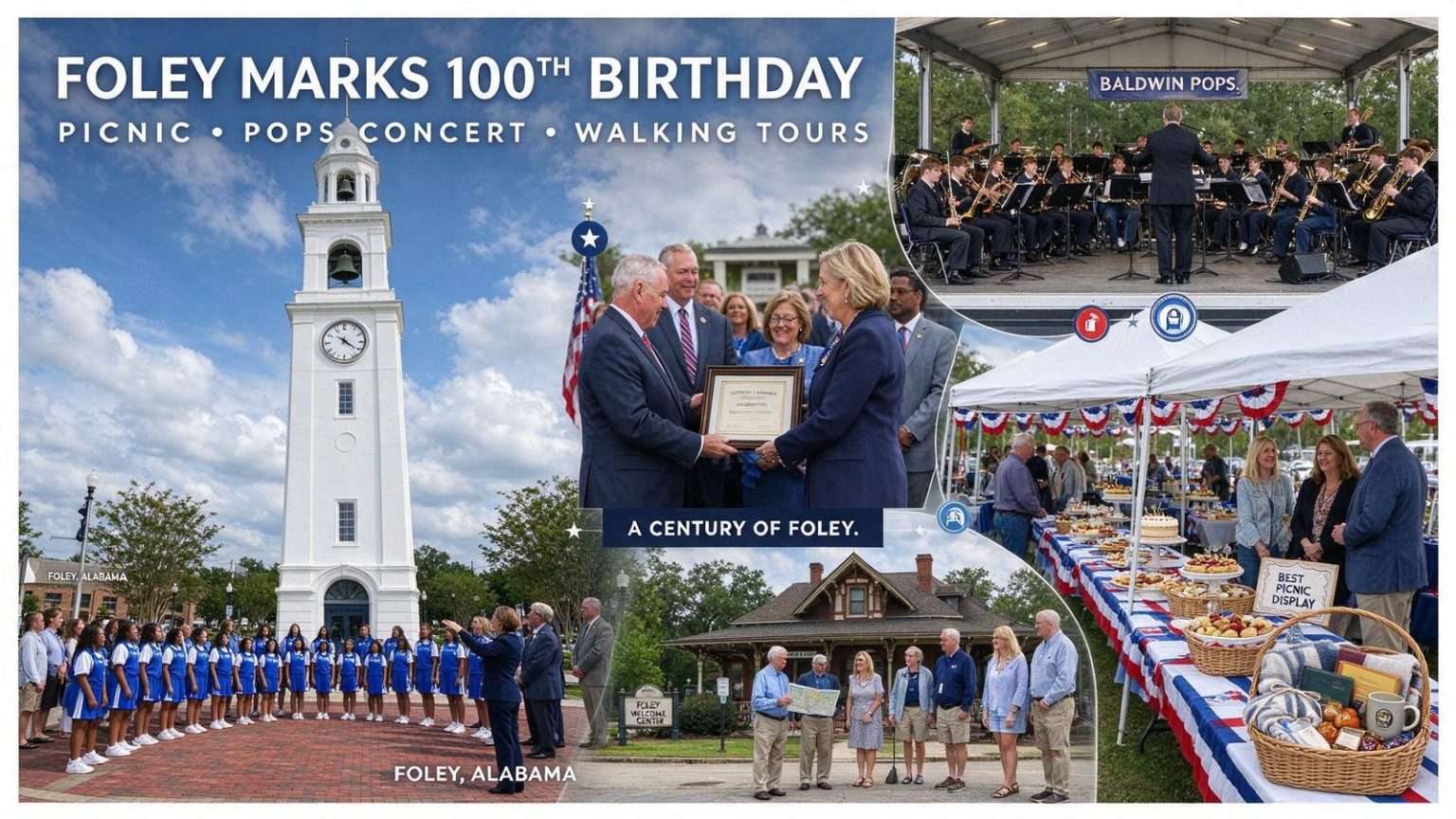
Foley’s citywide celebration marking 100 years since its incorporation reached a high point in April, capping a kickoff earlier in the year that included the dedication of the city’s new Centennial Plaza and clock tower. Organizers billed the April gathering as the city’s “official birthday party,” an evening built around a community picnic and a concert by the Baldwin Pops at Heritage Park. When weather concerns clouded the original date, the city made a practical call: the festivities moved indoors to the Foley Civic Center so that the celebration could proceed as planned without asking families to sit out a spring storm.
The relocation underscores how much the centennial has come to mean to the south Baldwin County city. A birthday party a century in the making does not get postponed, only reshuffled, and city staff worked to carry over every element of the program, from the student performances to the evening concert, under the Civic Center’s roof. For residents who had followed the centennial since the January kickoff, the indoor edition of the party kept the year’s momentum intact.
The birthday festivities were set to kick off with a performance by Foley Elementary School’s show choir at the base of the city’s new 52-foot clock and bell tower. The choice of performers was deliberate. Involving the city’s youngest students in the program ties the centennial to the generations who will carry Foley through its next hundred years, and school choirs have long been a fixture at civic gatherings along the Gulf Coast. The tower itself, rising over the plaza dedicated earlier in the year, has quickly become the most visible symbol of the anniversary.
Following the performance, members of the Centennial Committee planned to recognize a number of the city’s historic homes and businesses with special certificates honoring their role in Foley’s history. The recognitions shine a light on the older structures that survive along the city’s historic corridors, buildings that predate the retail boom and the resort traffic that define Foley today. Business owners whose storefronts have anchored downtown through decades of change, and families whose homes trace back to the city’s early years, were to receive the certificates as a formal thanks from the community.
An Evening of Music Built for the Centennial
Later in the evening, the Baldwin Pops were slated to perform a special concert, joined by top Baldwin County band students taking part in a scholarship performance series. The Baldwin Pops, the community orchestra that performs across Baldwin County throughout the year, has made educational outreach a signature of its programs, and the centennial concert gave the county’s strongest young musicians a rare chance to sit alongside experienced players on a major civic stage. The scholarship performance series the students are part of has become one of the orchestra’s most valued traditions, pairing performance opportunities with support for young musicians pursuing their craft.
The program itself was tailored to the occasion. The orchestra’s conductor composed an original Centennial Tribute March specifically for the event, giving Foley a piece of music it can call its own. Composing a commemorative march for a town’s milestone birthday follows a long American tradition, in which community bands and orchestras have marked founding anniversaries with new works meant to be played for generations.
The program also included other marches originally written in 1915, the year Foley was founded, alongside a mix of more contemporary selections. That blend of 1915-era music and modern pieces let the concert trace a century in a single evening, from the sounds a new railroad town might have heard at its founding to the repertoire audiences expect today. For older residents in the audience, the period marches offered a link to the music of their parents’ and grandparents’ generations.
A Picnic With a Prize
City organizers encouraged residents attending the picnic to bring their most creative spread, offering a special centennial gift basket as a prize for the best-decorated picnic display of the day. The contest added a lighthearted, family-friendly element to the program, the kind of detail that turns a civic ceremony into a genuine community party. Picnic contests have been a staple of Southern town celebrations for generations, and Foley’s organizers leaned into that tradition for the city’s hundredth birthday.
The prize itself, a centennial gift basket, gives the winning family a keepsake from the year rather than a simple cash award. City officials have repeatedly framed the centennial as a celebration meant to be shared, and details like the picnic contest are designed to draw out residents who might not otherwise attend a formal ceremony. Even with the event moved indoors, organizers kept the picnic format and the contest, so the informal, bring-your-own-blanket spirit of the evening survived the change of venue.
Walking Tours Bring Downtown History to Life
In the weeks leading up to the birthday picnic, the city also planned a series of historic downtown walking tours, held each Saturday morning in April. The hour-long tours were set to begin at the Foley Welcome Center near the intersection of Alabama 59 and U.S. 98, with no reservations required for participants. That open-door approach made the tours accessible to anyone passing through town, from longtime residents to spring visitors heading toward the Gulf beaches.
The Welcome Center itself is a fitting starting point. Housed in the city’s former railroad depot, the center stands as one of the most tangible links to Foley’s founding era, when the railroad put the small farming community on the map. Starting the tours there lets participants begin their walk in the very building where a century of the city’s commercial history began, before stepping out to see what remains of the downtown that grew up around the tracks.
Saturday morning timing suited both locals and tourists. April is one of the busiest stretches of the year along the Alabama 59 corridor, as families make their way to the coast for spring vacations, and the weekly schedule meant no visitor had to plan an entire trip around a single date. For residents, the recurring format turned the tours into a standing Saturday option throughout the month rather than a one-time event that many would miss.
Walking tours of this kind serve a purpose beyond nostalgia. They help residents see familiar streets with new eyes, pointing out building dates, architectural details, and the locations of businesses long gone. They also reinforce the work of local preservation efforts, since a community that understands the history embedded in its downtown is more likely to support keeping those structures in use as the city grows.
A Farming Town That Became a Retail Hub
The centennial celebration reflects Foley’s broader effort throughout the year to highlight its history as a small Baldwin County farming community that grew into one of the area’s most recognizable retail and tourism hubs. That transformation is one of the more striking stories in south Alabama. Foley began in 1915 as a planned settlement tied to the lumber and agricultural interests moving into southern Baldwin County, built around the rail line and surrounded by farmland. For decades, its economy rested on potatoes, cotton, and the other crops that made Baldwin County one of the state’s agricultural powerhouses.
The city’s position on the highway corridor running south toward Gulf Shores and Orange Beach eventually changed its character. As beach traffic grew year after year, Foley evolved into a shopping destination in its own right, drawing travelers off the road and into its stores and outlets. The growth brought new rooftops, new schools, and a diversifying economy, but city leaders have consistently paired that growth with investment in the kind of civic amenities, parks, a civic center, museums, and the new Centennial Plaza itself, that keep a fast-growing city feeling like a community.
That balance is visible in how the city chose to mark its hundredth year. Rather than a single gala, Foley spread its celebration across the calendar, with the plaza dedication in January, the April birthday party, and the walking tours in between, so that the centennial belonged to the whole year rather than one weekend.
The January Kickoff Set the Tone
The celebration builds on momentum from the city’s January kickoff event, when Foley officially unveiled its new plaza and began ringing the clock tower’s bell for the first time, marking the formal start of a yearlong tribute to the city’s founding a century earlier. That first ring of the bell gave the centennial its signature moment, and the tower has served as a gathering point and backdrop for centennial activities ever since.
Centennial plazas and clock towers have become a common way for Southern cities to mark founding anniversaries, precisely because they leave something permanent behind. A fireworks show ends in smoke and a parade disperses by afternoon, but a plaza with a 52-foot tower becomes part of the city’s daily landscape, a place for festivals, photographs, and ordinary afternoons long after the anniversary year ends. Foley’s decision to anchor its celebration in a lasting public space reflects the same instinct.
City officials pointed residents and visitors to the city’s tourism website for a full schedule of centennial events planned throughout the year. The steady stream of programming has given civic groups, schools, and churches a framework for their own anniversary tie-ins, multiplying the reach of the official events. Community celebrations of this scale tend to work that way: the city provides the anchor points, and local organizations fill in the calendar around them.
What the Centennial Means for Foley Going Forward
For a city that has spent the past several decades growing as fast as any in Baldwin County, the centennial offers a moment to take stock. Foley’s population has climbed steadily as retirees and families move to the Alabama Gulf Coast, and new commercial development continues along the 59 corridor. Growth on that scale can erase a community’s sense of its own past, and the yearlong centennial push, the plaza, the bell, the certificates for historic homes and businesses, the walking tours, is aimed squarely at keeping that history in view while the city changes around it.
The April birthday party, even moved indoors, captured that spirit. A show choir of elementary students opened the program; the evening closed with a community orchestra playing a march written for the occasion alongside music from 1915. Between those bookends came certificates honoring the businesses and homes that carried the city through its first century. It was, in effect, the story of Foley told in a single evening: rooted in farming and the railroad, proud of its surviving landmarks, invested in its children, and looking squarely at the next hundred years.
Residents who missed the April festivities still had the Saturday walking tours as a way to take part, and the tourism website continued to list centennial events through the rest of the year. For a community celebrating a milestone a century in the making, the city’s message has been consistent: the party belongs to everyone, and there is room in it for anyone who wants to join.