Gulf Shores, Orange Beach Sports Tourism Hits Record $30.8 Million in 2014
Sports tourism in Gulf Shores and Orange Beach generated a record $30.8 million in visitor spending during 2014, capping years of steady growth.
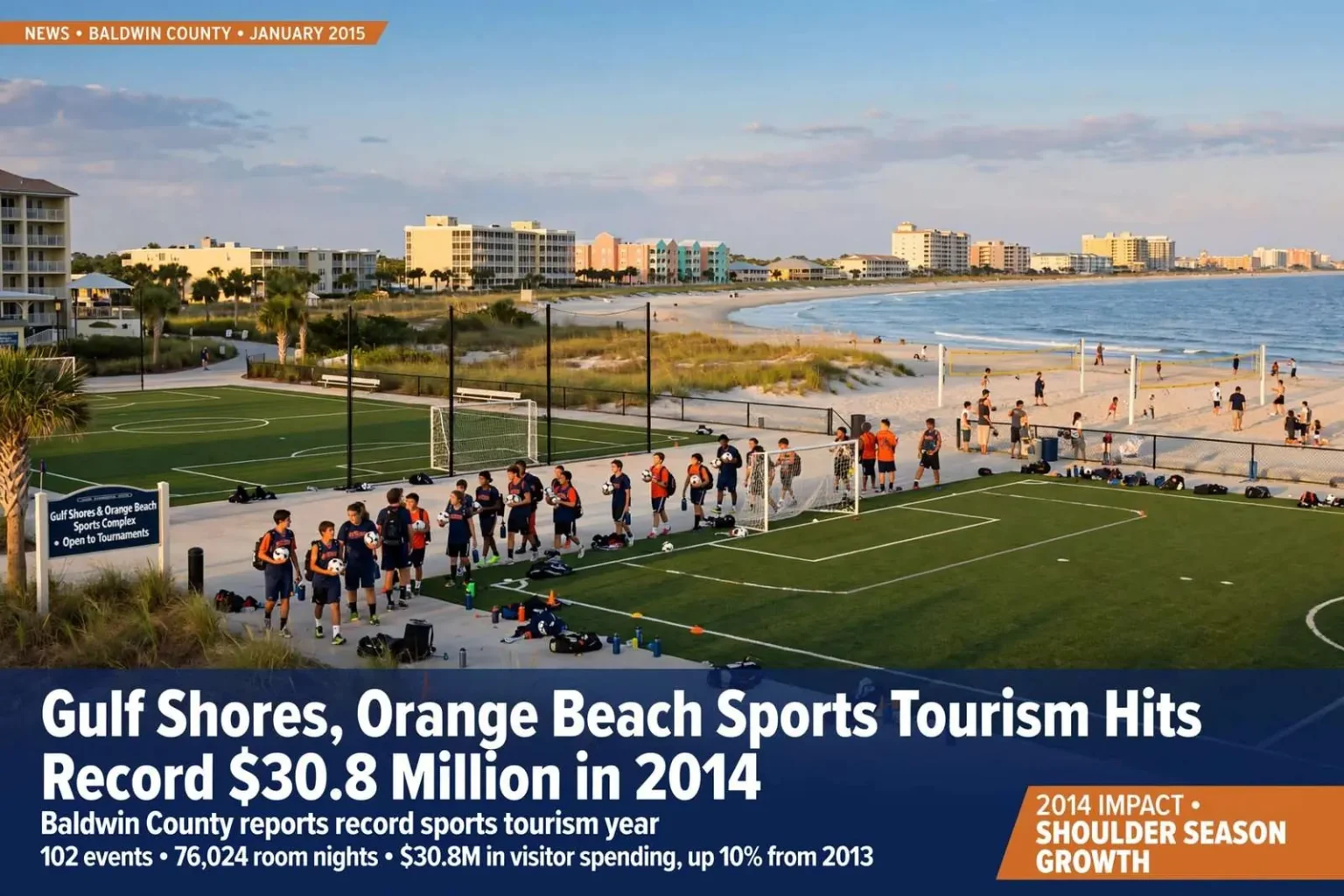
Sports tourism along Baldwin County’s beaches closed out 2014 with record numbers, mirroring years of steady growth in retail sales and lodging revenue across Gulf Shores and Orange Beach. The year’s results confirmed what local hospitality leaders have argued for a decade: youth and amateur athletic events have become a pillar of the beach economy, filling hotel rooms in months when the sand alone cannot.
Both beach cities have poured resources into sports facilities over the past several years, each operating its own sports complex and jointly funding the Gulf Shores & Orange Beach Sports Commission to help recruit tournaments and events. The two-city approach is unusual in a state where neighboring municipalities often compete for the same visitors. By pooling recruitment dollars and dividing facility responsibilities, Gulf Shores and Orange Beach have positioned the entire stretch of the Pleasure Island–area coast as a single destination for tournament organizers weighing venues across the Southeast.
The commission, formed in 2007 with backing from the two cities, Gulf Shores & Orange Beach Tourism, the Coastal Alabama Business Chamber and various sponsors, has seen dramatic growth since its founding. In its first year, the commission drew 27 events that generated roughly 11,961 room nights and $3.4 million in visitor spending. By 2014, those numbers had climbed to 102 events, 76,024 room nights and $30.8 million in spending — a more than ninefold increase in economic impact over seven years of operation.
That figure represents a 10 percent jump in visitor spending over the previous year’s $27.9 million, with room nights growing nearly 6 percent compared to 2013. Growth on that scale, sustained across a decade, has changed how the beach cities plan their seasons. Tournaments now anchor weekends in the spring and fall, stretching the traditional summer tourist season into what the industry calls shoulder months and smoothing out the staffing and revenue swings that once defined coastal hospitality work.
A Ripple Effect Through the Local Economy
Beth Gendler, vice president of sales for the sports commission, said in a statement that the continued growth reflects the strong local economic ripple effect sporting events generate through hotel stays, restaurant visits and retail spending, particularly during the shoulder seasons between the area’s busiest summer months. Tournament travelers, she noted, are a distinct audience from the traditional beach vacationer: they arrive in teams, travel with families, fill multiple rooms per party and spend heavily on meals and entertainment between games.
That spending pattern reaches far beyond the hotels and fields themselves. Condo rentals along the beachfront, restaurants along Highway 59 and the Orange Beach waterfront, bait shops, gas stations and shopping centers all absorb the flow of visiting athletes and families. Because events are spread across the calendar, the spending arrives when conventional tourists are scarce, giving restaurants and retailers a base of business in months when seasonal operations might otherwise cut hours or close entirely.
The sports tourism boom has tracked closely with the broader economic recovery in Gulf Shores, Orange Beach and the Fort Morgan peninsula since the 2010 Gulf oil spill. The spill, which struck just as the summer season began, devastated the area’s tourism economy and forced a years-long rebuilding of visitor confidence. The recovery since has been steady and broad-based, with athletic events playing a visible role in re-establishing the beaches as a destination for groups as well as families.
Taxable lodging rentals across those areas rose 8.5 percent in 2014 to nearly $380 million, an increase of more than 35 percent since 2011. Taxable retail sales climbed almost 8 percent to $727 million over the same period, according to figures compiled by the local tourism bureau. Because lodging and sales taxes fund a large share of municipal services and beach maintenance in both cities, those gains translate directly into the budgets that keep the resort communities running.
Foley Joins the Race for Events
Nearby Foley also posted strong numbers, with retail sales growing almost 6 percent to $641 million and taxable lodging rentals jumping nearly 20 percent to $11 million, a boost tied to a lodging tax increase that took effect in October 2013. The inland city, long known for its outlet shopping as a commercial anchor of southern Baldwin County, has increasingly sought a place in the region’s tourism economy as well.
That additional tax revenue is helping fund the upcoming Foley Sports Tourism Complex, slated to open in late 2015 with 16 multi-purpose athletic fields and a 100,000-square-foot events center along Baldwin County 20, west of the Foley Beach Express. The complex is the first phase of a larger entertainment development that will also include two adjacent hotels. Together, the fields, events center and lodging are intended to let Foley bid for the same multi-day tournaments that have driven growth in the beach cities, keeping visitors — and their spending — inside the county rather than watching them pass through on the way to the coast.
The investment reflects a competitive reality across the Gulf Coast: communities that build dedicated athletic infrastructure win the events, and the events win the lodging revenue. Foley’s entry into the market adds a third public sports venue cluster to Baldwin County’s offering, complementing the complexes in Gulf Shores and Orange Beach and giving tournament organizers a range of options within a short drive of one another.
A Crowded 2015 Calendar
As of late January, the Gulf Shores & Orange Beach Sports Commission had 97 events already scheduled for 2015. The early bookings put the commission on pace to approach, and potentially exceed, the 102 events it recorded in 2014, even before adding the late-summer and fall signings that traditionally round out the calendar.
Upcoming spring highlights include the Alabama Tennis Invitational, the American Open Beach Handball Championships, the Southern States Athletic Conference outdoor track and field and softball championships, an American Volleyball Collegiate sand volleyball national championship, and the Alabama High School Athletic Association’s regional track championship. The mix spans youth, collegiate and amateur adult competition, and it pairs beach-format events that take advantage of the natural coastline with field-sport championships that fill the cities’ athletic complexes.
High school and collegiate championships carry particular weight in the regional market. They bring multi-day crowds that include athletes, coaches, families and fans, and they build returning audiences as teams and programs develop loyalties to a host city. Conference and state-association relationships, once established, tend to generate repeat bookings — one reason the commission’s event count has grown so steadily since its first year.
Organizers say the growing events calendar is expected to keep drawing athletes, families and fans to the beach communities well beyond the traditional summer tourist season. For the two cities, the record 2014 figures are both a milestone and a benchmark: proof that the strategy of investing in complexes and a joint commission has paid off, and a baseline that 2015’s schedule of 97 early signings will be measured against when the year’s final numbers are tallied.
The broader takeaway for Baldwin County is that tourism on the Alabama coast is no longer defined solely by summer beach weeks. With more than $30 million in annual sports-driven visitor spending, hundreds of thousands of room nights over the commission’s history and new competition emerging in Foley, the county’s resort economy now runs on a fuller calendar — and the shoulder seasons that once went quiet have become some of its busiest stretches of the year.
What the Numbers Mean for the Beach Cities
Behind the headline figures is a funding structure that depends on the growth itself. In Gulf Shores and Orange Beach, lodging tax receipts and sales tax collections pay for services that would otherwise strain general funds, from public safety during crowded event weekends to the routine grooming and maintenance that keep the beaches themselves marketable. Every additional room night booked by a traveling softball team or track club therefore feeds the same municipal ledger that keeps the destination attractive for the next visitor.
The shoulder-season emphasis also changes the economics for local businesses. A hotel that once counted on ten peak summer weeks and endured an empty spring can now plan around a calendar of tournaments stretching from February through November. That steadier occupancy supports year-round staffing, gives restaurants confidence to remain open through the winter, and encourages the kind of investment in facilities and renovations that is harder to justify when revenue arrives in a single compressed season.
For visitors, the growth has produced a more complete sports destination than existed when the commission was founded. Gulf Shores’ sports complex and Orange Beach’s adjacent facilities offer tournament-grade fields and courts within minutes of the beach, restaurants and lodging, a combination that organizers in landlocked markets cannot replicate. The beach itself doubles as a venue, hosting the volleyball and handball competitions that set the Alabama coast apart from competing bids across the Southeast.
The commission’s 2007 founding partners — the two cities, the tourism board, the Coastal Alabama Business Chamber and a roster of sponsors — have been joined over the years by a wider network of hoteliers, restaurant owners and residents who host visiting families each weekend. As the 2015 season opens with 97 events on the books, that coalition enters the year with a record $30.8 million in annual visitor spending to defend, a nearly full calendar to execute, and the late-2015 arrival of Foley’s 16-field complex promising to make Baldwin County one of the deepest sports tourism markets on the Gulf Coast.