Baldwin County Sheriff Warns of Scammer Posing as Lieutenant
The Baldwin County Sheriff's Office warned residents of a phone scam using threats of arrest to pressure victims into buying prepaid gift cards.
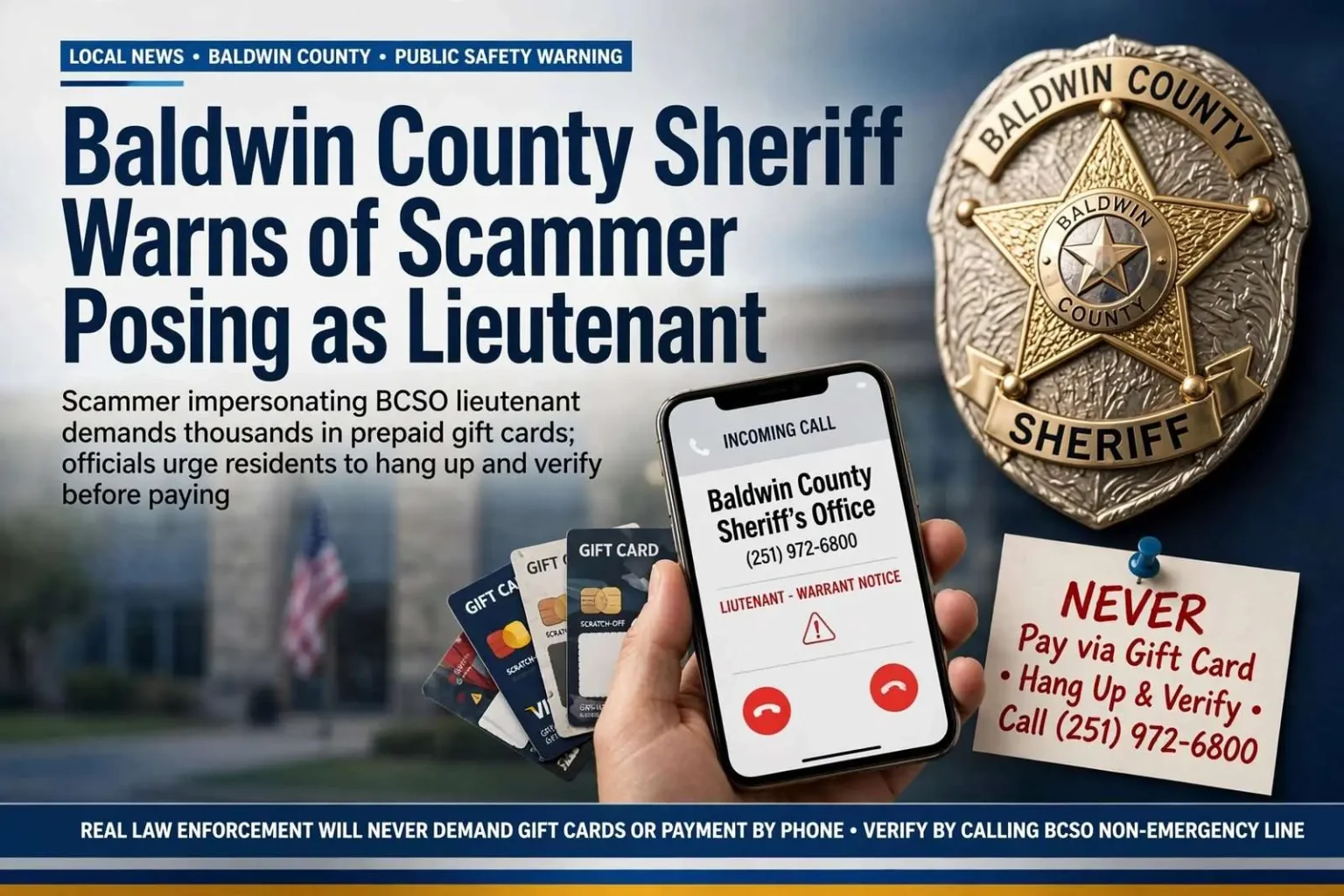
The Baldwin County Sheriff’s Office issued a warning to residents after a scammer impersonating a sheriff’s lieutenant targeted at least one local resident with threats of arrest unless money was paid immediately, according to investigators.
The victim reported receiving a phone call from someone claiming to be a Baldwin County Sheriff’s Office lieutenant, who warned that an arrest was imminent unless a payment reaching into the thousands of dollars was made right away, said BCSO Capt. Stephen Arthur. What made the call especially convincing, Arthur said, was that the caller appeared to already know personal details about the victim, including their birthday, home address and the type of vehicle they owned.
That knowledge is less impressive than it sounds, investigators note, and it is the backbone of a whole family of modern scams. Large-scale data breaches over the past decade have exposed names, addresses, birth dates and other personal details for hundreds of millions of Americans, and that information circulates freely in criminal marketplaces. Scammers purchase it and use it to sound authoritative, turning facts the victim assumes only law enforcement could know into proof that the caller is legitimate.
Gift cards and a courthouse address
Rather than requesting a wire transfer or cash payment, the scammer instructed the victim to purchase prepaid gift cards and then read the card numbers aloud over the phone, allowing the fraudster to drain the funds remotely. Gift cards have become the preferred currency of telephone fraud for a simple reason: unlike wire transfers or checks, they are nearly impossible to trace or reverse once the money is gone, and the codes can be redeemed within minutes from anywhere in the world.
In an added twist, the caller told the victim to mail the physical cards to the address of the Baldwin County Circuit Clerk’s Office, apparently to lend false legitimacy to the scheme. Circuit Clerk Jody Campbell said her office has never requested prepaid cards from residents and confirmed the calls were fraudulent. “This is obviously a scam being perpetrated on area residents,” Campbell said.
Borrowing the address of a real government office is a recognized confidence trick. It gives the scheme a paper trail that looks official, and it exploits the fact that most residents have limited contact with county offices and cannot easily judge what those offices do and do not request. The Circuit Clerk’s Office handles court records, filings and fees, and its officials have joined the Sheriff’s Office in urging residents to treat any demand for gift cards as disqualifying on its face.
Sheriff’s officials said the tactic mirrors a wider pattern of impersonation scams that have targeted communities across the country, in which callers pose as law enforcement or court officials and use the threat of immediate arrest to pressure victims before they have time to verify the claim independently.
The script is remarkably consistent across the country. A caller identifies himself as a deputy, a lieutenant, a marshal or a court officer, states that a warrant or a failure to appear has been issued against the victim, and offers a single way out: immediate payment by phone. The demands are timed to create panic, and victims who ask questions are met with threats — arrest at work, additional charges, or consequences for family members.
Technology has made the deception harder to spot. Caller ID spoofing allows scammers to display the actual phone number of a sheriff’s office on the victim’s screen, and some operations go further, programming their lines to play recorded hold messages that sound like genuine dispatch lines. Residents who call the number back after hanging up may reach the spoofed line again rather than the real office, deepening the illusion.
Investigators emphasized that legitimate law enforcement agencies do not resolve warrants or fines over the phone through gift card payments. No deputy, clerk or judge will call a resident to demand money, and no legitimate agency accepts payment in gift cards, cryptocurrency transfers to strangers, or cash mailed to an office building. Warrants in Alabama are served in person or through formal court process, and fines owed to a court are paid through the clerk’s official channels, never through a phone call initiated by someone demanding immediate action.
How to protect yourself
The Sheriff’s Office and fraud prevention specialists recommend the same defensive sequence whenever a caller claims to be law enforcement and demands money: hang up, look up the agency’s publicly listed non-emergency number independently, and call that number to ask whether anyone from the agency is trying to reach you. Officials say no legitimate matter becomes worse because a resident took five minutes to verify it, and agencies would rather answer a verification call than have a resident victimized.
Residents are also advised never to confirm personal information to an unsolicited caller, even when the caller already knows some details. Reciting a birth date or address back to a scammer simply adds more data to the criminal’s file. It is equally important to resist the urgency; pressure to act immediately is itself a warning sign, since genuine legal matters arrive in writing with time to respond.
Families can extend that protection to older relatives, who are disproportionately targeted by impersonation scams. Consumer advocates suggest having a simple household rule — no one pays anyone by gift card, ever — and talking through the scheme in advance so a parent or grandparent recognizes it when the call comes. Gift card purchases above certain amounts at retail stores have themselves become a red flag that clerks are trained to question, and many stores now post warnings at the register.
Anyone who has already paid a scammer is urged to act quickly, even though the odds of recovery are slim. Reporting the loss immediately to the gift card issuer, the store where the cards were purchased, and local law enforcement gives investigators the best chance of intercepting funds before they are fully laundered. Victims should also file a report with the Federal Trade Commission, which tracks impersonation scams nationally and uses the data to build cases against the operations behind them.
Reporting matters beyond the individual case as well. Each complaint helps agencies map the scope of the problem, and patterns in the reports — the numbers called from, the stories used, the offices impersonated — help law enforcement warn the public faster. The Baldwin County Sheriff’s Office asked anyone who believes they have been targeted by the scheme, or who receives a similar call, to contact the agency directly rather than following any instructions from the caller.
The damage from these schemes is measured in more than dollars. Victims frequently describe shame and embarrassment that keeps them from telling family members or reporting the crime, and that silence is exactly what scammers depend on. Fraud prevention groups emphasize that intelligent, careful people fall for these calls every day because the scripts are engineered to bypass judgment through fear, and that reporting a scam is an act of protection for the whole community rather than an admission of foolishness.
Sheriff’s offices across Alabama have reported waves of similar schemes in recent years, with callers impersonating deputies, constables and federal agents. Some versions demand payment for a supposed missed jury duty, others for an unpaid fine or a fictional bail bond for a relative. The common threads are the same: an official-sounding story, a demand for untraceable payment, and a clock ticking loudly enough to drown out doubt.
Local agencies have responded with public education campaigns, social media alerts and community meetings, and the Baldwin County Sheriff’s Office has made a point of repeating one message above all: the agency will never ask for money by phone. Deputies say residents who internalize that single fact are largely immune to the entire category of fraud, no matter how the script changes or how convincing the caller sounds.
Consumer protection officials add one more safeguard worth remembering: slow everything down. Scammers lose their advantage the moment a victim stops, takes a breath, and talks to someone else before acting. Telling a neighbor, a bank teller or a family member what the caller demanded is often all it takes to break the spell, which is why prevention campaigns boil their advice down to a simple habit — verify before you pay, every single time.
For Baldwin County residents, the takeaway from this case is straightforward. A real lieutenant does not call to demand thousands of dollars in gift cards. The Circuit Clerk’s Office does not accept prepaid cards by mail. And any caller who knows your birthday and address is not proving he is law enforcement — he is proving he bought your data. Hang up, call the agency yourself, and let the sheriff’s office know what you heard.