Robertsdale Police Announced Arrest of Baldwin County Drug Suspect in 2009
Robertsdale police announced the 2009 arrest of a Baldwin County drug suspect after a caller reported seeing him near the Highway 59 and Highway 90 intersection.
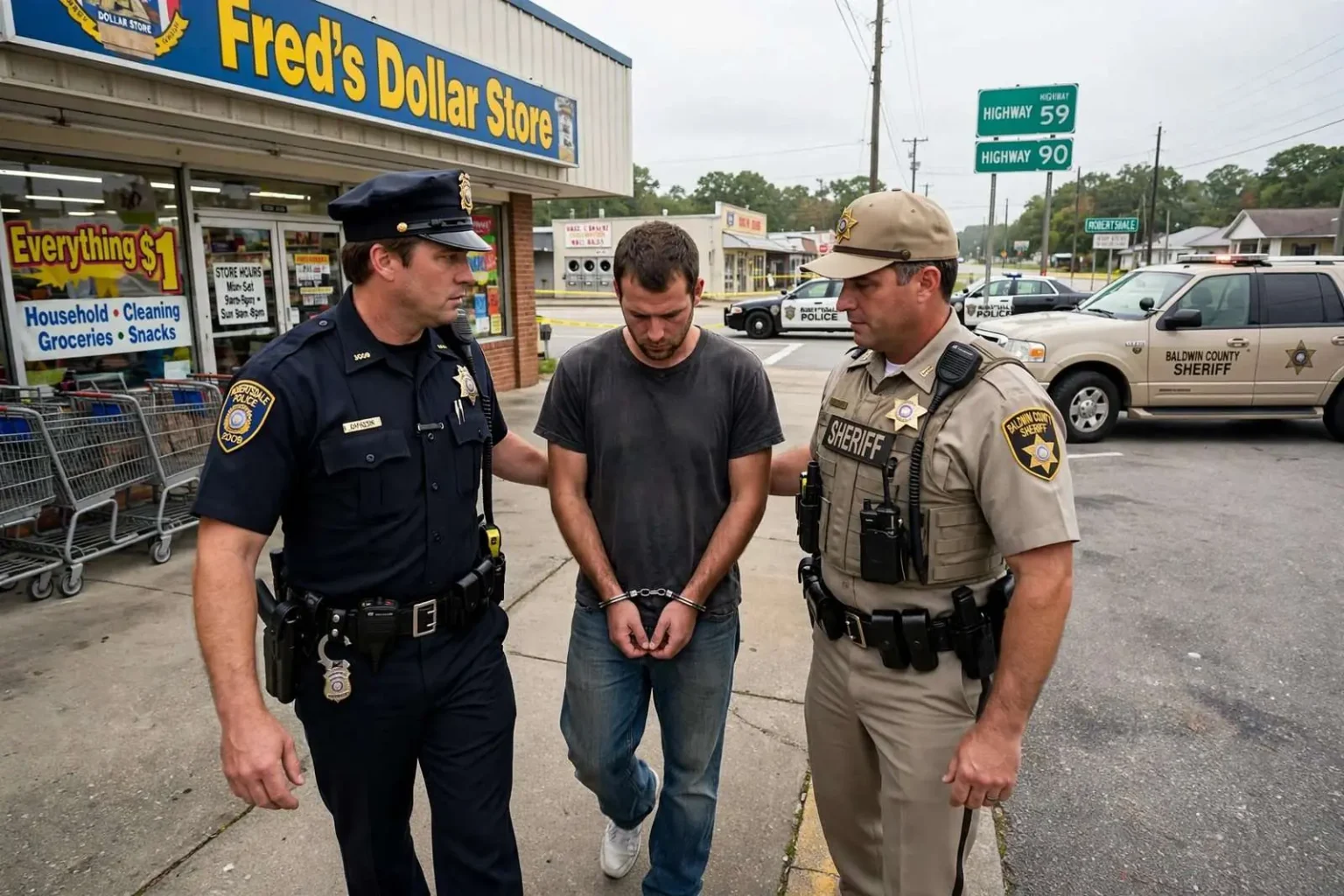
Robertsdale police announced an arrest in May 2009 after a caller reported seeing a Baldwin County drug suspect near the intersection of Highway 59 and Highway 90. Police said Todd Gates was spotted walking near a Fred’s Dollar Store and was arrested shortly before 10 a.m. — the quick ending to a search that began the day before with a sheriff’s office raid at a Summerdale home.
The arrest followed a sheriff’s office raid at a Summerdale home the previous day, a search that put the Baldwin County Sheriff’s Office on notice that its suspect was close at hand. When a caller phoned in a sighting near the Highway 59 and Highway 90 intersection — the crossroads at the heart of Robertsdale — patrol officers moved quickly, located Gates walking near the Fred’s Dollar Store and took him into custody without incident, all before the morning had reached ten o’clock.
What deputies reported: Baldwin County deputies said they found methamphetamine and firearms at the Summerdale property but did not locate Gates during the initial search. The combination — a controlled substance and weapons under the same roof — typically escalates a drug case into felony territory with enhanced exposure, and it explains why authorities characterized Gates as a high-priority suspect during the search. Sheriff Hoss Mack said the home had surveillance cameras and a security system that investigators believed could alert occupants to an approaching police presence, a detail that suggested whoever was inside may have had warning before deputies arrived.
Authorities characterized Gates as a high-priority suspect during the search, and the reports at the time focused on law enforcement’s allegations that methamphetamine was found at the home and that the suspect was involved in its use and manufacture. The rapid tip-to-arrest sequence in Robertsdale — a public sighting called in, a fast patrol response, an arrest within hours — illustrated how the sheriff’s office and municipal departments shared information during active searches, with the wanted man’s description circulating quickly enough that a single phone call ended the hunt.
Historical allegations and case status
The account reflects the statements made by police and sheriff’s officials when the arrest was announced. It does not establish guilt or a final judicial outcome. An arrest is not a conviction, and later court records would be needed to determine how any charges were resolved — whether by conviction, plea, dismissal or some other disposition. That distinction matters as much in a small county as anywhere: a name attached to an arrest announcement is not the same as a name attached to a judgment.
The geography of the case tells its own story about Baldwin County in 2009. Summerdale sits in the county’s southern tier, a small town along Highway 49 south of Foley, while Robertsdale straddles the Highway 59 corridor that funnels traffic between the beach communities and Interstate 10. The two towns are a short drive apart, which is why a suspect who slipped out of a Summerdale home before deputies could reach him could surface the next morning on foot in Robertsdale — the kind of short-range flight that rural counties see often, and that ends quickly when residents call in what they see.
The caller’s report was also the decisive element, and it was no accident. Law enforcement agencies in Baldwin County have long credited public tips with closing searches that might otherwise have dragged on for days, and the sheriff’s office has historically publicized wanted suspects precisely to generate those calls. A sighting near a busy retail corner like Highway 59 and Highway 90 — where the Fred’s Dollar Store anchored a stretch of shops and parking lots that see steady morning traffic — gave police a fixed point to converge on within minutes.
Sheriff Hoss Mack’s comments about the Summerdale home’s surveillance cameras and security system reflected a trend that was still new at the time: residential camera systems becoming common enough that drug operations used them as early-warning networks. The observation cut both ways in the investigation — the equipment might have tipped off occupants before the raid, but it also meant the property itself contained evidence of how it was operated, and it foreshadowed the far larger role that camera footage would come to play in Baldwin County investigations over the following decade.
Methamphetamine was, by the accounts of Baldwin County deputies in that era, one of the most persistent drug problems in the county — a concern that shaped staffing, training and coordination between the sheriff’s office and the district attorney’s drug task force. Cases that combined the drug with firearms, as this one was alleged to have done, drew particular attention from prosecutors because of the sentencing enhancements that federal and state law attach to drugs and guns together.
How the case was handled and preserved
The 2009 arrest showed how a report from a member of the public led police to a suspect sought after the Summerdale raid. It also involved coordination between Robertsdale police and the Baldwin County Sheriff’s Office — the sheriff’s office conducting the raid and developing the suspect, the municipal department making the arrest when the tip came into its jurisdiction, and the two agencies sharing information across city limits in real time. That kind of handoff is routine in Baldwin County, where a handful of small police departments operate alongside the sheriff’s office across short distances.
For Robertsdale itself, the arrest was a routine afternoon in the life of a small police department on a busy crossroads. The city sits where Highways 59 and 90 meet, and its officers spend much of their time on corridor traffic, retail theft and the occasional more serious case that passes through. A quick arrest on a tip, executed before 10 a.m. with no reported injuries, is the kind of outcome departments measure in quiet ways — no pursuit, no confrontation, a wanted suspect in custody within hours of the search that lost him.
The case also sits in a specific moment in Baldwin County’s growth. In 2009, the county was already one of Alabama’s fastest-growing, but the development wave that would transform Spanish Fort, Daphne and Foley over the following decade was still building. Drug enforcement in that era leaned heavily on raids, tips and patrol work rather than the camera networks, license-plate readers and data sharing that came later — which is why the sequence here, a home raid followed by a public tip and an arrest on foot, reads like a textbook of the period’s methods.
The mention of a Fred’s Dollar Store anchors the report in its time as well. The discount chain was a fixture of small-town Alabama retail for decades, its stores serving as everyday landmarks in communities like Robertsdale, and a sighting reported at such a location reflected how residents described their world before the era of cell-phone cameras and instant mapping. Many of the chain’s locations, including stores across Baldwin County, closed after the company’s later bankruptcy, making the reference a small historical marker in its own right.
South AL News is preserving the report as a historical local record while clearly distinguishing law-enforcement allegations from a court finding. The 2009 announcement documented what police said they found and what they alleged; it did not, and does not, amount to proof. Readers encountering the account today — whether through archives, family research or county history — should read it the way the original reports were structured: as a record of an arrest, of allegations made at the time, and of a process that would only be resolved, one way or another, in a courtroom.
The presumption-of-innocence framing is more than boilerplate in a case like this one. Arrest announcements circulate widely in the days they are issued and then fade, while the court record that determines what actually happened may be consulted by no one. Preserving the original reporting with its allegations clearly labeled gives future readers the full picture: what authorities said in May 2009, what the evidence at the time consisted of, and what the law requires before any of it becomes a finding of guilt.
The people behind the tip
It is worth pausing on the anonymous caller who set the arrest in motion. Every coordinated drug investigation depends on residents willing to make such calls, and Baldwin County’s agencies have consistently pointed to public tips as the difference between a search that ends and one that does not. The sheriff’s office maintained tip lines for exactly this purpose, and the department’s publicity of wanted suspects — names, descriptions, known haunts — was designed to make the next sighting reportable. In this case, the system worked as designed: a resident saw someone they recognized from a wanted notice, made one call, and a two-day search ended on a Robertsdale sidewalk.
The case, in the end, is a snapshot of three Baldwin County institutions doing what they were built to do in 2009 — a sheriff’s office executing a raid and hunting its suspect, a small-city police department responding to a citizen’s call, and a local press that recorded both while noting carefully where the allegations ended. The record of that May morning near the Fred’s Dollar Store now survives as history: complete in its description of what was said at the time, and appropriately silent about anything a court was later left to decide.