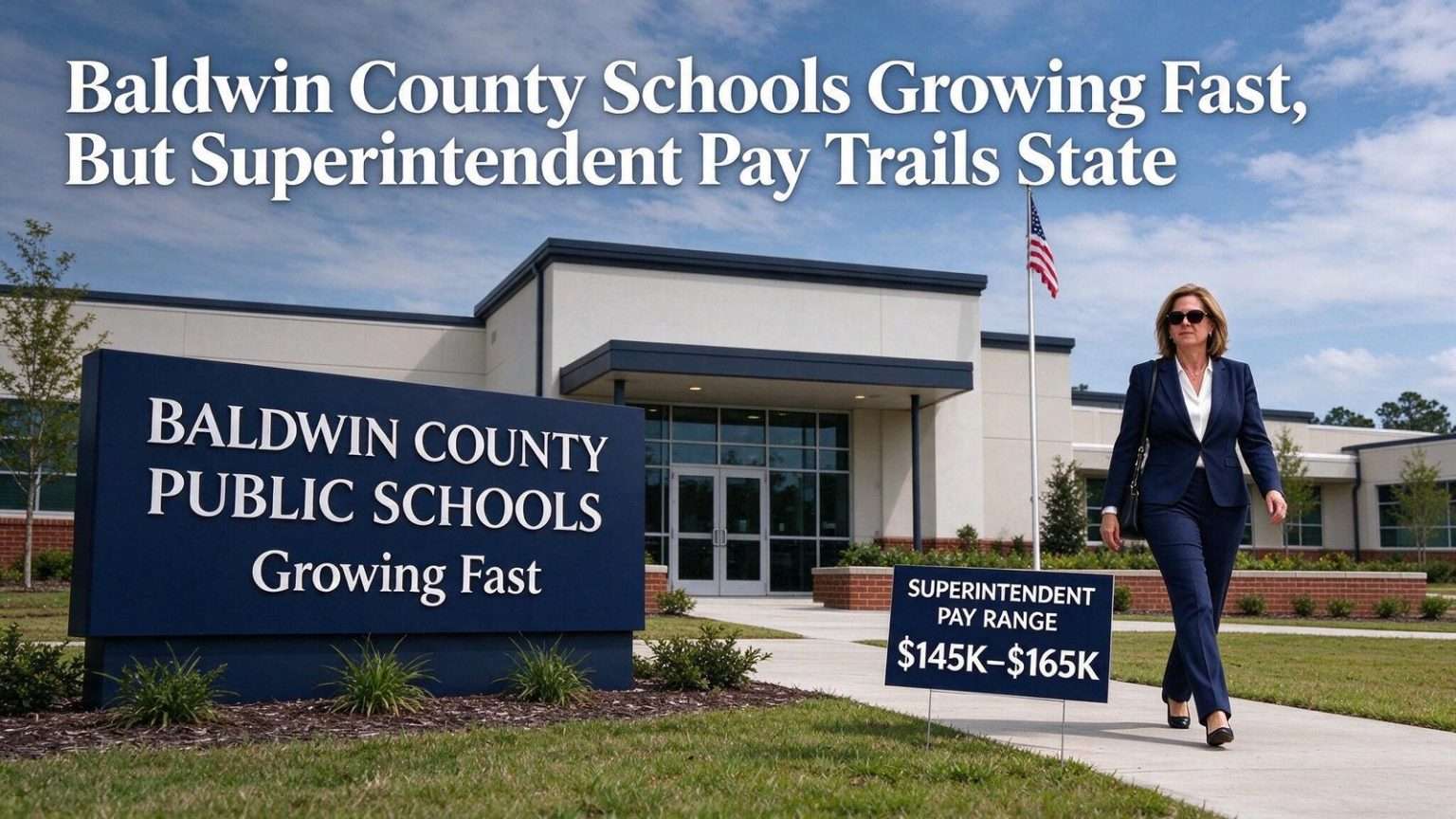
Baldwin County Schools Growing Fast, But Superintendent Pay Trails State
Despite ranking among Alabama's fastest-growing districts, Baldwin County offered a superintendent salary well below dozens of smaller systems.
Baldwin County’s public school system ranks fourth in enrollment among Alabama’s public districts, yet the salary range the board offered for its incoming superintendent trailed more than two dozen smaller systems across the state, according to figures from the Alabama State Department of Education — a gap that has framed the district’s leadership search in questions about pay, growth and fiscal caution.
As the board prepared to finalize its choice for the district’s next leader, officials set a pay range of $145,000 to $165,000 a year for a superintendent who will oversee a system expected to top 30,000 students for the first time. Only Mobile County, Jefferson County and Montgomery Public Schools enroll more students statewide, placing Baldwin County’s schools among the very largest employers and institutions in a county whose population has grown steadily for decades.
The range drew attention because of how it stacked up against the rest of Alabama. Statewide records show that 24 of the state’s 136 public school systems pay their superintendents $145,000 or more, and 14 systems pay $165,000 or higher, including some districts far smaller than Baldwin County. One north Alabama city system with roughly a tenth of Baldwin County’s enrollment pays its superintendent more than $167,000 annually. The highest-paid superintendent in the state earns $228,000 a year leading Jefferson County Schools.
Those comparisons set the terms of the debate in Baldwin County, where taxpayers have watched the school system stretch to accommodate wave after wave of new students while the board weighed every dollar of administrative compensation against classroom needs and construction demands.
The Board’s Defense of the Range
A board member defended the range, noting that every finalist who applied for the job understood the posted salary parameters going in. “Considering the finances of our system, I am comfortable with that range,” the board member said, tying the number directly to the district’s budget picture rather than to the market for superintendents in general.
That argument carried weight in a county where school finances have been a recurring public preoccupation. Baldwin County’s school system has cycled through periods of rapid enrollment growth, tight budgets and difficult funding votes, and board members are keenly aware that administrative salaries are scrutinized by the same taxpayers who are asked to support tax measures and bond issues for new schools. A posted range at the middle of the statewide pack, rather than the top, was a deliberate signal of fiscal restraint.
There was also a practical consideration embedded in the defense: finalists knew the pay before applying, so no candidate could claim to have been surprised or misled at the negotiation stage. The board effectively argued that the range had already functioned as a market test — the applicants who came forward did so knowing what the job paid, and the search proceeded from there.
Pay Does Not Track Enrollment
A district spokesman said superintendent pay across Alabama doesn’t track closely with enrollment size, noting that some smaller systems historically pay more than Baldwin County while some larger systems pay less than expected. The observation reflects a long-running quirk of Alabama school governance: superintendent compensation has as much to do with local tax base, city wealth and historical precedent as with the number of students a district serves.
Alabama has 136 public school systems, a count swollen by the state’s structure of independent city districts layered over county systems. A prosperous small city can support a superintendent salary that dwarfs what a sprawling rural county pays, even when the county educates many times as many children. That dynamic explains how a north Alabama city system with a fraction of Baldwin County’s enrollment could top $167,000 while the state’s fourth-largest district posted a range starting at $145,000.
The mismatch frustrates boards that measure workload by headcount. A superintendent responsible for more than 30,000 students, dozens of schools spread across a county the size of some northeastern states, thousands of employees and a capital program sized to Baldwin’s growth is running one of the most complex organizations in the county — yet the salary survey reads like a mid-tier position.
The Case for Looking at Total Compensation
Another board member cautioned against comparing base salaries alone, arguing that full compensation packages, including vehicle allowances or mileage reimbursement that have factored into past superintendent negotiations, should be part of any comparison. The point is more than technical in Baldwin County, because mileage matters here in particular: Baldwin is the largest county in Alabama by land area.
The county’s sheer size shapes the superintendent’s job in ways that a salary survey does not capture. Schools stretch from the Eastern Shore communities of Fairhope, Daphne and Spanish Fort to Gulf Shores and Orange Beach on the coast, and north through Bay Minette, Robertsdale, Foley, Loxley and beyond. Traveling between campuses, state meetings in Montgomery and community events across that territory adds up to thousands of miles a year, and how the district compensates that travel — a vehicle, an allowance or mileage reimbursements — can swing the real value of the package by thousands of dollars.
Total-compensation comparisons also capture insurance, retirement contributions and deferred benefits that vary from district to district. A board that pays a lower base salary but funds a richer benefits package may be offering more real value than the raw numbers suggest, and the board member’s caution was aimed at keeping the public debate anchored in what the district actually spends rather than a single line item.
Growth, Finances and the Job Itself
Board members also pointed to the district’s financial uncertainty as a factor shaping the offer. Baldwin County’s schools have ridden a demographic wave for years, and growth is expensive even when it is welcome: new students arrive faster than sales tax revenue catches up, mobile classrooms multiply while permanent buildings await funding, and each year’s budget must balance classroom staffing against debt service on construction.
The county has repeatedly turned to its voters on school funding, and the results have shaped the system’s trajectory. Local support has enabled major building campaigns across the county’s municipalities, but the underlying pressure never fully subsides. In that environment, board members weighed the superintendent’s salary not against what neighboring districts pay, but against what the system can sustain while continuing to build schools for the students already arriving.
The next superintendent inherits a to-do list that reflects the county’s growth. Enrollment past 30,000 students brings the system to a scale where administrative decisions — zoning, staffing formulas, transportation routes that cross one of the largest counties in the Southeast — affect thousands of families at a time. The position demands a manager comfortable with construction budgets, a negotiator capable of working with county commissions and municipal leaders across more than a dozen communities, and an educator credible with teachers and principals in schools ranging from aging campuses in established neighborhoods to brand-new buildings on freshly annexed land.
What the Search Means for Residents
For Baldwin County families, the superintendent’s pay is less interesting than the leadership that comes with it. The superintendent sets the tone for how the district handles the questions that reach every kitchen table: where new schools get built, how attendance zones are drawn as neighborhoods fill, which programs survive a tight budget year, and how the system communicates with a public that has shown, in tax referendums and at board meetings, that it pays close attention.
The salary debate also offers residents a window into the tradeoffs their board is making. A range in the middle of the statewide field preserves money for classrooms and construction, but it may narrow the pool of candidates willing to take on one of the largest jobs in Alabama education. Board members who defended the range believe the county’s appeal — its growth, its Gulf Coast quality of life and its reputation as a destination school system — attracts strong candidates without top-of-market pay.
The comparison figures themselves are worth keeping in hand as the discussion continues. Baldwin County’s range of $145,000 to $165,000 sits at the threshold of the top quartile statewide: only 24 of Alabama’s 136 systems pay at or above $145,000, and the county’s upper limit matches the level just 14 systems reach. Jefferson County’s $228,000 ceiling and the north Alabama city district paying more than $167,000 with a tenth of the enrollment will remain the touchstones critics cite whenever the topic arises.
How those numbers are weighed depends on what residents believe the job requires. A system of more than 30,000 students carries responsibilities — budgets, construction, personnel, transportation across the state’s largest county by land area — that resemble those of a mid-sized corporation, and supporters of higher pay argue the market for proven executives does not pause for the conventions of public education. Others counter that public service has its own economics, that Alabama’s pay levels reflect local realities, and that a candidate drawn primarily by salary may not be the right fit for a county whose residents have consistently voted their expectations about fiscal stewardship.
The incoming superintendent’s performance will settle the argument better than any editorial page can. If the district continues to grow without losing ground on achievement, finances or community trust, the board’s restraint will look like wisdom. Whatever the outcome, the figures from the state department’s records give residents a rare, concrete look at how Alabama districts value their chief executives — and a benchmark the board can measure itself against when the next search comes around.