Baldwin Deputies Announced Capital Murder Charge in 2009 Loxley Case
Baldwin County deputies announced a capital murder charge in February 2009 after a man was found dead near Loxley on Truck Trail 17.
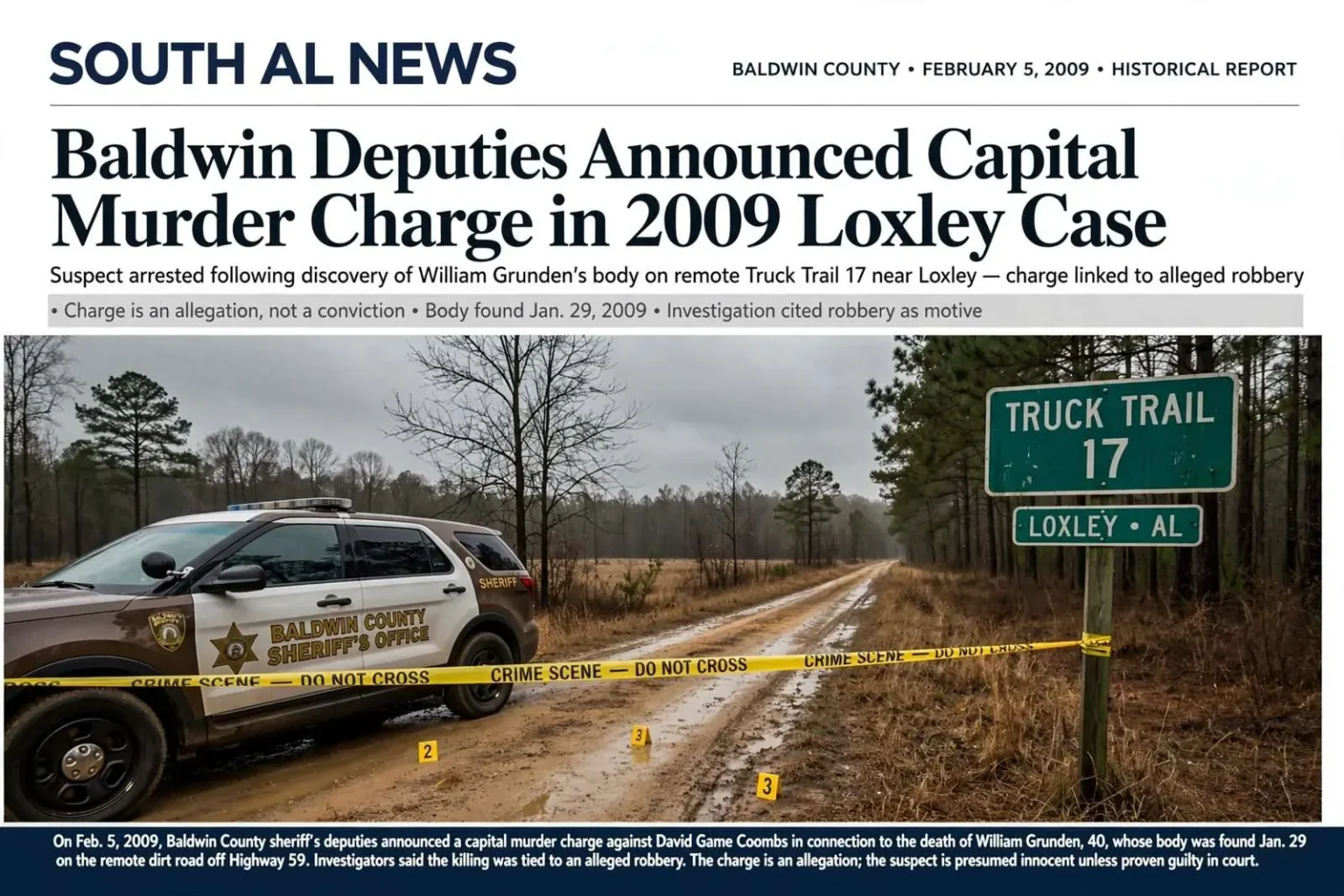
Baldwin County sheriff’s deputies announced a capital murder charge in February 2009 following the death of a man whose body was found near Loxley. Investigators identified the victim as William Grunden, and the announcement marked a major step in a case that had begun with the discovery of a body on a remote dirt road in one of the county’s fastest-growing corridors.
His body was discovered Jan. 29 on Truck Trail 17, a dirt road off Highway 59 in the Loxley area. The location, a sparsely traveled track off the main highway, is the kind of place investigators say is sometimes used to conceal crimes — far enough from the busy roadway to escape notice, close enough to be reached in minutes.
Charge announced by investigators
Deputies said they arrested David Game Coombs and charged him with capital murder. According to the sheriff’s office, investigators believed the killing was connected to a robbery involving a substantial amount of money. Authorities said Grunden was shot after the alleged robbery.
The capital murder classification matters under Alabama law. A killing committed during the course of a robbery — one of the felony offenses that elevates a homicide to capital status under the state’s criminal code — carries the most serious potential consequences in the Alabama justice system. The classification also shapes how the case moves through the courts, from the initial bond considerations to the decisions prosecutors must make about how to proceed.
The report identified the location where the body was found and summarized the investigators’ account of the case at the time the arrest was announced. Sheriff’s investigators worked the case from the discovery of the body through the arrest, piecing together the sequence of events that they said connected the death to a robbery.
The announcement came roughly a week after the body was found, a pace that reflected the intensity of the early investigation. Detectives gathered evidence from the scene on Truck Trail 17, canvassed the area, and followed the money trail they believed linked the killing to a substantial loss.
Historical allegation, not a conviction
The capital murder charge was an allegation made during the investigation. An arrest or charge is not a conviction, and the account does not establish the ultimate result of the criminal case. Every person charged with a crime is presumed innocent unless and until proven guilty in a court of law.
Later court records would be required to determine whether the charge was amended, resolved by plea, dismissed or decided at trial. That distinction is central to responsible reporting on any criminal case: what a sheriff’s office announces at an arrest is the state’s initial account, not a finding of fact by a judge or jury.
The Loxley area and the Highway 59 corridor
Loxley sits along the U.S. Highway 59 corridor in central Baldwin County, a community that has grown rapidly as the county’s population has expanded toward the Interstate 10 interchange. In 2009, the town was already in the midst of that transformation, with new subdivisions and commercial development pushing out from the highway while older farm roads — places like Truck Trail 17 — remained much as they had been for decades.
The geography of central Baldwin County shapes how its law enforcement agencies work. The sheriff’s office patrols a county that stretches from the Mobile Bay shore to the Florida line, covering rural back roads where response times are longer and discoveries of anything unusual often come from hunters, drivers or property owners rather than passersby on a city street.
Highway 59 itself is one of the county’s main north-south arteries, running from Interstate 10 through Loxley, Robertsdale, Summerdale and Foley toward Gulf Shores. The traffic that moves along it every day — tourists headed to the beaches, commuters, trucks serving the county’s farms and nurseries — passes within a short distance of the quiet dirt roads where the Grunden case unfolded.
How capital cases move in Baldwin County
A capital murder charge sets a case on a distinct path through the Alabama courts. Prosecutors in the Baldwin County District Attorney’s Office review the evidence before deciding how to proceed, and capital cases involve additional procedural steps, including grand jury review and decisions about sentencing that ordinary murder cases do not require.
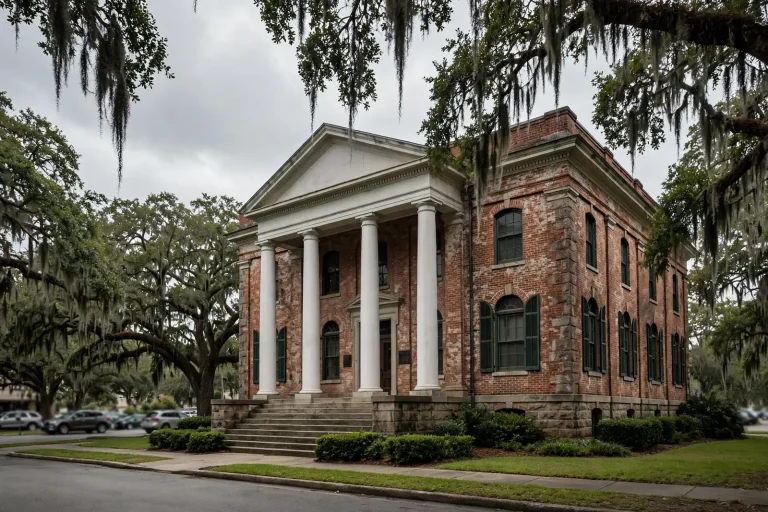
The Baldwin County Judicial Center in Bay Minette, where the county’s circuit courts sit, would be the venue for any trial in such a case. Capital prosecutions can take years to resolve, moving through motion practice, competency and penalty-phase considerations, and appeals that follow any conviction.
Because of what is at stake, capital charges are also among the most carefully scrutinized cases in the system. Defense representation, the quality of the investigation, and the strength of the evidence connecting a killing to an underlying felony — in this case the alleged robbery — all become central questions as the case advances.
Preserving the historical record
The February 2009 announcement marked a significant development in the Baldwin County investigation, coming shortly after the body was found near Loxley. It also highlighted the role of the sheriff’s office in connecting the reported robbery and shooting to the capital-murder allegation.
South AL News is preserving this item as a historical local record, using careful attribution to distinguish law-enforcement statements from a final judicial finding. The approach reflects a commitment to keeping the community’s record of significant local events while honoring the legal principle that a charge is not a verdict.
Investigating a death on a rural road
Deaths discovered on remote roads present some of the most demanding work a county sheriff’s office faces. When a body is found, the first questions are basic: who is the person, how did they die, and how did they come to be in that place. Investigators document the scene exhaustively, photographing and collecting physical evidence, and canvass nearby properties for anyone who might have seen or heard something in the days before the discovery.
Identification comes first, and in the Grunden case investigators moved quickly to confirm the victim’s identity and begin building a timeline of his final days. Working backward from the last confirmed contact, detectives traced movements, interviews and financial records — the standard scaffolding of a homicide investigation.
The connection to a robbery, described by the sheriff’s office as involving a substantial amount of money, added a financial thread to the work. Investigators following that thread examined where the money came from, who knew about it, and what movements followed — the kinds of questions that transform a death investigation into a capital murder case.
Rural Baldwin County’s terrain works both ways for investigators. Dirt roads like Truck Trail 17 can conceal activity from the highway, but they also limit escape routes and leave physical traces — tire tracks, footprints, discarded items — that a city street would never preserve. Deputies worked the scene with those realities in mind.
The sheriff’s office in a growing county
The Baldwin County Sheriff’s Office entered 2009 as the primary law enforcement agency for a county in the midst of dramatic growth. Baldwin had been expanding for years, drawn by its schools, its coastal proximity and its position between Mobile and the beach communities, and that growth spread deputies across an ever-larger map of subdivisions, farm roads and highway corridors.
The agency operates from the county complex in Bay Minette, with patrol divisions, investigators and support staff covering everything from traffic deaths to major felonies. Capital murder investigations draw on all of those resources at once, with patrol deputies securing scenes and canvassing neighborhoods while investigators handle interviews and evidence work.
Sheriff’s announcements of major arrests are among the most widely covered events in Baldwin County’s local news cycle. The February 2009 press announcement of the Coombs arrest drew attention across the county precisely because it connected a disturbing death to a named suspect within days of the body’s discovery.
What a charge means, and what it does not
It bears repeating that the system distinguishes sharply between accusation and proof. The capital murder charge announced in 2009 was the state’s position at a moment in time. What followed — the grand jury’s decision, any pretrial rulings, plea negotiations or trial, and the final disposition — lives in court records that would tell the rest of the story.
Reporting that preserves that distinction serves several purposes. It keeps the historical record accurate, it protects the rights of everyone involved, and it gives future readers a clear account of what was known, and by whom, at each stage of the case. When the only record that survives is an arrest announcement, the temptation is to treat the charge as the ending; careful archives resist that temptation.
For the family of William Grunden, the case that began with a discovery on a January morning near Loxley represented a loss measured in personal terms rather than legal ones. The legal process that followed the February 2009 announcement existed to answer the state’s questions, but no court record can capture the full weight of a life lost in a case like this one.
The case remains part of Baldwin County’s documented history — a February 2009 arrest announcement, an allegation of capital murder, and an investigation that began on a dirt road off Highway 59 near Loxley.