Gulf Shores Police Chief Defends License Plate Cameras as Residents Raise Privacy Concerns
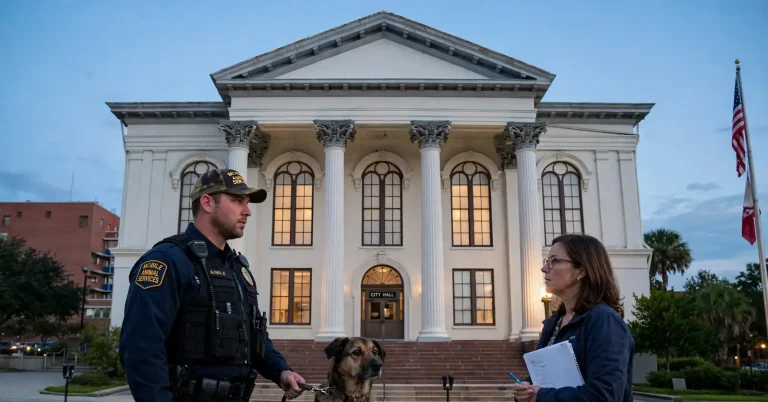
Gulf Shores Police Chief Dan Netemeyer defended the city's use of Flock license plate cameras after residents raised privacy and surveillance concerns.

The growing use of Flock Safety license plate reader cameras is fueling debate in city halls and county commission chambers nationwide, with critics warning about government surveillance, potential police misconduct and possible constitutional violations. That debate reached the Alabama coast this week, as Gulf Shores residents questioned the city’s use of the technology at Monday’s City Council meeting.
Gulf Shores Police Chief Dan Netemeyer defended the cameras, saying they have become a valuable public safety tool that isn’t going away unless courts rule the technology unconstitutional. “I’ve been doing this for 40 years now and what Flock is doing to assist law enforcement in solving crimes we didn’t know happened until well after the fact is almost on the level, if not at the same level, of DNA and fingerprinting,” Netemeyer said. “In my opinion, they are (in Gulf Shores) until the Supreme Court says they are unconstitutional. Until that time, I’ll use them to keep the city safe.”
Residents who spoke at the meeting echoed concerns raised by civil liberties advocates nationally, including questions about privacy, government overreach, misuse by individual officers and potential Fourth Amendment violations. The City Council did not respond to the comments during the meeting. “Do you want cameras watching you, your grandchildren, every day?” resident Vicki Brown asked. “We are being subjected to an intrusion of our privacy.” Fellow resident Sheryl Cave said she trusts the local police department but worries the technology creates a perception of government overreach. “They are going to be used for nefarious purposes,” Cave said. “It’s not a matter of if, but when.”
The debate has also divided Alabama Republicans. State Auditor Andrew Sorrell recently argued on social media that the cameras conflict with Fourth Amendment protections, while the Alabama Sheriffs Association has publicly supported Flock cameras as a valuable crime-fighting tool when used with appropriate safeguards. In Springville, officials are exploring ending the city’s Flock contract after an audit found an officer had misused the system.
Netemeyer said many concerns stem from misunderstandings about how the cameras work, noting that the vast majority in Gulf Shores only read license plates rather than record into private property. He pointed to cases where the cameras helped locate a 90-year-old dementia patient driving the wrong way on a highway in Panama City, Fla., and helped curb a recurring problem of abandoned pets near the city’s dog park.
Gulf Shores purchased about 87 cameras last year and has established a policy governing their use, intended to help identify stolen vehicles, stolen license plates and missing persons. Under the policy, data is retained for 60 days unless there is a legitimate law enforcement reason to preserve it longer, and Netemeyer said every search of the system is logged and subject to audit. “The employees here know that we have a zero tolerance policy on this,” he said of misuse. “The misuse of any government computer is met with zero tolerance.”
Brad Lehmann, an assistant professor of criminal justice at Virginia Commonwealth University, said public trust will be central to the technology’s future. “Public trust is a whole issue, especially eroding when data is shared beyond stated purposes, cameras are deployed without transparency, retention periods are long, oversight is weak, communities feel surveilled rather than protected, and even people who are not harmed directly may lose trust in police and hesitate to seek help,” Lehmann said. He added that researchers are also studying whether the growing number and placement of cameras, which can track identifying features beyond license plates such as dents, stickers and aftermarket parts, could amount to a form of mass tracking.
Netemeyer said Gulf Shores’ cameras are not installed in residential neighborhoods but are positioned near parks, schools, government buildings and the beachfront, with the goal of protecting both residents and the roughly 7.1 million visitors who travel to Alabama’s beaches each year.
Flock Announces New Company-Wide Safeguards
Update: Flock Safety CEO Garrett Langley has announced additional company-wide changes the company says are designed to prevent misuse of its camera network amid the continuing backlash. Langley said Flock will shorten its standard data retention window from 30 days down to seven days, and that the company is building in safeguards that could lock users out of the system when their search activity appears abnormal. “We realize our responsibility and opportunity to set a new standard for safety and privacy has grown with it,” Langley said. He continued to defend the cameras as a significant law enforcement tool, saying, “Last month alone, we helped detect over a thousand missing people, over 20,000 stolen cars.”
The concerns raised by Gulf Shores residents are not isolated. In St. Clair County, an officer in Springville resigned and an officer in Moody was fired after their departments determined the two had violated policies governing use of the Flock system, adding to the list of misuse cases cited by critics of the technology.
Mobile Police Say They Don’t Use Flock
Mobile police, unlike their counterparts in Gulf Shores, said their department does not use Flock cameras, though officers do rely on other brands of license plate reader technology. The department declined to disclose the specific locations of those cameras. Online maps that claim to identify license plate reader locations in the area proved unreliable in at least a few instances: a check of four locations listed on those sites found cameras made by other manufacturers at each site, rather than Flock equipment. Separately, multiple Flock cameras were found installed on private property near a Lowe’s store in the Tillman’s Corner area, outside of any city-run camera network. Mobile police said no officers have been investigated or disciplined for violating the department’s policy governing the use of license plate readers, and a copy of that policy has been requested.
How License Plate Readers Work
Automated license plate readers photograph passing vehicles and use software to convert plate numbers into searchable text, which can then be checked against “hot lists” of vehicles tied to stolen-car reports, warrants or missing-person alerts. The U.S. Supreme Court has not ruled directly on whether the technology is constitutional, but critics often point to its 2018 decision in Carpenter v. United States, which held that police generally need a warrant to obtain historical cellphone location records, as a sign that long-term tracking of a person’s movements can raise Fourth Amendment concerns.