Escambia County Deputies Announced Arrests in 2009 Atmore Homicide
Escambia County deputies announced arrests after an Atmore man was fatally shot in September 2009 during an argument, according to investigators.
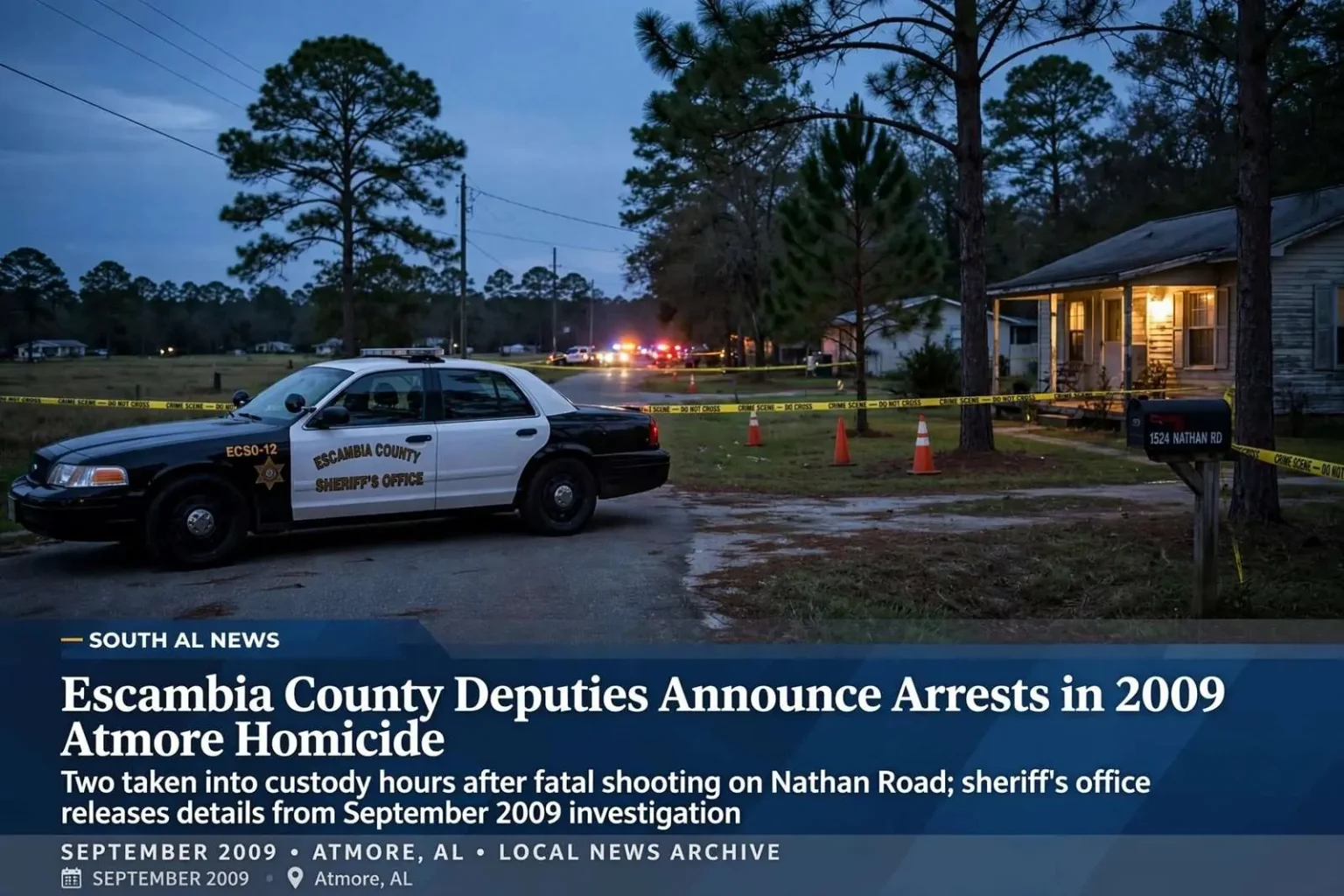
Escambia County deputies announced two arrests in September 2009 after an Atmore man was fatally shot outside a home on Nathan Road. The quick series of events — a Thursday evening shooting, a rush to a Mobile trauma center and arrests within hours — unfolded in one of the quiet residential stretches on the outskirts of Atmore, a small city in south Alabama’s Escambia County near the Florida line.
Investigators said Kenneth Porter was shot at about 7:30 p.m. on a Thursday evening. He was taken to USA Medical Center and died roughly two hours later, according to the sheriff’s office. The hospital — the University of South Alabama Medical Center in Mobile — serves as the primary trauma facility for the region, and the decision to transport a shooting victim there reflects the reality of rural emergency medicine in southwest Alabama: critically injured patients from Escambia County are moved quickly down the highway toward the higher level of care available in Mobile, roughly an hour away by road.
For a community the size of Atmore, news of a fatal shooting travels fast. Neighbors on Nathan Road and surrounding streets reported hearing the commotion of the emergency response as deputies and ambulance crews converged on the scene in the fading light of a Thursday evening, and word of the victim’s identity spread through the town before the night was over.
Arrests Announced After the Shooting
Authorities said they took Clarence Luker and Lorraine Gray into custody shortly before 11 p.m., after the two were seen returning to the scene. The return to the location of a serious crime is a detail investigators weigh carefully, and in this case it appears to have given deputies the break they needed to move from an open investigation to arrests within roughly three and a half hours of the shooting itself.
Investigators said the shooting followed an argument over property. Disputes over possessions, land and money have long been among the most common precursors to serious violence in rural Alabama, and deputies noted the property dispute as the apparent thread connecting the parties involved. The statement, released while the investigation was still in its first hours, gave the public an early sense of the case’s outline without detailing the evidence behind it.
The case was in its early stages when the arrests were reported. Law-enforcement statements at the time focused on the location of the shooting, the timing of the response and the reported dispute that preceded it. That restraint is typical of agencies in the first days of a homicide investigation, when evidence is still being gathered, witnesses are still being interviewed and prosecutors have not yet determined what charges the facts will support.
The Escambia County Sheriff’s Office handles law enforcement across the county’s unincorporated areas and supports the municipal departments in its towns, including Atmore, Brewton and Flomaton. A homicide in a rural stretch outside a city draws on that full network — deputies secure the scene, investigators work the case, and the district attorney’s office guides the legal path forward. In small counties, those systems are staffed by people who often know the families involved, which adds a human dimension to cases that larger departments handle more anonymously.
Historical Report and Case Status
The events described here are based on the information released by the Escambia County Sheriff’s Office in the immediate aftermath of the shooting. The arrests were allegations, not convictions. This historical account does not determine the ultimate outcome of any prosecution; later court records would be needed to confirm the final disposition of the case.
That distinction matters. An arrest is the beginning of a legal process, not its end, and the individuals taken into custody were at that point accused of crimes rather than adjudicated. The American legal system presumes innocence until guilt is established in court, and any account of an early-stage criminal case must be read with that presumption intact. Reports written in the days after a crime capture a moment in time, not a final verdict.
The 2009 report documented the swift response by investigators after the shooting, with arrests announced within several hours. It also reflected the difficult circumstances faced by the victim’s family as the investigation began. A family that loses a member to violence in a small town grieves in public, with the case’s details discussed at the grocery store and the gas station as much as in the courthouse, and the deputies who worked the case were mindful of that reality.
South AL News preserves this account as a local historical record. The article avoids repeating unnecessary personal details while retaining the key information released by authorities about the investigation and the allegations made at the time.
Archiving cases like this one serves a purpose beyond memory. Local news records are often the only public account of what happened in a community’s more serious crimes, and they become references for families, researchers and journalists years later. Preserving them with their original caution — separating what authorities said from what courts later decided, and omitting details that serve no public interest — is part of responsible local journalism.
Atmore and Escambia County in Context
The setting of the case is worth understanding. Atmore sits in the northern part of Escambia County, Alabama, along the rail line and highways that connect south Alabama to the Florida panhandle. The city is home to a historic downtown, a diverse population and an economy shaped by timber, agriculture and, in the surrounding area, the large correctional facilities that employ many residents of the region. Nathan Road lies in the rural reach beyond the city’s core, where residential plots give way to fields and pine stands.
Escambia County, Alabama, is one of the state’s smaller counties by population, with communities spaced across a landscape of farmland, forest and slow rivers near the Florida border. Violent crime is rare enough in its towns that a homicide draws sustained community attention, and the outcome of a case like this one remains part of local memory long after the courthouse files close.
For the residents of Nathan Road and the wider Atmore community, the September 2009 shooting was a shock that arrived on an ordinary weeknight — the kind of event that changes the texture of a neighborhood. The response that followed, from the first deputies on the scene to the investigators who closed in on arrests before midnight, reflected a small county’s determination that a fatal shooting would not go unanswered.
What can be said from the record is what the sheriff’s office said at the time: a man was killed outside a home on Nathan Road, two people were taken into custody within hours after being seen returning to the scene, and investigators believed the shooting grew out of an argument over property. Everything beyond that point belongs to the court record — and to the ongoing work of a community, and a family, making sense of a loss that began on a Thursday evening in September 2009.
How Homicide Investigations Work in Small Counties
The timeline of this case illustrates how a rural sheriff’s office responds to a death investigation. Deputies secure the scene within minutes, keeping bystanders back and preserving whatever evidence the yard and roadway hold. Investigators document the scene through the night, and the victim’s body is transported for examination as part of the state’s death-investigation process. Statements are taken while memories are fresh, and investigators return to the scene in the following days as the picture of what happened takes shape.
The speed of the arrests in this case — announced within hours of the shooting — reflected information that came together quickly, including the reported sighting of the two individuals near the scene. Not every case moves that fast, and investigators are careful to explain that speed depends on the evidence each case provides. When it does move quickly, it is usually because witnesses came forward promptly and the pieces fit together early.
Once arrests are made, the case passes from the sheriff’s office to the district attorney, who reviews the evidence and decides what charges to file. From there, the process moves through the courts at its own pace, with preliminary hearings, grand jury review where applicable, and eventual resolution by plea or trial. The public role of law enforcement effectively ends at the arrest; everything after belongs to the prosecution and the defense.
Preserving the Record
Readers who followed this case in 2009 will remember the details differently than readers encountering it now, which is precisely why historical accounts are kept. News archives allow a community to look back at what was known, and when, without the distortion of memory. They also protect against a subtle danger: the drift by which allegations harden into remembered fact over time. A preserved account that labels arrests as allegations keeps that boundary visible decades later.
South AL News maintains accounts like this one for that reason — accurate at the level of what was officially reported, restrained beyond it, and available to the community for as long as the record is needed.