
Standing room only at public meeting on Mobile River Bridge toll
A standing-room-only crowd in Spanish Fort opposed the proposed Mobile River Bridge toll at a public hearing this week.
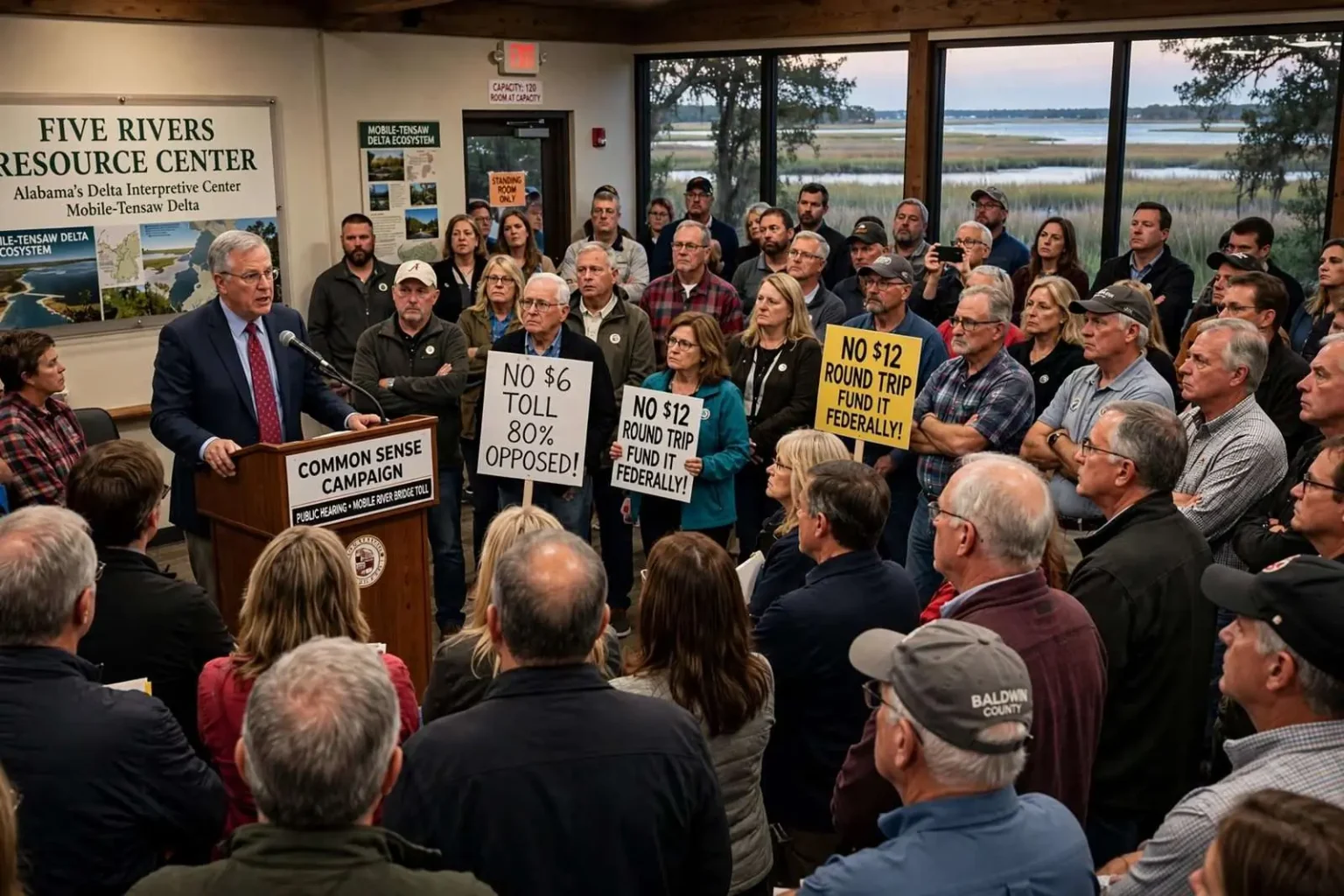
A standing-room-only crowd turned out on the Causeway on Thursday night for a public hearing on a proposed toll bridge over the Mobile River, and the response was so heavy that the venue filled to capacity and some people were turned away at the door for safety reasons.
The Five Rivers Resource Center, the state’s delta interpretive center that sits along the Causeway between Spanish Fort and Mobile, filled to capacity as residents gathered to discuss the project. The hearing was hosted by State Auditor Jim Ziegler and the Common Sense Campaign, a government watchdog group that has been critical of the toll proposal.
Residents voiced concern about a proposed $6 toll to ease traffic through the Wallace tunnels, with a $12 round-trip toll also discussed and its impact on families and businesses. A poll released earlier in the week showed roughly 80% disapproval of the toll.
Several drivers and local leaders — including the mayors of Spanish Fort, Daphne and Fairhope and the Baldwin County Commission — spoke against it, calling on the Alabama Department of Transportation to secure more federal funding for the project instead of relying on toll revenue.
A Crowded Hearing on the Causeway
The Five Rivers Resource Center is no stranger to crowds, but organizers and attendees alike described Thursday’s turnout as exceptional. The facility, perched on the banks of the Mobile-Tensaw Delta at the edge of Mobile Bay, serves as a meeting space and educational center, and its main hall reached its legal occupancy limit well before the hearing began. Late arrivals were turned away at the door for safety reasons, with some residents remaining outside in hopes of following the discussion.
The Causeway itself, formally U.S. Highway 90, runs along the southern edge of the Mobile-Tensaw Delta and links the Eastern Shore communities of Baldwin County to the city of Mobile. For decades it was the primary route between the two, and it remains a working road for thousands of commuters who live on one side of the bay and work on the other.
That daily reality framed the hearing. Speakers who addressed the crowd described the prospect of paying a toll to cross the river on a commute they already make twice a day, five days a week — a cost that adds up quickly for working families, small businesses with vehicles on the road, and residents who have no practical alternative route across Mobile Bay.
What the Toll Proposal Would Do
At the center of the debate is the proposed bridge over the Mobile River, part of a larger plan to build a new Interstate 10 crossing between Mobile and the Eastern Shore and to relieve the chronic bottleneck at the George Wallace Tunnel. The tunnel, bored beneath the river in the late 1960s, carries I-10 traffic under downtown Mobile in two lanes each way, and backups there routinely stretch for miles during morning and evening rush hours.
The toll discussed at the hearing was set at $6 for a one-way crossing, which would amount to $12 for a round trip. For a commuter who crosses the river daily, that arithmetic translates into a recurring monthly expense of well over $100 — a figure that drew sharp criticism from speakers who said the burden would fall hardest on working families and fixed-income residents.
Business owners in both Mobile and Baldwin County also raised concerns. Companies that move goods, send service vehicles across the bay or employ workers who live on the opposite side of the river would see transportation costs rise directly with the toll. Speakers argued that those costs would ultimately be passed on to customers across the region.
Ziegler and the Common Sense Campaign
State Auditor Jim Ziegler, a Mobile-area Republican known for his vocal style and his willingness to challenge state agencies, hosted the hearing along with the Common Sense Campaign. The group has positioned itself as a taxpayer watchdog and has made the toll proposal one of its signature issues, organizing opposition and pressing state officials to justify the financing plan.
Ziegler told the crowd that the hearing was intended to give residents a direct forum — something he argued had been lacking as the state moved forward with planning. The event was not an official ALDOT proceeding, but it drew the kind of turnout that public officials in both counties could not ignore, and several local officeholders used the platform to state their positions on the record.
The timing mattered as well. A poll released earlier in the week showed roughly 80% disapproval of the toll, a figure that speakers cited repeatedly as evidence that public sentiment in the affected communities runs overwhelmingly against the financing plan. Polling of that kind, critics of the toll argued, shows that residents understand the need for a new crossing but reject making drivers bear the cost through user fees.
Local Leaders Line Up Against the Toll
The hearing drew opposition from the top elected officials of the Eastern Shore. The mayors of Spanish Fort, Daphne and Fairhope all spoke against the toll, along with representatives of the Baldwin County Commission. Their opposition carried particular weight because those leaders represent the residents who would pay the toll most often — the thousands of Baldwin County residents who commute into Mobile each day.
The mayors argued that the new crossing is genuinely needed — congestion through the Wallace tunnel and along the Bayway is among the worst in the state — but that the state should fund it the way other major infrastructure has been funded, through federal grants and appropriations rather than a toll imposed on local commuters. They called on the Alabama Department of Transportation to secure more federal funding for the project.
Speakers pointed to the region’s economic importance to the state, noting that the Mobile metropolitan area is a national port city, a center of shipbuilding and a growing tourist destination. Investing in the region’s infrastructure, they argued, is a statewide obligation, not a local expense to be paid at the toll gate.
What Happens Next
No vote was taken at Thursday’s hearing, and ALDOT’s planning process for the bridge and toll continues. But the size of the crowd and the unanimity of the local officials who attended sent a clear signal to state leaders about the political terrain the project faces on the Eastern Shore.
Opponents said they intend to keep the pressure on, pressing state officials and the state’s congressional delegation to pursue federal funding. Supporters of a new crossing, including business and port interests, have argued that the region cannot afford to wait for federal money that may never arrive, and that congestion through the tunnels already costs commuters and businesses every day.
For now, residents along both sides of Mobile Bay are watching a debate that will shape how — and how much — they pay to cross the river for years to come. Thursday’s packed house on the Causeway made it plain that they intend to be heard before the decision is made.
The Congestion Problem Behind the Project
Anyone who has driven Interstate 10 through Mobile at rush hour understands why a new crossing has been discussed for years. The George Wallace Tunnel funnels the interstate beneath the river in just two lanes in each direction, and traffic merging from U.S. 98, the Bankhead Tunnel and downtown exits compounds the squeeze. On a bad day, the backup can stretch back onto the Bayway, leaving commuters idling on the high-rise bridge with a view of the bay and nowhere to go.
The bottleneck is more than an inconvenience. The Port of Mobile, one of the busiest deepwater ports on the Gulf Coast, and the growing industrial corridor around it depend on freight moving efficiently through the area. Trucks that sit in tunnel traffic add cost to everything they carry, and planners have warned for years that the region’s growth will only make the constraint worse.
A new bridge over the river — taller than the tunnels and free of their dive-and-climb profile — has long been the centerpiece of proposals to fix the problem. The dispute that filled the Five Rivers Resource Center on Thursday is not really about whether the region needs relief; it is about who pays for it, and through what mechanism.
Tolls and the Regional Economy
The $6 one-way figure discussed at the hearing would put the Mobile River crossing among the more expensive toll points in the region. For daily commuters, the practical effect is a new monthly bill for a trip that has been free since the tunnels opened. For residents on fixed incomes, for families shuttling between the two counties for school and work, and for small businesses operating fleets of vehicles, speakers said the cumulative cost would be substantial.
Opponents also argued that a toll on the new crossing would leave drivers stuck with a choice: pay to use the smoother new bridge, or sit in the tunnel traffic that remains. That dynamic, they said, would concentrate the worst congestion on the free route while effectively converting a daily commute into a subscription service.
There are real-world examples on both sides of the debate. Toll financing has funded major highway projects in other Southern cities, and transportation officials argue it shifts costs to the people who use the new facility rather than to all taxpayers. Critics in the Causeway crowd countered that the Eastern Shore’s commuters would be paying for a bridge whose benefits — a modernized interstate, faster freight, port growth — accrue to the entire state.
A Issue That Crosses County Lines
Although the hearing took place in Baldwin County’s backyard, the issue binds the two sides of the bay together. Mobile residents who work on the Eastern Shore, Baldwin residents who work in the port city, and travelers passing through on I-10 all stand to be affected by how the project is financed. The packed house on Thursday included residents from both counties.
Local officials who spoke against the toll acknowledged the political risk of opposing any solution to congestion that has frustrated their constituents for decades. But they said the constituency against a $12 round trip is broad enough that the state should go back to the drawing board on financing before committing to a plan that polls show 80% of residents already reject.
The hearing ended without formal resolutions, but organizers said the message to state officials was simple: find the federal funding, build the crossing the region needs, and do not balance the budget on the backs of the commuters who cross Mobile Bay every day. Whether that pressure changes the project’s financing plan will determine how the next chapter of this long-running debate is written.
Update: Fairhope mayor, state senator weigh in as opposition spreads
Thursday’s hearing is one of many gatherings opposing the proposed toll that have sprung up around Mobile and Baldwin counties. A petition opposing the toll is circulating, and several proposals to reduce or eliminate the tolls have been mentioned.
State Sen. Chris Elliott, R-Daphne, said a meeting on the issue should be held in Mobile or Baldwin County rather than requiring residents to travel.
Fairhope Mayor Karin Wilson said in a July 30 social media statement that she is “100% against a toll to build this bridge whatever the fee.”
“The State should have invested the billion+ dollar BP settlement into the two counties that suffered the most instead of taking this money for its own operating budget,” Wilson said. “Why punish the tourists and hardworking citizens of Mobile and Baldwin County to make up the shortfall due to poor planning and budgeting? We’re the ones paying the most to the State in tourism dollars.”
Wilson said the need for a new bridge has been discussed for more than a decade. “To react as though building it now is an overnight emergency is absurd,” she said.
Wilson compared the issue to Fairhope’s budget, saying that before she took office the city relied on half of its utility profits, almost $6 million a year, to balance its budget, and that after spending cuts and efficiency measures the city is now self-sustaining and has paid off its debt. “Proposing a toll due to lack of strategic planning and budgeting is not the answer,” she said.


