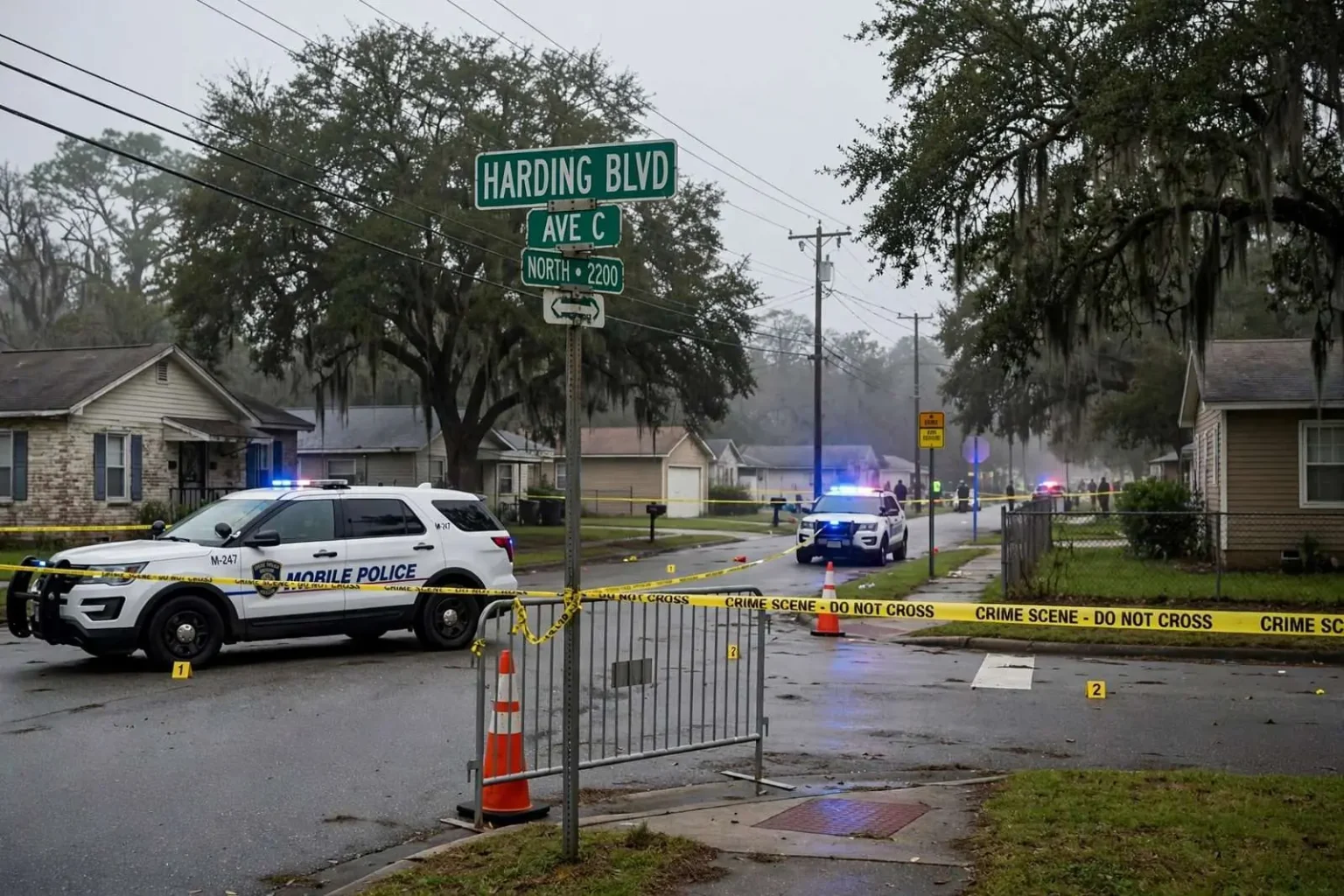
One man was killed and another was hospitalized after a shooting Thursday morning near Harding Boulevard and Avenue C in Mobile, according to the Mobile Police Department. The episode unfolded in a residential pocket of the city where morning routines were interrupted by patrol cars, taped-off streets and the grim work of a homicide investigation that would extend through the weekend and beyond.
Officers responded to the area shortly after 9 a.m. on August 13 in reference to a reported shooting. The call came in at an hour when much of the surrounding neighborhood was already awake — children waiting on school buses, residents heading to work along the grid of streets that runs through that part of north-central Mobile. Upon arrival, officers discovered a male victim who had died from a gunshot injury. There was nothing medics could do for him at the scene.
A second male victim was found with a gunshot injury and was transported to a local hospital for treatment; his condition has not been released. The wounded man’s identity has been kept from public view along with nearly every other detail of the case, a silence that investigators say is standard in the earliest hours of a violent-crime probe when officers are still working to establish what actually happened and who was involved.
Victims Not Identified as Investigators Piece Together the Case
Police have not released the names or ages of either victim. The man who died has not been publicly identified because investigators still need to notify next of kin, a step the department treats as a hard prerequisite before any confirmation is offered to the public or the press. In Alabama, that practice is not merely courtesy — it reflects a deliberate policy choice by law enforcement agencies across Mobile County to keep potentially inaccurate or premature identifications out of circulation while families learn of a loss in person, not from a news alert.
Investigators have not yet determined who fired the shots, what led up to the shooting, or whether the two victims knew each other. Those three questions — shooter, motive, and connection — form the backbone of nearly every shooting investigation, and their absence from the public record signals how early the department’s work still was. Detectives from the department’s investigative units took over the scene from patrol officers, and the area around the intersection remained the focus of their attention through the day.
Officers canvassed the area and spoke with nearby residents as part of the investigation. Door-to-door canvassing is one of the oldest and most labor-intensive tools available to homicide detectives, and it remains one of the most important. Residents who heard shots, saw unfamiliar vehicles, or noticed someone running from the block can provide the fragments of detail that, stitched together, give investigators a timeline. In cases like this one, where detectives had not yet named a suspect, that neighborhood-level cooperation can make the difference between an unsolved file and an arrest.
Second Shooting in Less Than 12 Hours
The shooting was the second that Mobile police responded to in less than 12 hours, coming hours after a separate, unrelated shooting on Elm Circle the previous night. The back-to-back calls underscored the demands placed on the department’s patrol shifts, which must secure scenes, interview witnesses and begin casework each time — often with the same finite pool of detectives and evidence technicians cycling from one investigation to the next.
For residents of the neighborhoods where the two shootings occurred, the quick succession of violence carried its own weight. Mobile, like many Southern cities of comparable size, has spent years working through the question of how to reduce gunfire in its residential areas, and each incident adds to the community strain that follows in the wake of a death — the vigil, the funeral, the memorial of stuffed animals and candles on a corner, and the lingering unease on the block where it happened.
Mobile Police Public Information Officer Roderick Miles used the back-to-back incidents to call on the community to seek out better ways of resolving conflicts. “If people had a little bit more conflict resolution, that’ll help us from coming out to things like this and having to make death notifications to the family — and having a lot more victims than the deceased who are still having to deal with this,” Miles said. His framing put the focus on the widening circle of harm that follows a killing: the family awaiting a death notification, the witnesses who saw it happen, and the officers who carry the scene home with them at the end of a shift.
Miles’ remarks reflect a message department leaders have returned to repeatedly in recent years — that a significant share of the city’s violent incidents grow out of personal disputes that escalate before anyone calls for help, and that conflict resolution is as much a public safety tool as any patrol car. Community organizations, faith leaders and neighborhood associations across Mobile have made parallel appeals, hosting mediation resources and youth programs aimed at intervening in disputes before they reach a street corner.
What the Days After a Homicide Look Like
In the hours and days after a fatal shooting in Mobile, the visible police presence at a scene like Harding Boulevard and Avenue C usually fades quickly, but the work behind it does not. Detectives follow up on canvass notes, process any physical evidence recovered, review camera footage from nearby homes and businesses, and wait on lab results that can take weeks. Families of victims, meanwhile, are assigned a point of contact within the department, and investigators must balance the competing demands of an active case with the privacy and grief of those left behind.
Update: Suspect Arrested and Charged
Mobile police have arrested a suspect in connection with the shooting. John Walter Myers, 50, was arrested Friday, Aug. 14, and charged with murder and attempted murder. He was booked into Metro Jail, the booking step that formally moves a case from an investigation into the court system and sets in motion the sequence of appearances and filings that will determine how the charges proceed.
The arrest came barely a day after the shooting itself, a pace that investigators owe in large part to the overnight work that followed the Thursday morning call — the canvass, the interviews, and the processing of the scene near Harding Boulevard and Avenue C. An arrest within roughly 24 hours of a fatal shooting is a notable outcome in any jurisdiction, and it provided at least an initial measure of resolution for a neighborhood still processing what had happened on its streets.
Myers is accused of killing 57-year-old Robert Baehr, who police say was the man shot and killed near Harding Boulevard and Avenue C on Aug. 13. The naming of the victim answered the question that had hung over the case since the first reports — the identity of the man who died — and marked the point at which the department confirmed that next-of-kin notification had been completed. The second man wounded in the shooting was hospitalized in critical condition; no update on his condition has been given.
Police say the investigation into what led to the shooting remains ongoing. An arrest and charges are not the end of that work: prosecutors and detectives will continue building the file of evidence that the case will ultimately be tried on, and any additional details about motive or the relationship between the individuals involved remain part of what investigators are still assembling.
What the Charges Mean Under Alabama Law
The two charges Myers faces carry very different weight. Murder under Alabama law is a Class A felony, the most serious category in the state’s criminal code, punishable by the longest terms the sentencing scheme allows for a non-capital case. Attempted murder, charged separately here, alleges that a second person was targeted as well — consistent with the fact that a second victim was shot and survived.
Filing both charges in a single case gives prosecutors a path to hold a defendant accountable for the full scope of an incident rather than only its most tragic outcome. That structure matters for the surviving victim and his family as much as for the deceased’s, since the attempted murder count exists specifically because someone else was shot and lived. Prosecutors in Mobile County, as elsewhere in Alabama, weigh evidence, witness accounts and the circumstances of each count when deciding how to proceed from arrest toward trial.
Surviving Victim’s Condition Still Unknown as of Monday
As of Monday morning, the surviving victim’s condition still had not been released by authorities. Hospitals and police departments routinely withhold or limit information about shooting victims, both out of respect for family privacy and because an injured witness can be a key part of an active case. In this instance, the absence of an update days after the shooting left open the most basic question the community had about the second man struck that morning — how he was doing.
A criminal complaint detailing the charges against Myers was also not yet available in online court filings, meaning further specifics of the case against him have not been made public. Complaints typically lay out the factual basis officers cite when making an arrest, and their absence from public dockets in the first days of a case is not unusual — filings can lag the booking process by days as paperwork moves between the arresting agency, the jail and the courts.
What comes next follows a well-worn path through the Mobile County court system. After booking, a defendant appears before a judge for an initial appearance, where the charges are read and conditions of release — or the lack of bond — are addressed. From there, the case moves toward a preliminary hearing or grand jury review, where prosecutors must show enough evidence to proceed to trial. Each stage creates new public records, and with them, more of the story of what happened near Harding Boulevard and Avenue C on August 13.
For now, the case stands as the latest chapter in a recurring pattern for Mobile: a morning of gunfire, a death notification to a family, a wounded man in a hospital bed, and a department pleading for disputes to be settled some other way. Officer Miles’ appeal after the Elm Circle and Harding Boulevard shootings — that a little more conflict resolution would spare families the knock on the door that follows a killing — is the same message the department has carried into neighborhood meetings across the city, and it will likely be repeated as long as the calls keep coming.
Anyone with information about the case can contact the Mobile Police Department, as detectives continue to ask residents who witnessed anything that morning to come forward. The investigation remains ongoing, and updates on the surviving victim’s condition and the progress of the charges against Myers are expected to emerge through the court system as the case advances.