Baldwin County Began H1N1 Testing in April 2009
Baldwin County health officials said a possible H1N1 flu case was under testing in April 2009 while Gulf Shores officials sought to calm unfounded outbreak rumors.
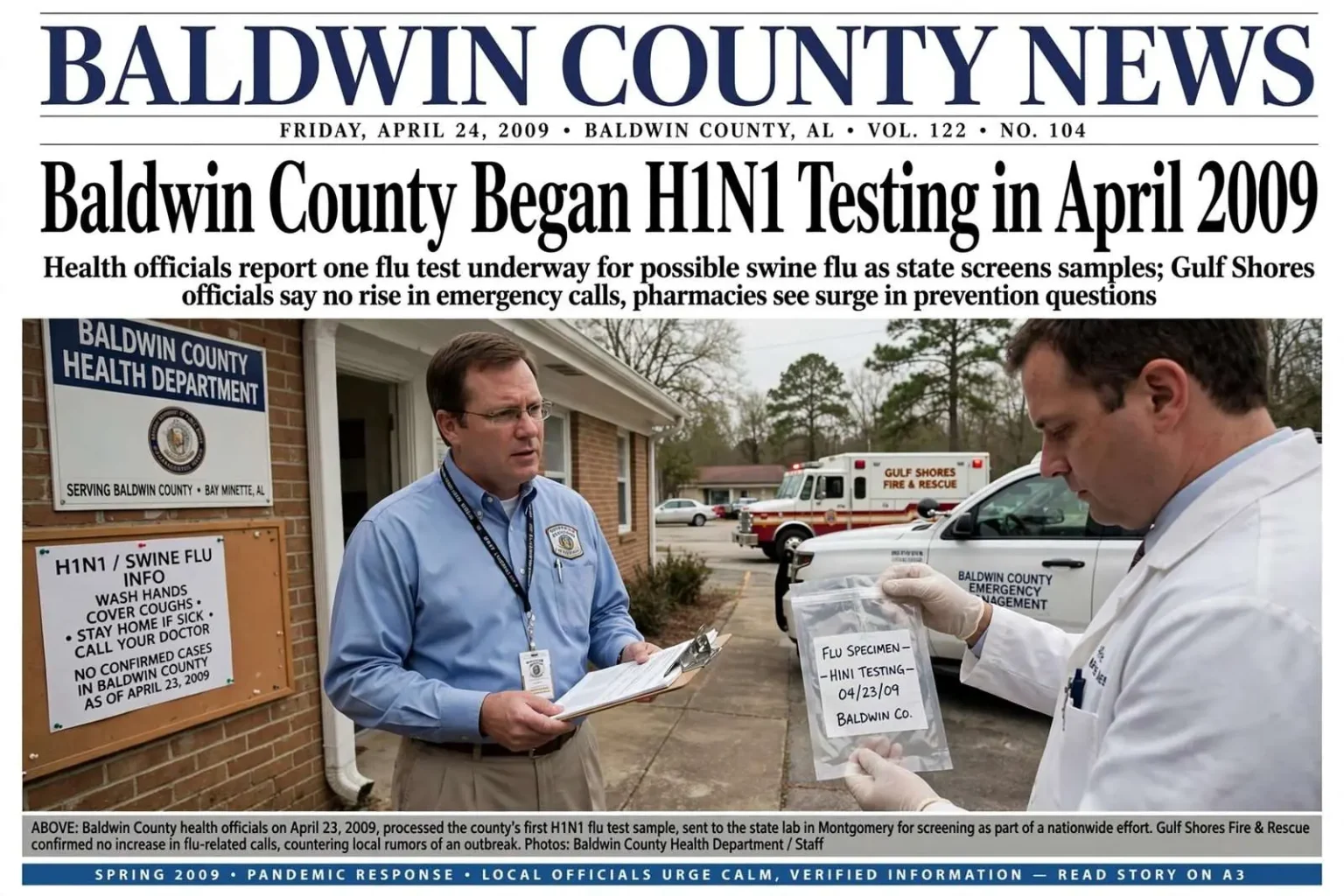
Baldwin County health officials said in April 2009 that at least one flu test was underway for possible H1N1, then commonly called swine flu. The report came as the state examined several flu samples, part of a nationwide screening effort during the first weeks of what would become a global pandemic.
The spring of 2009 marked the opening chapter of the H1N1 influenza pandemic. A novel strain of the virus, combining genetic material not previously seen in seasonal flu, had emerged in North America that April, and public health agencies at every level scrambled to identify cases, track the spread, and calm a public reading alarming headlines from around the world.
In Baldwin County, the response followed the pattern playing out in communities across Alabama and the nation: cautious testing, active rumor control, and steady messaging from local officials urging residents to stay informed rather than frightened.
Rumors Met With Reassurance
Gulf Shores Fire Department officials said rumors of a local epidemic were false and that they had not seen an increase in flu-related calls. Fire departments in Baldwin County’s beach communities serve as first responders for medical calls as well as fires, which places them on the front line of any outbreak and makes them an early indicator of whether illness is actually spreading.
Their report that call volumes had not risen was an important data point for a public hearing escalating national news. Emergency response agencies see the practical reality of local health conditions before anyone else, and Gulf Shores officials’ direct rebuttal of epidemic rumors reflected the kind of local verification residents could trust over distant speculation.
Pharmacies reported heavy public interest and questions about flu prevention. Counter staff and pharmacists were fielding questions about symptoms, hand sanitizers, and masks as coverage of the new virus dominated television and newspapers, and the pharmacy counter became, for many families, the first stop for health information.
Local officials urged residents not to panic and to contact health-care professionals with questions. That message, repeated in communities across the country that spring, aimed to route concerns to medical providers rather than to rumor, and to discourage the kind of panic buying and absenteeism that could do economic damage even in places where the virus had not appeared.
How the Public Health System Responded
The testing underway in Baldwin County was part of a layered system. Suspicious flu samples collected by local providers and county health departments were forwarded to the state laboratory, which screened for unusual strains and passed likely positives to federal labs for confirmation. That pipeline meant that a county’s “test underway” could take days to resolve, and health officials asked residents for patience while results moved up the chain.
During the same period, the federal government declared a public health emergency and the World Health Organization raised its pandemic alert levels as the virus spread beyond North America. Schools in affected areas closed, travel advisories were issued, and state health departments activated emergency communication plans. Alabama’s public health system, organized around county health departments serving as the local face of the state agency, leaned on those structures to distribute guidance.
For Baldwin County, a fast-growing county whose population doubles in spots during tourist season, the outbreak’s timing raised particular considerations. The county’s beach communities draw tens of thousands of visitors from across the Southeast, and health officials in resort areas have long understood that communicable disease does not respect municipal lines. The April 2009 testing came at the front end of the season, before the summer crowds arrived.
The National Picture Behind the Local News
The virus that prompted the local testing was a strain of influenza A, subtype H1N1, that had not circulated among humans before. First identified in the United States in April 2009, it spread with unusual speed for a spring outbreak, out of step with the normal winter flu season. Within weeks, cases were confirmed in multiple states, and the count grew daily as laboratories worked through backlogs of samples.
Because the strain was new, almost no one had immunity, which meant public health officials planned for the possibility of widespread illness even as they emphasized that most cases so far were mild. The uncertainty itself was part of the challenge: officials had to prepare for a worst case while reassuring residents that everyday precautions, hand washing, staying home when sick, covering coughs, remained the practical response.
The panic officials urged against was real enough to observe. Across the country that spring, some schools dismissed students as a precaution, pork producers saw markets tumble over the “swine flu” name, and pharmacies sold out of masks and sanitizers in some communities. The pushback from local leaders, including the plain statements from Baldwin County and Gulf Shores officials that no epidemic existed locally, was part of a deliberate strategy to separate verified fact from rumor.
What Happened After April
History records how the story unfolded. The H1N1 virus continued spreading through the summer of 2009, when ordinary flu usually fades, and returned in force that fall. A vaccine was developed and distributed beginning in the autumn, initially in short supply and prioritized for health care workers, children, pregnant women, and others at elevated risk. By the time the pandemic was declared over in August 2010, it had sickened millions in the United States alone, though the final toll proved milder than early fears suggested.
For the Gulf Coast, the fall wave of H1N1 arrived in the middle of an extraordinary year that also included the BP oil spill and its aftermath, testing the region’s public institutions in quick succession. Health departments that had rehearsed emergency communication during the April scare found the experience useful when the larger challenges of the autumn arrived.
Baldwin County’s April 2009 experience also fit into a longer regional story. The county’s public health infrastructure, county health department offices serving communities from Bay Minette to Foley, Fairhope, and Gulf Shores, had been built over decades to handle exactly this kind of episode: a fast-moving national health story with local implications, uncertain local cases, and a public hungry for information.
A Historical Record, Not Current Guidance
This is a historical account of a local public-health response in April 2009. It is not current medical guidance, case data, or advice about influenza treatment or prevention. Readers seeking current information about influenza should consult their health-care provider or the Alabama Department of Public Health.
Preserved as history, though, the episode documents how a Gulf Coast community handled the first days of a pandemic scare: local testing coordinated through the state, first responders directly rebutting false epidemic rumors, pharmacies fielding a flood of prevention questions, and officials holding the line against panic. The communities of Baldwin County share interconnected histories and institutions, and their April 2009 response showed that public health communication at the local level, fire departments, pharmacists, county health officers, plays a decisive role in how such moments are experienced.
The lessons of that spring, clear communication, verified information, and calm repetition of basic precautions, informed how local public health agencies across Alabama approached the emergencies that followed, and the archival record of coverage like this preserves what residents actually heard and said while the story was still uncertain.
Fire departments’ role in health surveillance deserves a closer look. In Baldwin County’s beach communities, fire-based emergency medical services handle the majority of ambulance responses, logging every call by type and location. When a respiratory illness spreads, those logs shift within days, and fire chiefs are often the first officials who can say with authority whether a wave of illness has actually reached a community. That is why Gulf Shores officials’ statement carried weight: they were not speculating, they were reading their own call data.
The fire department’s presence also made it a natural channel for public reassurance. Residents know their local firefighters, see the stations, and trust the people inside them, and when a fire department says it has seen no increase in flu-related calls, that statement reaches an audience that official health bulletins sometimes miss.
Pharmacies, meanwhile, function as an informal public health network. In April 2009, as now, pharmacists in Baldwin County answered questions from patients worried about symptoms, interactions, and preventive measures, often more frequently than those patients saw a physician. The heavy public interest reported by local pharmacies tracked what was happening nationally, where demand for hand sanitizer, thermometers, and over-the-counter flu remedies spiked within days of the first headlines.
The county’s health officials had institutional experience to draw on. Baldwin County health departments have coordinated vaccination campaigns, responded to hurricane evacuations that fill the county with displaced residents, and managed disease investigations in fast-growing communities where new subdivisions outpace established services. Each episode has contributed to a playbook that officials applied to the swine flu scare.
Regional geography shaped the response as well. Baldwin County sits between Mobile Bay and the Florida line, its economy tied to tourism along the Gulf beaches and agriculture in its northern sections. Health threats anywhere along that corridor ripple quickly into the county’s livelihoods, since rumors of illness in a resort town can empty beaches as effectively as weather. Local officials’ urgency about countering false epidemic rumors was therefore economic as well as medical.
The 2009 episode also arrived as county demographics were shifting. Baldwin County was already one of the fastest-growing counties in Alabama, drawing retirees and families from across the region, and its health infrastructure was growing with it. New residents meant new patients for local providers and new audiences for public health messaging, a dynamic that made the county’s communication effort in April 2009 larger than its case count.
Viewed across the years since, the local reporting from April 2009 preserved a portrait of a community between panic and pandemic: tests pending, rumors denied, questions answered at pharmacy counters, and officials asking for calm. It is a snapshot of the ordinary machinery of public health at work, and of the institutions, from the fire station to the county health office, that residents rely on when a global health story lands on local shores.