Fires Destroy Four Dauphin Island Homes and Popular BBQ Restaurant, One Dead
Overnight fires on Dauphin Island destroyed four homes and a beloved barbecue restaurant in August 2015, leaving one man dead and neighbors stunned.
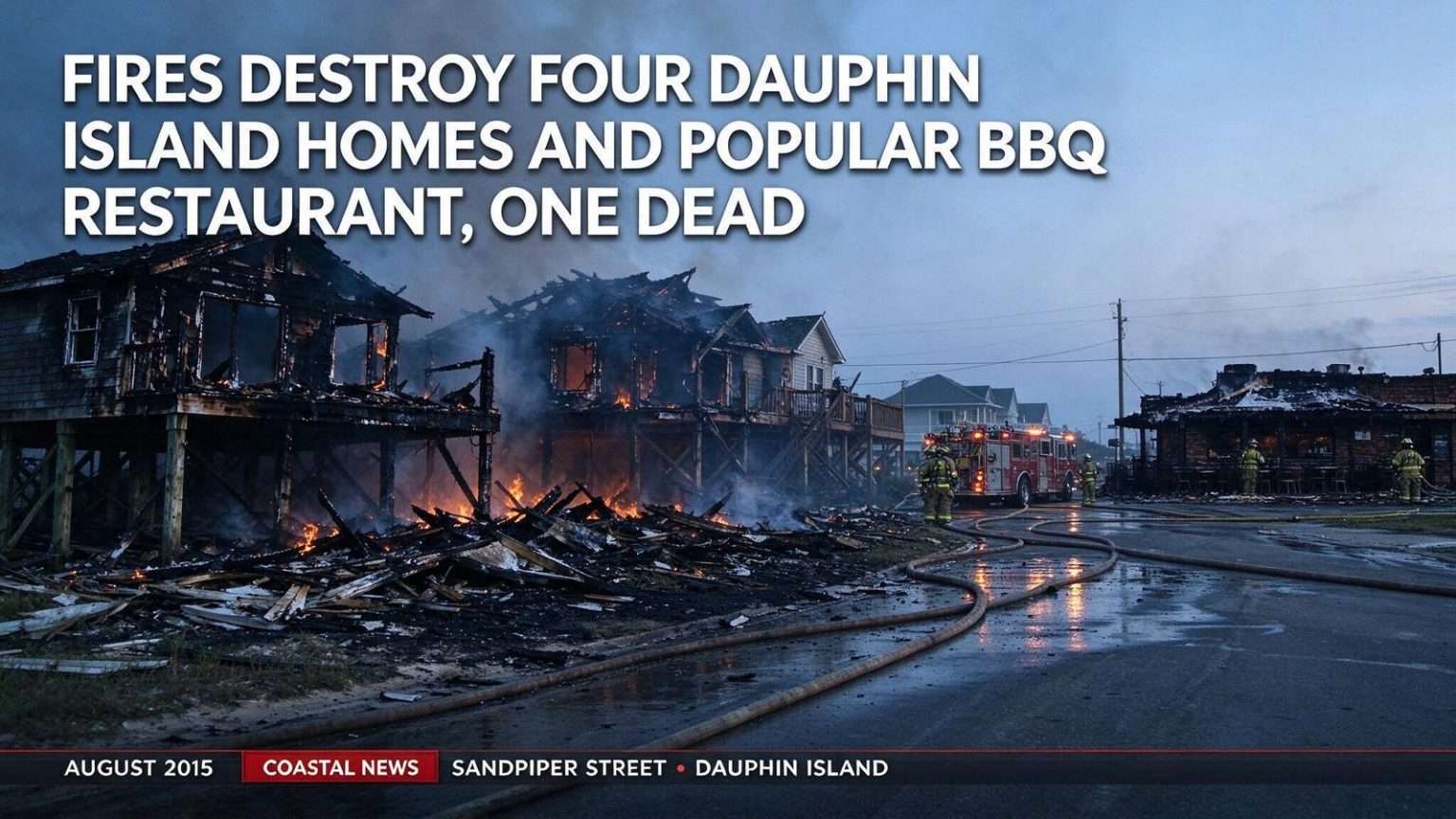
A quiet stretch of Dauphin Island turned chaotic in the pre-dawn hours of an August Saturday in 2015, when fire tore through a residential street and, separately, a longtime barbecue restaurant a few miles away. By the time crews had the flames under control, four homes on Sandpiper Street lay in ruins, the restaurant was gone, and one man was dead. For a barrier island community of a few thousand year-round residents, the night amounted to one of the most destructive stretches of fire in memory, and the questions it left behind outlasted the smoke.
A death on Sandpiper Street
Island officials said the man, whose name was not immediately released, was found across the street from one of the burning houses. Neighbors believed he may have suffered a heart attack while trying to pull belongings from the home before the fire overwhelmed it. The details available in the hours after the fires were sparse, and officials declined to speculate on the exact sequence of events as the investigation began. What was clear was that the man had been drawn toward the danger by the same instinct that moves so many residents of small communities — the urge to save what can be saved before it is lost.
Residents who watched the fire spread described a terrifying, fast-moving scene. One neighbor who lives across a narrow inlet from the burned homes said the heat was intense enough to scorch structures on the opposite side of the street, even though the houses there never caught fire themselves. He credited calm, windless conditions that night with keeping the blaze from spreading even further into the tightly packed beach community. The account captures how narrow the margin was: on the Gulf Coast, where summer breezes and sea breezes are constants, a still night was the only thing standing between four destroyed homes and a dozen more.
How fast island fires move
Firefighting on a barrier island carries complications that mainland departments rarely face. Homes on Dauphin Island sit close together on narrow lots, many of them elevated on pilings that expose them to wind and radiant heat from every side, and the island’s supply of fire hydrants and water pressure is limited by the same geography that gives it its character. Once a beach-house fire gains a head start, the tight spacing of the Sandpiper Street neighborhood gives it a path from roof to roof that crews can do little to interrupt.
The barbecue restaurant, gone in one night
Roughly three miles away, a well-known local barbecue spot burned to the ground at almost the same time. The restaurant had been a fixture for island residents and visitors alike, and its sudden loss compounded the shock of the night for many longtime islanders. Establishments like it occupy a place in small coastal towns that goes beyond food: they are where fishing crews eat breakfast, where summer visitors end their beach days, and where the community gathers after storms and graduations alike. Losing one overnight leaves a gap that residents feel at every meal.
The near-simultaneous timing of the house fires and the restaurant blaze left some residents suspicious that the incidents might be connected, though authorities cautioned it was too early in the investigation to draw that conclusion. Losing four homes and a decades-old restaurant landmark on the same night struck many as an unlikely coincidence, even as officials worked to determine a cause. Investigators treat simultaneous fires as a standard question to answer, running through the ordinary explanations — storm activity, electrical faults, a common ignition source such as a passing storm front — before considering anything more deliberate. The island has weathered its share of summer lightning storms, and electrical systems in older coastal buildings are a recurring source of accidental fires across the Gulf Coast.
A volunteer department stretched thin
Dauphin Island relies on a volunteer fire department to protect its roughly 14-square-mile footprint, and crews from several other area agencies responded to assist once the scope of the emergency became clear. The island’s department, like those in small communities across coastal Alabama, operates with volunteer firefighters who leave their homes and jobs when the tones sound, supported by mutual aid agreements with departments on the mainland. The scale of the response reflected how quickly the fires had grown before firefighters could get ahead of them. Pre-dawn calls test volunteer departments hardest, when most members must first drive to the station before a single engine rolls.
Mutual aid across Mobile Bay and the bridges that connect the island to the mainland adds response time that islanders understand comes with the territory. Departments from surrounding communities routinely answer those calls in both directions, and the arrangement is one of the quiet bargains of small-town coastal life: help will come, but it comes from neighbors who are also volunteers.
Life on a barrier island
Dauphin Island occupies a unique place on the Alabama Gulf Coast, a three-mile-long barrier island at the mouth of Mobile Bay that guards the bay’s main ship channel and hosts the historic Fort Gaines. The island’s roughly 14 square miles include protected Audubon bird sanctuaries, an east-end beach that ranks among the top in the nation, and a town government that governs one of the smallest incorporated communities in Mobile County. Year-round residents number in the low thousands, a population that swells with tourists each summer and empties during hurricane evacuations, when the island’s single bridge becomes the only road out.
That geography shapes every emergency the island faces. The volunteer fire department, the small police force, and the town’s limited budget all operate with the understanding that outside help begins with a drive across the Gordon Persons Bridge from the mainland. Residents accept the trade-offs — limited services in exchange for a life on the water — but nights like this one test the arrangement in ways that no planning meeting fully anticipates.
Anatomy of a pre-dawn fire investigation
Fires that begin in the pre-dawn hours present investigators with particular challenges, since darkness, overnight humidity, and the speed at which coastal fires spread all obscure the point of origin. Fire investigators typically begin by interviewing the first crews on scene about where the flames were heaviest, then work backward through the debris to find the origin point and examine it for signs of accidental or intentional ignition. The work proceeds methodically, and officials generally avoid public conclusions until laboratory analysis confirms what the scene suggests.
The investigation into the Sandpiper Street fires and the restaurant blaze would run on parallel tracks, with state fire investigators assisting local officials as is standard for fires involving fatalities or multiple structures. Findings in such cases can take weeks to become public, and in the meantime the questions residents ask — whether the fires were connected, whether lightning played a role, whether the losses could have been prevented — remain open.
A community holding its breath
In the aftermath, the loss reverberated through the close-knit island community, where longtime residents said they hoped answers would come quickly, both for the family grieving an unexpected death and for neighbors trying to understand how one night could claim so much of their small coastal town. Island communities absorb loss differently than cities do; there are no neighborhoods far enough away to feel detached from four burned homes and a demolished landmark, and everyone on the island knows someone who woke to the sirens that Saturday morning.
Neighbors step in where institutions cannot
The days after the fires brought the response that small towns specialize in: families who lost their homes were taken in by neighbors, donation drives appeared almost immediately, and the restaurant’s regulars began trading stories of the meals and milestones the building had hosted. On an island where the same families have summered for generations, the practical needs after a fire — a place to sleep, clothing, a loan of a truck — are met long before any formal assistance arrives. Community bulletin boards and church networks function as the island’s real emergency management system once the flames are out.
The four families displaced from Sandpiper Street faced the added complication of rebuilding on a barrier island, where construction costs run higher than on the mainland and insurance claims for coastal properties move through a tangle of wind, water, and flood policies. Contractors on the island stay busy in ordinary years, and a sudden demand for major rebuilding means months of waiting for materials and crews that have to be brought across the bridge.
Fire safety lessons for coastal communities
Fires like these renew the safety messages that fire officials in coastal Alabama repeat every season. Elevated beach houses with open ground floors, wooden construction, and stacked stored belongings beneath the living space present fast-burning fuel arrangements that can turn a small fire into a total loss before anyone notices. Officials urge residents to keep working smoke detectors in every level of elevated homes, to store flammables away from pilings and under-floor areas, and to resist the instinct to enter or re-enter a burning structure — the same instinct that neighbors believed claimed the man on Sandpiper Street.
Departments across Baldwin and Mobile counties use incidents like this one to remind visitors, too, that vacation rentals and beach houses are unfamiliar environments, and that families arriving for a week on the water should take a moment to note exits and locate fire extinguishers as routinely as they check the weather. The pre-dawn hours remain the deadliest time for residential fires everywhere, and island homes are no exception despite the salt air and open geography.
Waiting for answers
As the investigation continued, the island’s routine resumed around its gaps — traffic still rolled onto the ferry dock, anglers still filled the public beach accesses, and the lots where homes and a restaurant once stood sat fenced and quiet. Residents said the speed of the official findings mattered less than the certainty that they would come; in a community this size, unanswered questions do not fade, they circulate. What neighbors wanted most, they said, was to know whether the night’s destruction was a terrible coincidence or something the town needed to guard against — and to see the island, as it always had, put itself back together afterward.