
Jury Convicts Daphne Man in Deadly Easter Shooting at Audubon Park Apartments
A Baldwin County jury has convicted Joseph Gurley of murder and attempted murder in the 2024 Easter shooting at Audubon Park Apartments in Daphne. Sentencing is set for Oct. 13.
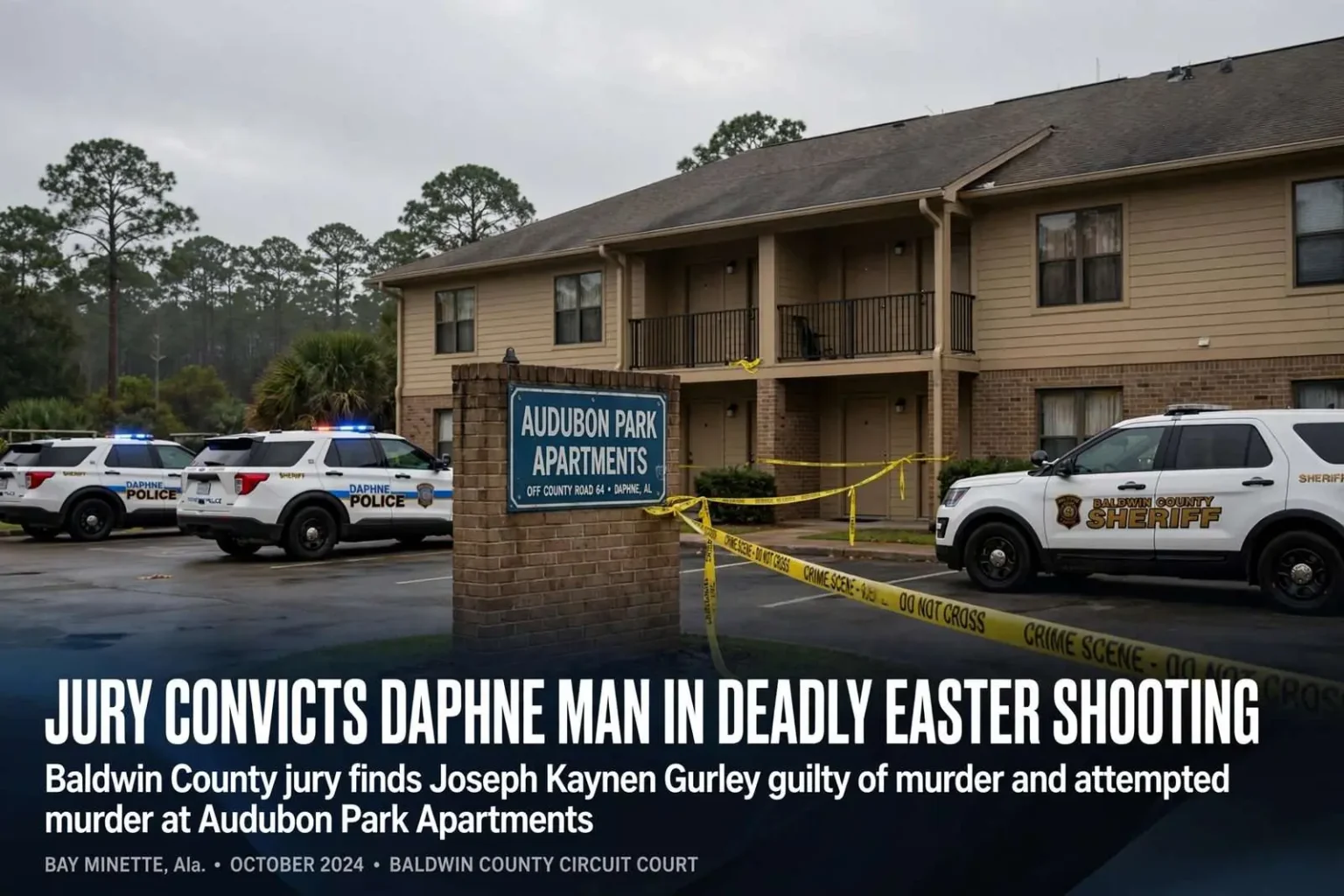
BAY MINETTE, Ala. — A Baldwin County jury has convicted a Daphne-area man of murder and attempted murder in connection with an Easter morning shooting at an apartment complex that left one man dead and another wounded.
Jurors found 25-year-old Joseph Kaynen Gurley guilty on both counts following a four-day trial in Baldwin County Circuit Court in Bay Minette, according to the Baldwin County District Attorney’s Office. Prosecutors said Gurley shot and killed J. Matthews “Matt” Bonnell Jr., of Lillian, and then immediately turned the gun on a second man, Michael Rohe, attempting to kill him as well.
The verdict closed the trial chapter of a case that began with gunfire in the pre-dawn hours of a holiday morning and ended with a manhunt, a capture in another county, and four days of testimony before a Baldwin County jury. For the families of both victims, the outcome delivered the accountability that prosecutors had promised from the outset — and it came after a trial that laid out, hour by hour, what happened at the apartment complex on Easter Sunday.
What Happened at Audubon Park Apartments
The shooting happened just before 2:45 a.m. on March 31, 2024 — Easter Sunday — at the Audubon Park Apartments off County Road 64 in Daphne. Daphne Police Department officers and Baldwin County Sheriff’s Office deputies responded after shots were fired and found Bonnell dead at the scene. The second man was rushed to University Hospital for treatment.
The response brought together the two primary law enforcement agencies of Alabama’s fastest-growing county. Daphne police, whose officers patrol the Eastern Shore city of more than 25,000 residents, took the lead at the scene, while sheriff’s deputies supported the response across the county’s unincorporated edges. The wounded man’s transport to University Hospital — the region’s major trauma center in Mobile — reflected the severity of his injuries and the reality that Baldwin County’s own hospitals could not provide the level of care a gunshot victim of that kind required.
Investigators say Gurley fled after the shooting and remained at large for more than 48 hours before he was tracked down hiding in the woods of Washington County. He was arrested there on April 2, 2024, by the U.S. Marshals Service.
The two-day manhunt stretched from the Eastern Shore into the pine woods of Washington County, a rural stretch of southwest Alabama north of Mobile. Fugitive cases that cross county lines typically draw in the U.S. Marshals Service, whose Gulf Coast fugitive task forces specialize in tracking suspects who move between jurisdictions. That Gurley was found more than 48 hours later, concealed in woodland well away from Daphne, reflected both the reach of the search and the difficulty of locating a suspect determined to stay hidden.
His capture set the case on its path through the Baldwin County court system, where the defendant would await trial while prosecutors assembled the evidence gathered from the scene, the witnesses and the agencies that worked the investigation.
Trial and Verdict
Assistant District Attorney Patrick Doggett prosecuted the case for the state, with assistance from Jodee Crites, a certified victim service officer and trial coordinator with the DA’s office.
The Daphne Police Department led the investigation under the direction of Lt. Jason Lazzari, with additional support from the Baldwin County Sheriff’s Office and the U.S. Marshals Service in both the investigation and Gurley’s eventual capture.
After hearing the evidence, the jury returned guilty verdicts on both the murder charge and the attempted murder charge.
“Prisons are made for people like Kaynen Gurley,” Doggett said after the verdict.
The statement captured the prosecutor’s view of a defendant whose actions, in the state’s telling, cost one man his life and nearly cost a second his. Jury verdicts in murder cases require unanimity, and the fact that jurors agreed on both counts — the completed killing and the attempt on the surviving victim — signaled that the evidence presented over four days left little room for doubt about what happened at the apartment complex or about who fired the shots.
For the Baldwin County District Attorney’s Office, the trial represented the kind of case its prosecutors handle at the courthouse in Bay Minette, the county seat, where the circuit’s felony dockets include homicides arising from across a county that has grown rapidly along the Eastern Shore and the Gulf-facing south. Victim service officers like Crites play a behind-the-scenes role in such trials, guiding surviving victims and victims’ families through the process from indictment to sentencing.
Sentencing Set for October
Gurley is scheduled to be sentenced on Oct. 13 at 11 a.m. before Judge Ashley Siebert. Because of his prior criminal history, he faces a mandatory sentence of life in prison or life in prison without the possibility of parole on both counts.
The mandatory terms stem from Alabama’s Habitual Felony Offender Act, which dramatically increases punishments for defendants with prior felony records. Under the statute, a defendant with a qualifying history who is convicted of a Class A felony like murder faces a life sentence without the possibility of parole, removing the discretion that judges would otherwise exercise at sentencing. The hearing in October will therefore be a formal proceeding rather than an open-ended decision — the judge will impose the terms the law requires, and the verdicts on both counts will run consecutively or concurrently according to the court’s order.
For the families, the sentencing date will mark the end of the criminal process, though for many victims’ relatives the moment carries mixed weight: final in a legal sense, but only one milestone in a grief that began on an Easter morning more than a year before.
The case began and ended in a slice of Baldwin County few residents ever see — the apartment complexes along County Road 64, where early-morning gunfire shattered a holiday weekend — but its resolution was a countywide effort. Daphne police investigators assembled the case in the days after the shooting, sheriff’s deputies supported the response, federal marshals ran down the fugitive, and prosecutors carried the evidence through a four-day trial in the Bay Minette courthouse to a unanimous verdict.
Gurley’s conviction also stands as a reminder of how quickly a dispute can escalate into irreversible violence, and of the trail such violence leaves: two victims, a community shaken, and a young defendant whose own life is now effectively over before it began. The October sentencing will close the file, but the losses on both sides of the courtroom are permanent.
Audubon Park Apartments sits along County Road 64, one of the corridors that threads through Daphne’s residential interior between the U.S. 98 commercial strip and the older neighborhoods near the bay. The complex, like much of Daphne’s rental housing, grew up with the city’s population boom, as families drawn to Baldwin County’s schools and lower cost of living turned the Eastern Shore into one of the fastest-growing corners of the state. Serious violent crime remains comparatively rare in the city, which is part of why the Easter morning shooting registered so strongly in the community.
University Hospital, where the surviving victim was taken, serves as the major trauma center for the central Gulf Coast, handling the region’s most serious gunshot wounds, vehicle crash injuries and other emergencies from both sides of Mobile Bay. For Baldwin County patients, reaching the hospital means crossing Mobile Bay by the Jubilee Parkway or being transported by helicopter, and the routing decisions made in the first minutes after a shooting can determine whether a critically wounded person survives.
The marshals’ role in Gurley’s capture is a common pattern in Alabama fugitive cases. Local agencies issue warrants, but when a suspect flees across county or state lines, the U.S. Marshals Service and its regional task forces bring specialized tracking resources and the authority to pursue suspects anywhere in the country. The 48 hours Gurley spent at large took him far enough from Daphne that finding him required exactly that kind of coordinated search, ending with his arrest in the woods of Washington County, two counties away from the scene of the shooting.
From there, the case moved on the timetable typical of Baldwin County felony prosecutions: an initial appearance and bond proceedings in district court, an indictment from a Baldwin County grand jury, pretrial motions in circuit court, and finally the trial itself, which stretched across four days of witness testimony and evidence before the jury began deliberations. When the verdicts came back guilty on both counts, the work of more than a year — for investigators, prosecutors and the families watching — reached the outcome the state had sought since the morning Bonnell was found dead at the scene. The guilty verdicts carried the added weight of unanimity, sparing the families the uncertainty of a hung jury or a partial result that would have forced a second trial.


