Exterior of a federal courthouse with columnsThe case is being heard in federal court in Mobile.

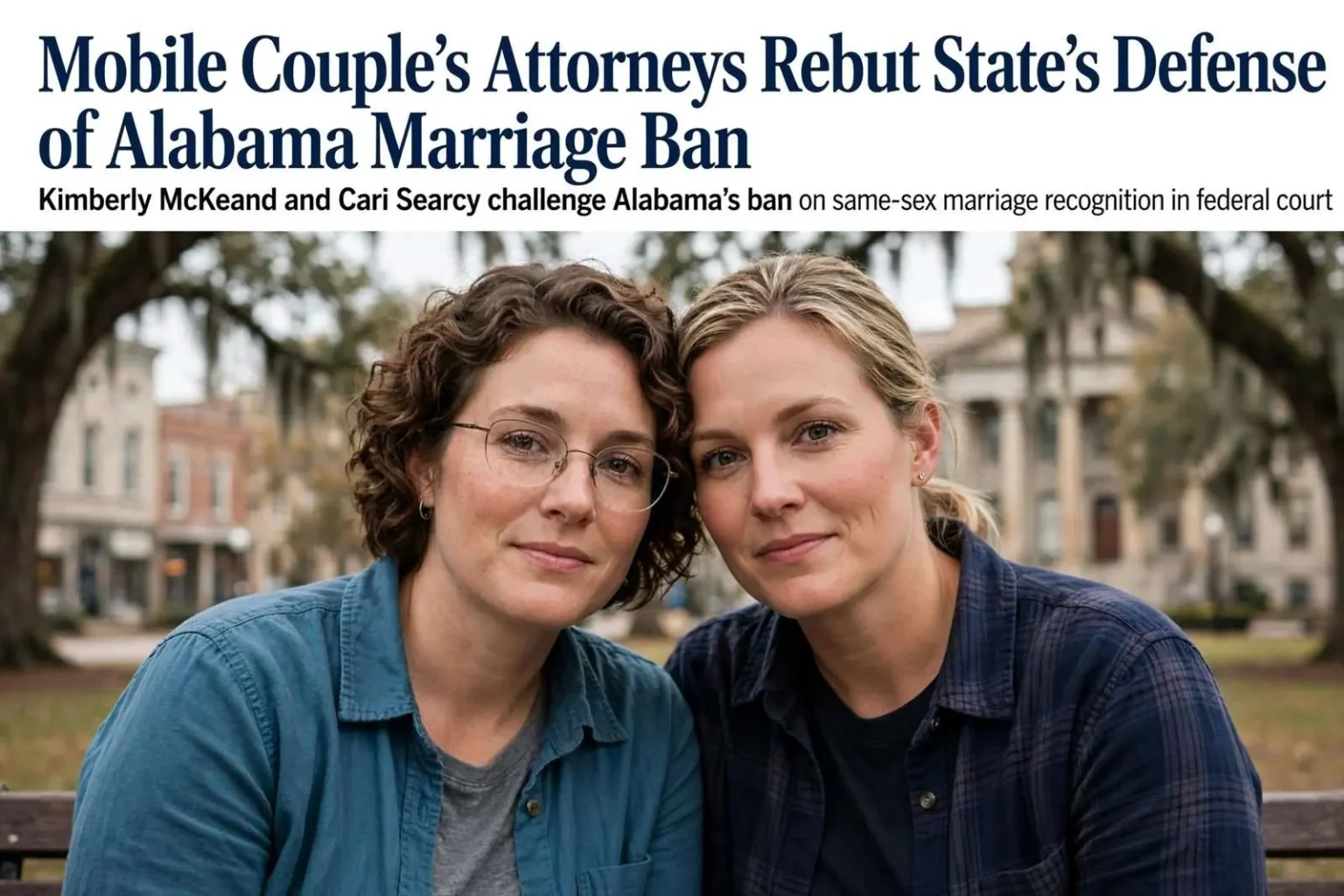
Attorneys for a Mobile couple challenging Alabama’s ban on recognizing same-sex marriages filed a sharp rebuttal this month to the state Attorney General’s Office, arguing that its defense of the law rests on faulty legal reasoning and unsupported predictions rather than evidence.

The case centers on Kimberly McKeand and Cari Searcy, who married in California and have raised a son together since his birth. Alabama officials denied Searcy’s request to complete a second-parent adoption of the boy, citing the state’s constitutional ban on same-sex marriage. The case is one of three lawsuits moving through federal court seeking to overturn that ban, with U.S. District Judge Ginny Granade expected to rule after a mid-November deadline for final motions.

In their filing, attorneys David Kennedy and Christine Hernandez pushed back point by point against arguments from Attorney General Luther Strange’s office. They argued that a 1972 U.S. Supreme Court case cited by the state, which let stand a Minnesota ruling against a same-sex couple, has been effectively abandoned by later rulings, including a 2013 decision striking down part of the federal Defense of Marriage Act.

The attorneys also rejected the state’s reliance on a Louisiana federal court ruling upholding that state’s marriage ban, calling it an outlier among the courts that have examined similar bans. They further dismissed warnings that recognizing same-sex marriages could destabilize the institution over time, writing that the state’s argument amounted to unsupported speculation rather than legal analysis.

On the question of parenting, the filing cited research indicating children raised by gay parents fare no worse than those raised by heterosexual parents, arguing the state offered no evidence to the contrary. The attorneys noted that Alabama has never questioned McKeand’s fitness as a parent, and argued the couple’s son would be left without a legal second parent, and without inheritance or custody protections, if the state’s position prevails. They noted the child’s biological father had already signed away his parental rights, meaning a ruling against the couple could leave the boy with no legal father and no adoptive second parent should Searcy pass away.

The filing also argued that Alabama’s ban amounts to unconstitutional discrimination under the 14th Amendment’s Equal Protection Clause, drawing a comparison to the reasoning used in the 2013 Defense of Marriage Act ruling.

The case is one of several across the country that gained momentum following that 2013 decision, as same-sex couples challenged state-level marriage bans in federal court. A ruling from Judge Granade was expected sometime after the November motions deadline, with both sides anticipating the outcome would be appealed regardless of which way it went.

See also  Interview: Caleb Caudle on Country, Americana and Callaghan's Irish Social Club

For McKeand and Searcy, the Mobile-based case carried personal stakes beyond the broader legal questions, centering on their son’s legal relationship to both of his parents under Alabama law.

Alabama is a state in the southeastern United States bordered by Tennessee, Georgia, Florida, the Gulf of Mexico, and Mississippi. Often called the Heart of Dixie, it spans Appalachian foothills in the north and flat coastal plains in the south. Its largest cities include Birmingham, Montgomery, Huntsville, and Mobile.

Alabama’s history encompasses Indigenous roots, Spanish and French colonial settlement, a cotton-plantation economy, the Civil War and Reconstruction, and the Civil Rights Movement of the 1950s and 1960s, followed by a shift toward manufacturing, aerospace, and technology. Local news across the state frequently reflects this mix of tradition and change.

Mobile is the county seat of Mobile County in southwest Alabama and the state’s only saltwater port. Situated where the Mobile River meets Mobile Bay near the northern Gulf of Mexico, the city has long served as a commercial and cultural gateway between Alabama and the wider Gulf Coast. Founded in 1702 as Fort Louis de la Louisiane and ruled in turn by France, Britain, and Spain before joining the United States in 1813, Mobile carries a layered heritage distinct from the rest of the state.

Today Mobile anchors a metropolitan area spanning Mobile County and neighboring Baldwin County, and it remains a center for shipping, aerospace, healthcare, and higher education in the region. Its downtown and waterfront have seen sustained revitalization, while historic neighborhoods preserve architecture from its colonial and antebellum past. The city’s identity is shaped as much by its working port and industrial base as by its festivals and food culture, making it a frequent focal point for news about growth and change in southern Alabama.

Probate courts in Alabama handle matters distinct from the trial courts that hear criminal and civil cases, including wills, estates, guardianships, and involuntary commitments for mental-health treatment. In Mobile County the probate judge is an elected official with broad administrative and judicial duties.

Cases involving involuntary psychiatric commitment require the court to balance an individual’s liberty interests against concerns for their safety and the safety of others, a sensitive legal threshold that has drawn scrutiny in many jurisdictions. The procedures governing such hearings, including who must appear and testify, are set by state law and local rule.

See also  Accused Cop Killer Marco Perez Set for Preliminary Hearing Tuesday as Gag Order Issued

Disputes over those procedures often surface tensions between healthcare providers, the court, and advocates for patients. Because the stakes involve both liberty and wellbeing, courts and clinicians alike face pressure to honor the law while ensuring that people in crisis receive timely and appropriate care.

The economy of the Mobile region is diversified across shipping and logistics, aerospace and shipbuilding, healthcare, tourism, and manufacturing. The Port of Mobile is one of the nation’s busiest seaports and a cornerstone of the local and state economy.

Major employers in aviation and defense contribute to a skilled workforce, while economic-development organizations aim to attract investment and jobs through incentives and infrastructure improvements. Small businesses, from restaurants to professional services, form the backbone of neighborhood commerce.

The health of the regional economy is a frequent subject of public discussion and reporting. Workforce development, recruitment of industry, and the fortunes of local retailers all feed into a broader picture of how the Gulf Coast competes and adapts in a changing national economy.

Baldwin County sits directly east of Mobile County across Mobile Bay and is the largest county in Alabama by land area. It encompasses the Eastern Shore communities of Daphne, Fairhope, Spanish Fort, and Foley and stretches south to the beaches of Gulf Shores and Orange Beach along the Gulf of Mexico.

Long among the fastest-growing counties in the state, Baldwin blends suburban development near the bay with tourism-driven coastal economies. Its proximity to Mobile and its position on the Eastern Shore make it a recurring subject of regional news covering growth, infrastructure, schools, and the balance between development and coastal preservation.

Mobile Bay is a shallow estuary in southern Alabama where freshwater from the Mobile, Tensaw, and other rivers mixes with saltwater from the Gulf of Mexico. It is among the largest estuarine systems in the United States and supports commercial and recreational fishing, shipping through the Port of Mobile, and wetlands that buffer the coastline from storms.

The bay’s Eastern Shore, in Baldwin County, includes Daphne, Fairhope, and Spanish Fort, while the Western Shore lies in Mobile County. Its ecology and economy have guided settlement for centuries, and the bay figures in regional debates over development, navigation, and conservation. Events on either shore are routinely covered as part of the interconnected life of the Mobile metro area.

See also  Vivian's Door Brings Black Farmers Together for Second Town Hall on Rising Costs and Resources

The Gulf of Mexico borders Alabama’s southern edge and defines much of the state’s coastal identity. Alabama’s Gulf coastline, centered on Dauphin Island, Gulf Shores, and Orange Beach, supports a tourism industry built around beaches, charter fishing, and marine recreation, while offshore waters host shipping lanes and energy interests.

The Gulf’s warm, shallow shelf and exposure to hurricanes make weather and disaster preparedness recurring concerns for communities from Mobile to Baldwin County. The marine environment also underpins commercial seafood harvests that have sustained Gulf Coast families for generations, tying the region’s economy and culture closely to the water.

The Federal Bureau of Investigation is the principal investigative arm of the United States Department of Justice, tasked with protecting the country against terrorist threats, foreign intelligence operations, cyber attacks, and major criminal activity. Established in 1908, the bureau operates a network of field offices across the country, each responsible for federal law-enforcement matters within its region.

Field offices such as the one serving Mobile work closely with state and local agencies, reflecting the bureau’s reliance on partnerships rather than unilateral action. The director, appointed by the president and confirmed by the Senate, sets national priorities that cascade down to individual offices handling everything from counterterrorism to public-corruption and civil-rights investigations.

Because federal agents are seldom the first to notice a threat in a community, much of the bureau’s effectiveness depends on tips and vigilance from local residents and police. That reality has made community outreach, including visits by senior leaders to field offices, a deliberate part of how the FBI maintains trust and communication with the public it serves.

Local law enforcement across South Alabama is carried out by municipal police departments, county sheriff’s offices, and state agencies that together cover a mix of urban, suburban, and rural territory. City departments handle policing within municipal limits, while sheriff’s offices provide courthouse security, jail operations, and patrol in unincorporated areas.