University of South Alabama Mobile
Pardon Closes a Painful Chapter for Mobile Ad Executive David Gwin
More than 25 years after his conviction in the Mobile Municipal Auditorium fraud case, David Gwin received an unexpected pardon, quietly pursued by two friends from the law enforcement community.
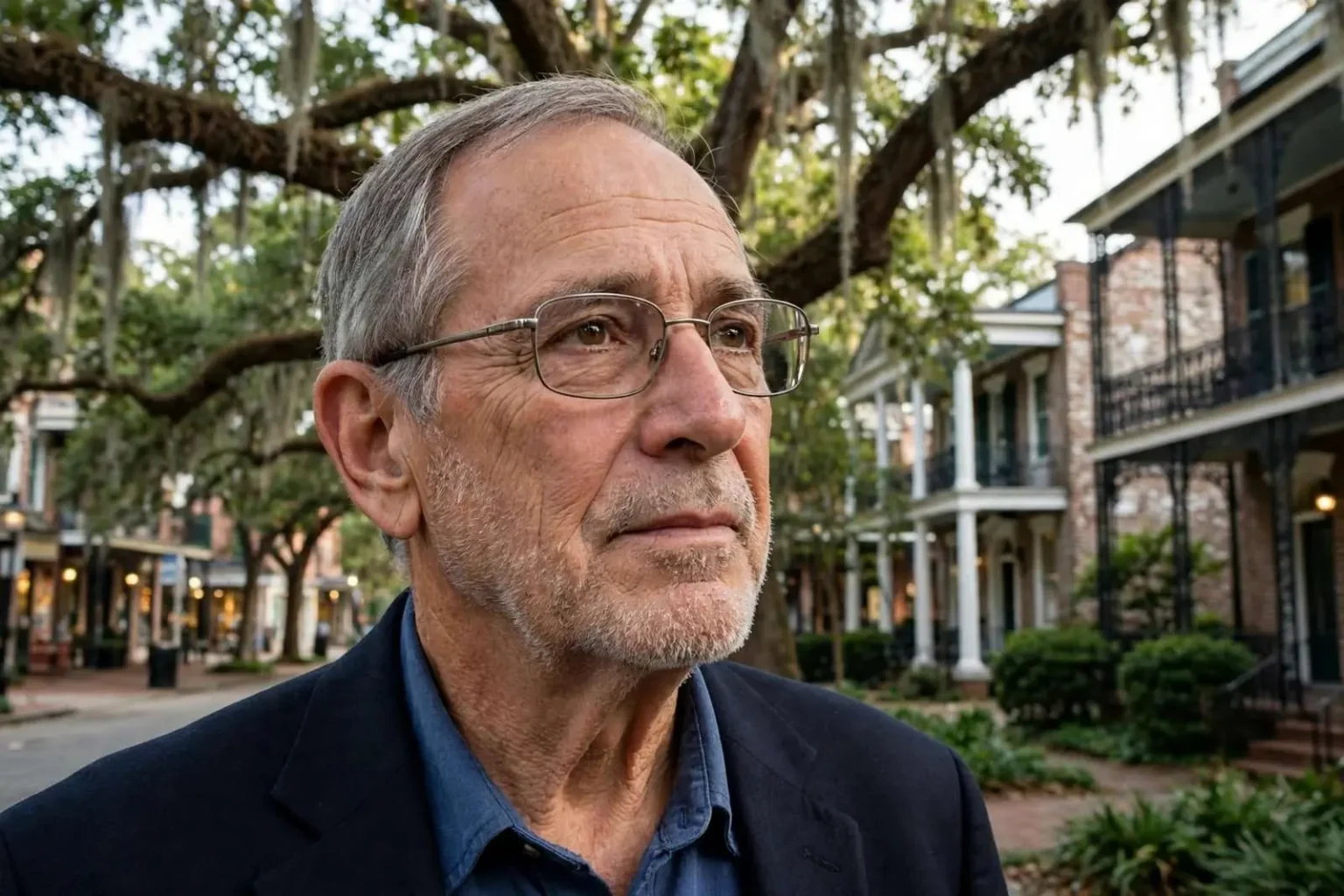
MOBILE – David Gwin received an early Christmas present when two friends with law enforcement credentials, unbeknownst to him, successfully sought and won a pardon for his convictions more than 25 years earlier in connection with the fraudulent operation of the Mobile Municipal Auditorium, where he had been an assistant manager.
The pardon closed one of the most notorious public-corruption chapters in Mobile’s history – a case that reached from the city’s concert halls to the City Commission – and it arrived not through any campaign of Gwin’s own making, but through the quiet persistence of two men who had watched him rebuild his life and decided the record should say so.
An unexpected gift
“I did not ask for it,” Gwin said. The effort was led by two close friends, former Mobile County District Attorney Chris Galanos and former high-ranking Mobile police official Ron Wilhelm, who navigated the process because they believed he deserved it.
“I was stunned when they told me,” Gwin recalled. The action restored his civil rights, including the right to possess a firearm and to vote. Gwin, 61, said he expected to vote more often than carry a gun.
The restoration of rights carried weight that went beyond the legal fine print. In Alabama, a felony conviction strips a citizen of the right to vote, to hold public office and to sit on a jury – the ordinary instruments of civic life. For a man who had spent a quarter of a century rebuilding a reputation in the city where the convictions were entered, the pardon formally returned all of it.
“The main thing really is that it’s almost like someone saying that chapter of your life has come to a conclusion. It’s past tense,” Gwin said.
The friends who made it happen were an unusual pair of advocates. Galanos had spent years as the county’s chief prosecutor, and Wilhelm had risen through the ranks of the Mobile Police Department. Between them, they knew the pardon process, the paperwork it demanded and the credibility a petition needed – and they quietly assembled the case without telling Gwin, who learned of the effort only after it had succeeded.
The auditorium case
In 1984, auditorium administrators George Juzang and Gwin pleaded guilty to two counts of a 34-count federal indictment alleging a conspiracy to skim proceeds from events held at the auditorium. Authorities estimated the stolen money may have run into the millions of dollars.
The Municipal Auditorium, the aging downtown arena that hosted concerts, circuses, sporting events and civic gatherings, handled a steady flow of cash from ticket sales and concessions – money that, prosecutors said, was being diverted before it ever reached city ledgers. The scale of the scheme, and the prominence of the venue, made the case a defining scandal of its era in Mobile city government.
The two men became the key prosecution witnesses at the trial of Mobile City Commissioner Gary A. Greenough. According to trial testimony, funds skimmed from concert profits by Juzang and Gwin were delivered to Greenough as campaign contributions.
Greenough was convicted in December 1984 by a federal jury on 14 counts involving conspiracy, fraud and extortion. He was sentenced to 25 years in prison and fined $25,000. Gwin and Juzang were paroled in early February 1986 after each served one year of a seven-year sentence, while Greenough was released in the fall of 1990 after serving nearly six years.
The case was prosecuted in an era when federal corruption investigations were reshaping Gulf Coast politics, and its outcome sent a message far beyond the auditorium’s box office. A city commissioner sentenced to a quarter-century in prison was a spectacle Mobile did not forget, and for the two men at the center of the scheme, the consequences followed them long after the prison gates opened – in job applications, in lending decisions and in the quiet arithmetic of a record that never went away.
The weight of a record
A federal conviction follows a person through every corner of ordinary life. Felons in Alabama and across the country face restrictions on employment, licensing, firearms and voting that persist long after sentences are served, and the stigma can outlast even those formal limits. Gwin’s pardon, won more than 25 years after his guilty plea, formally erased the civil consequences – but as he was the first to say, the deeper repair was personal.
“It was pure stupidity on our part,” Gwin said of the scheme. “I’ve lived with it a long time and I’ll live with it until I die. Still, I’ve been blessed in life. I have a wonderful business, a wonderful family, wonderful friends and a wonderful church.”
That candor marked the way Gwin spoke about his past: neither minimizing the crime nor allowing it to define the man he became. The pardon, he said, did not rewrite history – it marked a conclusion.
A life rebuilt
In the decades since, Gwin built a new chapter. He served as president of Visual Impact Communications, a full-service advertising agency with a national client base, with offices on Government Street in the garden district.
The agency’s offices sat in one of Mobile’s most storied neighborhoods, a stretch of Government Street lined with antebellum and Victorian homes in the city’s garden district. From there, Gwin ran a business serving national clients – a career that would have been impossible to imagine in the years immediately after his release, when a convicted former auditorium manager was not an easy hire anywhere in town.
He is married with a young daughter and has two sons from a previous marriage. About five years earlier, he founded the Gwin Charitable Foundation, which commissions artwork for churches and public spaces.
The foundation’s projects gave physical form to the life Gwin rebuilt. Among its efforts were a 16-foot bronze statue of St. Therese, sculpted by California artist Tuan Nguyen and placed in Little Flower Catholic Church, where the Gwins are parishioners; hand-painted murals by Peruvian artist Diana Mendoza for Little Flower; and a Bruce Larsen sculpture on the University of South Alabama campus.
Each project carried the same idea: putting lasting works of art into the public and sacred spaces of the community where his own story had taken its darkest turn. The St. Therese statue rose sixteen feet above the church where his family worships; the Larsen sculpture stood on the campus of the university district where he had built his business life. Fairhope sculptor Larsen, known across the Gulf Coast for kinetic and found-object work, was among the artists the foundation commissioned.
Forgiveness asked and given
The pardon, Gwin said, brought an emotional release. “When they told me, I was stunned and literally broke down; I had tears in my eyes,” he said. “If it had not been for them, it would not have happened because I would not have made the effort.”
His hesitation to pursue the pardon himself was telling. For years, Gwin had treated the conviction as something to be lived with rather than litigated – penance accepted, chapter closed but never revisited. It took friends who knew the system, and who believed the sentence had long since been paid in full, to move the process on his behalf.
He added a hope directed at the community he had long called home: “It took a long time for me to forgive myself. I hope the citizens of Mobile can forgive me and, if they can, I would be thankful for that.”
What a pardon means
Pardons occupy a singular place in the American legal tradition. A court can sentence a person and eventually release him, but only an act of executive clemency can say that a debt is fully paid – that the conviction itself, with all its civil consequences, no longer stands between a citizen and the ordinary rights of citizenship.
For Gwin, the pardon also carried a civic dimension specific to Mobile. The auditorium case had embarrassed the city, and his name had been attached to that embarrassment for more than 25 years. The pardon did not deny what he had done; it testified to what he had done afterward – the business, the family, the foundation, the artwork commissioned for churches and public spaces – and put the weight of official judgment behind the idea that a person is more than the worst act of his younger years.
The friends who secured it said as much through their actions. Galanos, who spent his career deciding which cases deserved prosecution, and Wilhelm, who spent his enforcing the law, together concluded that Gwin’s record no longer described the man – and they gave him, as an early Christmas present, the document that said so.
A chapter concluded
The story of the auditorium scandal has been told many times in Mobile – the skimming, the campaign contributions, the commissioner brought low. Gwin’s pardon adds a coda the original story never had: that one of the two men at its center served his time, built a life of work and faith and family in the same city, and at 61 received formal notice that the state considered his debt paid.
“I’ve lived with it a long time and I’ll live with it until I die,” he said – an admission that no pardon can undo memory. But with his rights restored, his friends’ judgment on the record and his hope for the community’s forgiveness voiced, the man who once helped skim concert profits at the Municipal Auditorium closed the longest-running case of his life the same week Mobile celebrates the season of second chances.