Emails and Amended Filings Reveal AEA’s Robo-Call Push for Bentley in GOP Runoff
Amended campaign finance reports and a trail of emails documented hundreds of thousands of teachers' union robo-calls made on behalf of Robert Bentley during his Republican runoff against Bradley Byrne.
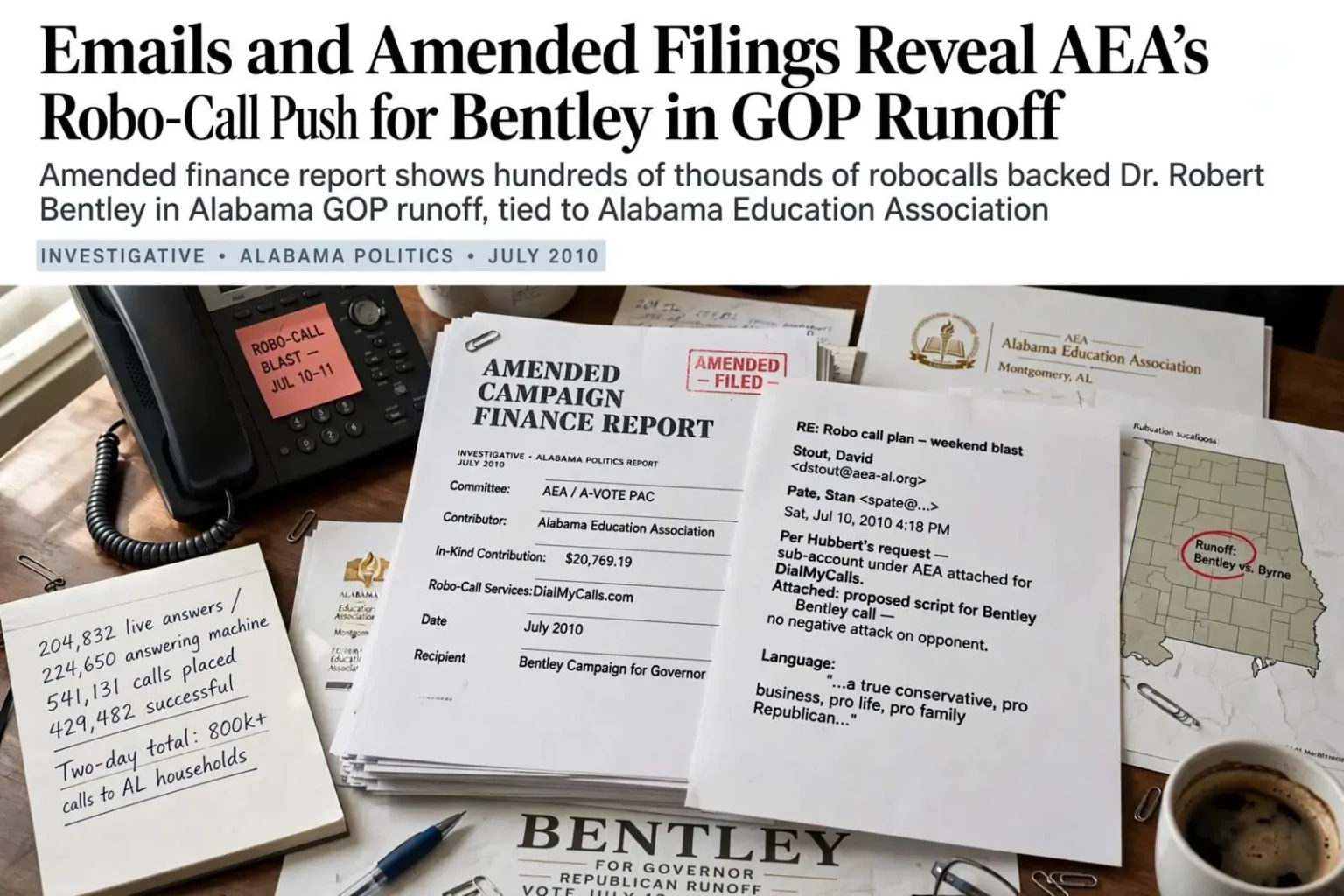
An amended campaign finance report was filed to reflect hundreds of thousands of robo-calls sponsored by the Alabama Education Association in support of Dr. Robert Bentley’s successful bid to win the Republican nomination for governor over his runoff rival, former state Sen. Bradley Byrne, according to AEA executive director Paul Hubbert.
The disclosure linked the state’s dominant teachers’ organization — long the central power in Alabama Democratic politics — to the machinery of a Republican runoff campaign, and the paper trail behind it read unlike anything else produced during that election season.
A Plan Laid Out in Emails
Emails between AEA staffers and one-time Bentley backer Stan Pate detailed a plan, developed July 8-11, to counter a Byrne offensive that included a wave of endorsements from leading Alabama Republicans.
The arrangement opened with a message from Nick Bailey, a former Siegelman administration figure whom Pate had hired for his Tuscaloosa real estate company following Bailey’s release from prison. Bailey’s email advised that David Stout, the AEA’s public relations director, would be calling Pate at Hubbert’s request.
An hour later, Stout confirmed that Pate could operate as a sub-account under the AEA’s relationship with DialMyCalls.com, the robo-call vendor. The next day, Stout emailed Pate the wording for a “potential ROBO call via AEA” to counter Byrne’s “negative (ads) and endorsements from the Riley establishment.”
One proposed script had Bentley warning voters they might receive “misleading phone calls, push polls, and negative messages,” and insisting he remained “a true conservative, pro business, pro life, pro family Republican.” A second, shorter script had Bentley pledging to make job creation his top priority and to “clean up the mess in Montgomery.”
The scripts themselves were carefully built. Both positioned Bentley as the aggrieved party in a campaign growing harsher by the day, and neither attacked his opponent by name — a distinction that would later matter to the question of whether the calls violated Bentley’s public no-negative-campaign pledge.
By the Numbers
On Sunday, July 11, fewer than 40 hours before the polls opened, Stout reported the results to Hubbert and other AEA figures, with Pate copied. The Friday “blast” produced 204,832 live answers, 224,650 answering-machine connections, 100,844 no-answer or bad numbers and 10,805 busy signals. Of 541,131 calls placed, 429,482 were deemed “successful.”
A Saturday blast was similar, with 428,573 “successful” connections out of 541,131 attempts. Across two days, the operation had reached well over half a million Alabama households — a volume that no ordinary campaign telephoning effort approaches, and that put a recorded message, in one form or another, into a substantial share of the state’s electorate on the final weekend of a runoff.
Industry veterans put the cost of such blasts at roughly seven or eight cents per call. At those rates, the two-day operation represented tens of thousands of dollars in in-kind value — money that had never appeared on any campaign finance report until the amendments were filed.
“We filed an amended report after discovering that our original one had failed to list this in-kind contribution,” Hubbert said.
The Bentley campaign also amended its filings with the secretary of state’s office. “When we first learned of an in-kind contribution, made by an independent third party, we amended our Financial Disclosure Report to reflect that immediately,” said Rebekah Mason of the Bentley campaign.
A-VOTE, an AEA political action committee whose treasurer was Hubbert, reported an in-kind contribution of $20,769.19 to the Bentley campaign, along with a payment to a telecom vendor. The filings made explicit what the emails had suggested: the state teachers’ organization had not merely blessed Bentley’s candidacy but had put its own resources directly into the closing days of his race.
The amendments also answered the question every observer of the runoff had asked since election night: how a retired Tuscaloosa physician with no party apparatus had closed a double-digit gap against a well-funded former chancellor in a matter of weeks. The calls, the emails and the filings together supplied an answer — a machine had been borrowed, briefly and quietly, and its work had been measured in hundreds of thousands of dial tones.
A Larger Rivalry
The disclosures pointed to a closer relationship between the AEA and the Bentley campaign than Bentley had acknowledged, even as they unfolded against the backdrop of a titanic feud.
Byrne, after accepting Gov. Bob Riley’s offer to head the state’s two-year college system as chancellor, had used that platform to intensify his criticism of the AEA and Hubbert. The chancellorship had been created in the wake of the two-year college scandals of the 2000s, and Byrne had treated the post as a bully pulpit against the organization he blamed for blocking reform. By the time he ran for governor, the animus was mutual and long-standing.
Hubbert, long a vice chairman of the state Democratic Party and once its gubernatorial nominee, directed his political resources against Byrne in ways that only later came to light, and he resigned his Democratic Party post to blunt charges of partisanship over his involvement in a GOP primary.
The resignation was the clearest public admission that something unusual had occurred. The AEA’s influence had always rested on its ability to sway Democratic primaries; deploying hundreds of thousands of recorded calls on behalf of a Republican — in a runoff against the man who had made attacking the AEA his signature issue — was a different kind of operation, and one that sat awkwardly under a Democratic Party title.
The runoff’s stakes explain the unorthodoxy. Byrne had led the first round of voting and entered the runoff as the favorite, backed by the Riley network’s endorsements. From the AEA’s perspective, the final weekend was the last realistic chance to shape the outcome, and the robo-call vendor offered a way to reach more voters, more cheaply, than any advertising buy the same dollars could fund.
The Message and the Pledge
Bentley’s message in the robo-calls did not conflict with his stated pledge to avoid negative advertising, a promise he had reaffirmed in late June. The scripts warned voters about misleading attacks without naming or attacking the attacker — a formulation that let the campaign maintain, plausibly, that the calls were defensive in character even as they bolstered Bentley on the final weekend.
The timing mattered as much as the content. Calls arriving on the closing Friday and Saturday of a runoff land on the voters likeliest to cast ballots, when memories of the campaign’s attacks are freshest and the commitment to vote is still being made. A message that reaches a household in that window carries weight no earlier advertising can match, which is precisely why the closing-weekend blasts were engineered at all.
Whether that distinction would have satisfied the pledge’s spirit was a question the runoff’s outcome largely buried. Bentley won the nomination, and the amended filings surfaced only afterward, when the emails and call counts became public.
The General Election Flip
And while whatever help the AEA provided Bentley in the runoff was one-sided, the union took a different tack in the general election, contributing at least $105,000 directly to Democratic nominee Ron Sparks.
The reversal was the AEA’s old playbook running in reverse. The organization’s power has always come from its willingness to back whichever candidate serves its interests — in either party’s primary — and then to shift resources to the general election race it prefers. Having helped Bentley past the rival it most feared, the AEA still hedged its bets for November with a direct contribution to the Democrat.
The two-track approach also reflected the practical reality of one-party dominance. With Republicans ascendant in Alabama, an organization that invested only in Democratic nominees would soon hold no cards at all; an organization that could influence Republican runoffs retained leverage regardless of November’s outcome. The Bentley episode demonstrated the new model in full: influence the primary, contribute to the opposition in the general, and keep the relationship alive whichever way the electorate moved.
Pate, who had since had a falling out with Bentley, did not immediately respond to a request for comment. His silence left the role of the middleman — the Tuscaloosa businessman whose phone calls set the operation in motion — without a public accounting, though the emails’ chronology was detailed enough that the absence of one man’s version mattered little to the overall picture.
What the Episode Left Behind
The amended reports changed the story of the 2010 Republican runoff in one essential way. What had been described as Bentley’s grassroots surge — the improbable second-place finisher who overtook the establishment favorite — now had a documented, six-figure assist from the most powerful political organization in the state, timed to the final weekend, executed through a vendor account and disclosed only after the votes were counted.
The episode became a lasting reference point in Alabama political arguments: about what counts as independent support, about the AEA’s bipartisan reach, and about how much of a campaign’s closing argument can be delivered by a machine its candidate never publicly owned.