Intrigue in the U.S. Attorney Sweepstakes, With Mobile’s Slot Still Open
A Mobile prosecutor once seen as the favorite for the Middle District post has watched the speculation move elsewhere, while four names continue to circulate for the U.S. attorney job in Mobile.
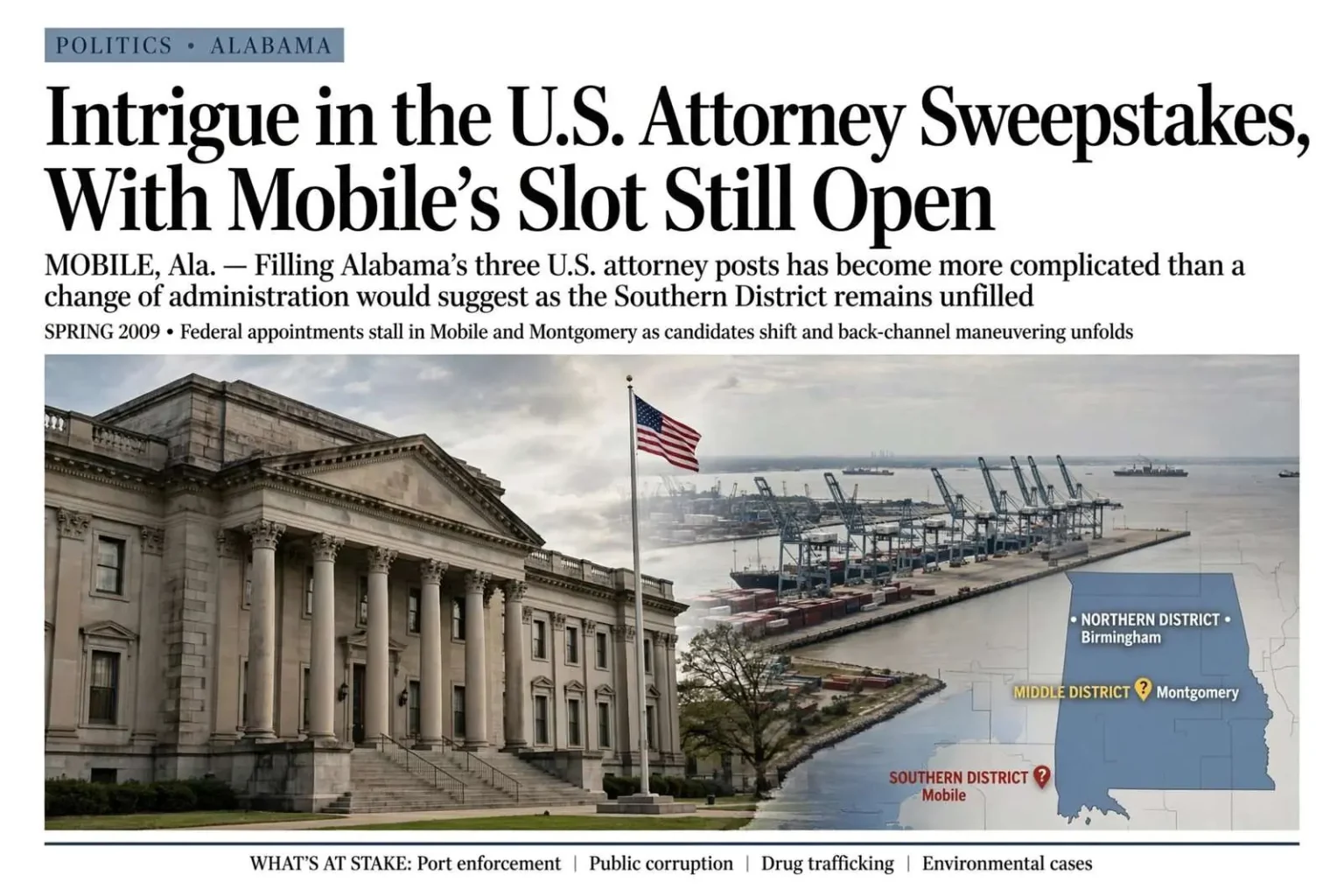
MOBILE, Ala. — Few appointments in Alabama carry more quiet consequence than the three U.S. attorney posts, and in the spring of 2009 the process of filling them has become considerably more complicated than a change of administration would suggest. The Southern District, headquartered in Mobile, remains unfilled. So does the Middle District in Montgomery. And in both cases, the early favorites have not held their position.
U.S. attorneys are the federal government’s chief prosecutors in each of the nation’s judicial districts, and in Alabama their reach extends into everything from bank robbery and drug trafficking prosecutions to civil fraud cases, environmental enforcement and public corruption investigations. With the change of presidential administrations, the previous administration’s appointees had departed, leaving interim leadership in place while the new White House worked through its own selection process — one that traditionally begins with recommendations from home-state senators before moving through Justice Department review and Senate confirmation.
The Nicrosi question
Michel Nicrosi of Mobile had been widely regarded as the heavy favorite for the Montgomery job — a return to her hometown as U.S. attorney for the Middle District. Her credentials were not in doubt. A former assistant in the U.S. attorney’s office in Mobile, she once headed the office’s criminal section, experience that gave her command of both the prosecutorial side of federal practice and the internal workings of the office she would have led.
Yet speculation in Montgomery has since shifted toward Joseph P. Van Heest. A recent column in the Montgomery Independent suggested the selection process there has been riddled with intrigue — and that the implications are trickling south, potentially affecting the Mobile appointment as well. In a state where the three districts share prosecutors, investigators and caseloads, maneuvering over one appointment rarely stays contained, and observers noted that candidates considered for one district can resurface as options for another.
The uncertainty illustrates how unusually opaque these selections can be. Unlike judicial nominations, which draw formal evaluation committees and public scrutiny, U.S. attorney recommendations are often settled through private consultations among senators, party figures and the Justice Department, leaving candidates and their supporters to compete through reputation and back-channel advocacy rather than public campaigns.
The Mobile field
For the Southern District post in Mobile, four names continue to draw mention: Vicki Davis, Pat Sims, Kenyon Brown and Nicrosi herself. Each represents a different strand of the local legal establishment, and none has emerged as a clear consensus choice in the way that candidates in other districts have.
The Mobile job is not a ceremonial one. The Southern District covers the Port of Mobile and the Gulf Coast, which means narcotics interdiction, maritime and customs enforcement, and public corruption cases that reach into county courthouses and municipal governments. Whoever takes it inherits an office that has been at the center of significant local prosecutions.
The district’s geography shapes its docket in ways few offices in the country share. Mobile Bay and the Port of Mobile make the district a front line for smuggling interdiction, cargo fraud and customs violations, while the stretches of interstate highway and Gulf Coast waterway that funnel toward the port have long made drug trafficking a central concern. At the same time, the district’s twelve-county sweep of south Alabama places a scattering of small county seats and city halls under the office’s watchful eye, where corruption investigations historically have arisen.
Whoever is chosen will also inherit the office’s relationships — with the FBI, DEA, ATF and Homeland Security Investigations agents who develop its cases, with the state district attorneys who refer and coordinate prosecutions, and with the federal judges who expect the office to manage a demanding calendar. Seasoned observers of the district note that continuity in those relationships often matters as much as any individual prosecutor’s trial record.
Where the process went smoothly
Birmingham stands as the exception. In the Northern District, Joyce Vance led the field from start to finish without visible hitch, though she has not yet been confirmed. Vance is the daughter-in-law of Robert Vance, the federal judge and Alabama Democratic figure who was assassinated by a mail bomb in 1989 — a name that still carries considerable weight in Alabama legal circles.
The contrast between the Northern District’s straightforward transition and the stalled selections in Mobile and Montgomery has become a running topic of conversation among Alabama lawyers. In Birmingham, the recommendation process moved cleanly from consensus to nomination, while in the southern districts the competing candidacies have left room for the kind of speculation that fills political columns and courthouse corridors alike.
The Vance name carries its own resonance in that comparison. Judge Robert Vance’s killing in 1989 — for which a man was later convicted and sentenced to death — stands as one of the darkest episodes in the state’s modern legal history, and his family’s standing within Alabama’s Democratic and legal communities has endured. For Joyce Vance, the association brought both recognition and expectations as her nomination advanced.
Until confirmations come through, the district offices operate under interim leadership, typically carried by the First Assistant or another senior career prosecutor. Career prosecutors in the offices keep the docket moving — grand juries continue, indictments continue, trials continue — but major policy decisions and new initiatives generally wait for a Senate-confirmed leader, one more reason the pace of selection matters to the offices themselves.
What is at stake for South Alabama
The stakes of the Mobile selection extend beyond the courthouse on Saint Joseph Street. The U.S. attorney for the Southern District sits at the intersection of federal law enforcement and local government for a broad swath of the Gulf Coast, and the office’s priorities ripple outward: which drug organizations get targeted, which maritime cases get pursued, which public officials face scrutiny. Business leaders, port interests and county officials all have reason to follow the appointment closely.
The delay also carries a human cost within the office itself. Career assistants who have invested years in long-running investigations must wait for a confirmed leader to make the charging decisions those cases require, and some cases age poorly. Defense attorneys, meanwhile, plan around the uncertainty, knowing that interim leadership is reluctant to launch the kind of high-profile prosecutions that a new Senate-confirmed administration appointee will eventually put a signature on.
For the candidates themselves, the waiting is its own ordeal. Federal prosecutor appointments are typically the capstone of a legal career, and the four Mobile names under consideration — Davis, Sims, Brown and Nicrosi — each carry backgrounds that would have made them plausible selections in any ordinary cycle. That no announcement has come suggests the White House and the state’s senators are still sorting through considerations that have little to do with prosecutorial credentials.
Until the paperwork is filed and the Senate acts, Mobile’s federal courthouse will keep operating under temporary leadership, and the legal community will keep reading the Montgomery Independent’s columns for hints about how the intrigue upstream might finally break loose the appointment that South Alabama is waiting on. When it does, the name announced will shape federal law enforcement on the Gulf Coast for years to come — which is precisely why so many people are watching a process that officially involves no candidates at all.
The Southern District itself has a long institutional history that shapes expectations for whoever takes the post. Established when Alabama’s federal judiciary was divided into three districts, the Mobile-based office has prosecuted generations of cases arising from the port, the railroads and the coastal economy, and its alumni have gone on to judgeships, state office and leadership roles in private practice. That institutional memory gives the office a strong career core, but it also means the community measures each new appointee against a demanding standard of predecessors.
Nomination mechanics add another layer to the delay. A U.S. attorney’s nomination travels from the senators’ recommendation to the Justice Department, then to the White House and finally to the Senate Judiciary Committee before a floor vote, and a single holdup anywhere along that chain can stall an appointment for months. Alabama’s senators, whose recommendations effectively frame the entire field, have remained publicly circumspect about their deliberations — leaving the candidates themselves with nothing to do but wait and keep their practices running.
Legal observers also note that the Alabama U.S. attorney’s offices face a demanding agenda regardless of who is confirmed. Coastal enforcement, violent crime in the cities, fraud cases touching public contracts and the steady caseload generated by the port all await the new leadership. The appointee for the Southern District will take charge of an office whose work reaches every county in south Alabama — and, given the current intrigue, will inherit a selection story nearly as complicated as any case on the docket.