Kenyen Brown Sworn In as the Southern District’s First Black U.S. Attorney
Kenyen Brown took the oath as U.S. attorney for the Southern District of Alabama, becoming the first Black person to hold the post, with a public ceremony expected to follow within weeks.
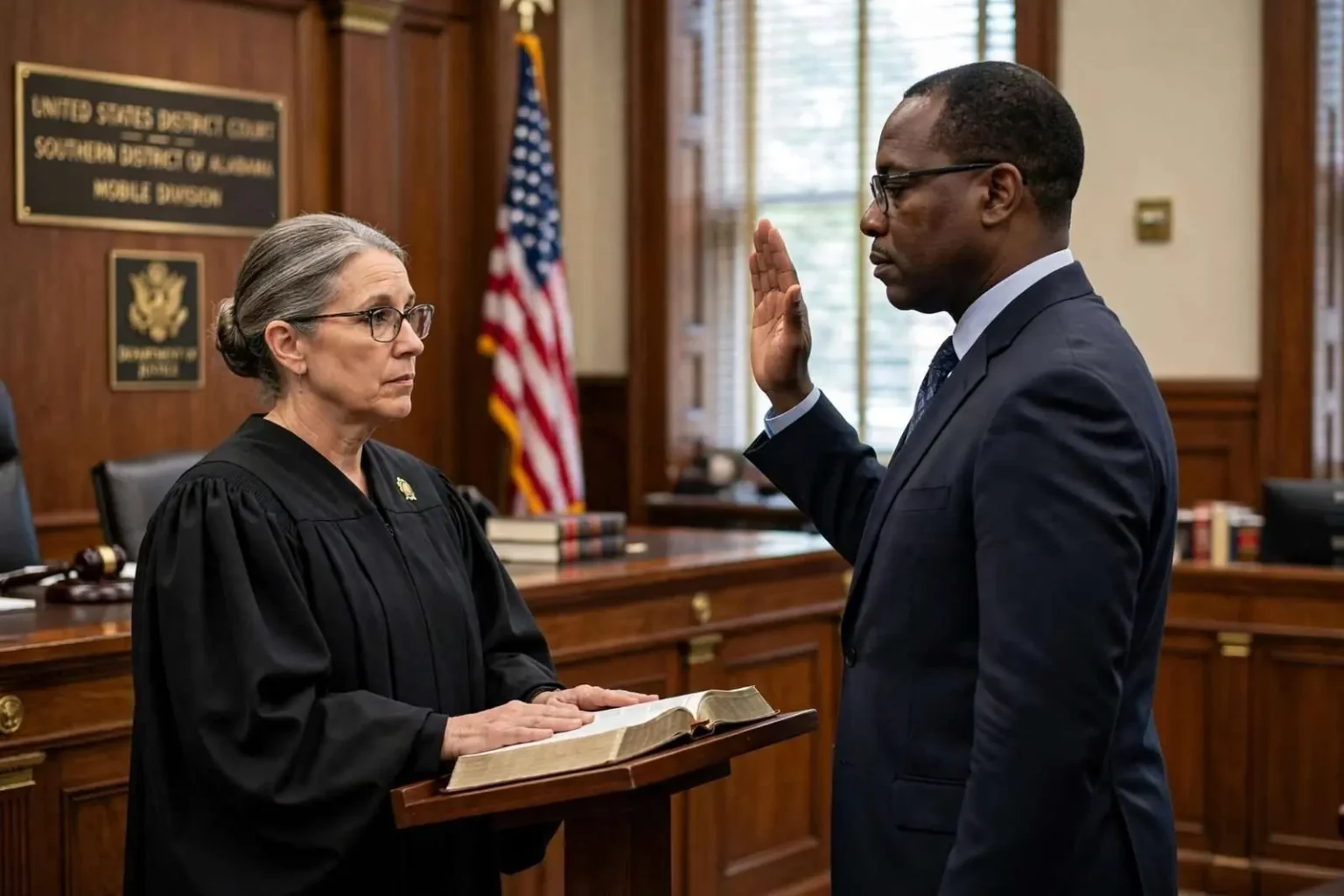
Kenyen Brown has been sworn in as the top federal prosecutor for the Southern District of Alabama, becoming the first Black person to hold the office in state history, according to sources at the federal courthouse in Mobile. The oath was administered privately, as is customary when a nominee is confirmed and the office needs a leader without delay. A public ceremonial swearing-in was expected to be staged within weeks, and U.S. Attorney General Eric Holder was expected to attend.
The private-first arrangement is standard practice across the federal system. Once the Senate confirms a U.S. attorney, the oath is often administered quickly by a federal judge so that the office has an authorized leader on the day it needs one, and the larger ceremony follows later, once family members, colleagues and dignitaries can gather. For the Mobile courthouse, the expected guest list carried its own weight: an attorney general’s appearance at a district-level swearing-in is uncommon, and it signaled the attention the White House had paid to this particular selection.
A Mobile connection at the top of the Justice Department
Holder’s expected presence carries a resonance particular to this part of Alabama. The nation’s first Black attorney general is married to Dr. Sharon Malone, an obstetrician and a Mobile native. Her sister, Vivian Malone Jones, was one of the two students whose enrollment at the University of Alabama in 1963 prompted Gov. George Wallace’s “stand in the schoolhouse door” — the moment that, more than any other, fixed Alabama in the national memory of the civil rights era.
Vivian Malone and James Hood registered for classes at the Tuscaloosa campus despite Wallace’s attempt to block their way, stepping aside only when federalized National Guard troops enforced a federal court order. Vivian Malone went on to graduate, and her sister’s path ran from Mobile’s public schools into a medical career. The Malone family’s story has long tied this city to the central chapters of the civil rights movement, and visitors to Mobile hear it retold wherever the era is discussed.
That a Mobile family should be connected both to that day in Tuscaloosa and to the swearing-in of the district’s first Black U.S. attorney nearly half a century later is the kind of symmetry Alabama produces more often than outsiders expect. The state’s history has a way of folding back on itself, and the people in the room at the courthouse knew they were watching one of those folds complete itself.
For residents of Mobile and Baldwin counties, the appointment also registered as a local milestone in the ordinary sense. The U.S. attorney’s office touches daily life here in ways that are easy to miss — the prosecution of drug and firearms cases, the policing of the port and the coast, the pursuit of fraud and corruption — and the person who leads it is a familiar name on the courthouse steps long before any headline is written.
A surprise selection
Brown’s appointment was not the one most people at the federal courthouse had anticipated. He had not applied for the position and was not recommended by either the screening committee assembled by U.S. Rep. Artur Davis or the panel convened by the state Democratic Party. The top choice of both committees was Vicki Davis, an assistant U.S. attorney in the office and no relation to the congressman.
The two-track screening process is how such openings have often been handled in Alabama. When a U.S. attorney’s seat comes open, interested lawyers submit applications, local panels interview candidates and forward names to Washington, and the White House makes the final call with input from the state’s congressional delegation. That Brown surfaced outside both channels — and still cleared the nomination — made his selection the kind of Washington decision that leaves even courthouse regulars recalibrating their assumptions about how the process works.
Vicki Davis’s standing as the committees’ preferred candidate was itself a reflection of the office’s depth. Assistant U.S. attorneys who have spent years trying cases in the Southern District accumulate the institutional knowledge that the job demands, and many in the legal community here had expected the position to go to someone from within that corps. Her exclusion from the final decision was noted around the courthouse without rancor, more as an example of how little the local process binds the final outcome.
Back in a familiar office
Brown was not, however, a stranger to Mobile. He previously served as an assistant U.S. attorney in the office under Don Foster, the Clinton appointee who led the district in the 1990s. He left a post with a congressional subcommittee in Washington to take command of a local federal prosecutor’s office long reputed to be a difficult one to manage.
That history gave the appointment a different texture than an outsider’s arrival would have carried. Brown knew the building, the judges, the docket and many of the prosecutors who would now report to him. Former colleagues from the Foster era remembered him as part of a generation of prosecutors who handled the district’s heavy load of drug and fraud cases in the 1990s, when the office’s criminal docket was among the busiest in the region.
The move from a congressional subcommittee staff position back to a line prosecution office was also unusual in the opposite direction. Washington staff work carries prestige and proximity to national power, but it is advisory; a U.S. attorney’s office decides actual cases. Brown’s willingness to trade one for the other was read locally as a sign of where his professional commitments lay.
Managing the Southern District has challenged more than one leader. The office spans a wide territory, answers to multiple federal agencies with distinct priorities, and operates under the scrutiny that comes with prosecuting public officials in a small state where politics and prosecution frequently intersect. The “difficult to manage” reputation that preceded Brown’s return was common knowledge among the defense bar and the press corps alike.
The office he inherits
The U.S. attorney for the Southern District of Alabama oversees federal prosecutions across the southern third of the state, a territory that includes the Port of Mobile, the Gulf Coast, and the rural counties reaching north toward the Black Belt. Its caseload has historically been heavy with drug trafficking, immigration, firearms and fraud, and — most consequentially for the region’s politics — with public corruption.
Alabama is divided into three federal judicial districts, and the Southern District is the one that borders the Gulf. Its jurisdiction stretches from the Mississippi line east to the Florida line and reaches inland to take in a swath of small cities and rural counties, which means the office’s work ranges from deepwater port and maritime matters to cases that begin in towns of a few thousand people. The Port of Mobile, one of the busiest on the Gulf, generates its own enforcement priorities — cargo, customs, smuggling — that no other district in the state faces in quite the same form.
Drug trafficking has shaped the office’s identity for decades. The interstate corridors that run from the coast toward Atlanta and the Midwest, combined with the shipping traffic through the port, have long made south Alabama a route for narcotics moving north, and the bulk of the office’s criminal filings in any given year have historically come from that trade. Firearms prosecutions and immigration matters follow the same geography, concentrated along the coast and the interstate spines.
An outsized role in the city’s civic memory
Public corruption is the category that has given the office its outsized place in Mobile’s civic memory. The wave of federal indictments of local officials in the 1970s and 1980s remains a subject of dispute here, with defenders of the prosecutions describing them as an overdue cleanup and critics describing them as politically driven.
That era installed a lasting wariness in local government. For years afterward, Mobile County commissioners, city council members and mayors across the region governed with the knowledge that federal prosecutors were watching, and the defense bar that grew up around those prosecutions became a fixture of the local legal scene. Every subsequent U.S. attorney has inherited the question that era left behind: how aggressively to pursue public officials in a community where the memory of past prosecutions is still contested.
Whoever holds the office inherits that history along with the docket. The position carries more local influence than most federal jobs, because its discretionary decisions — which cases to bring, which officials to investigate, which pleas to accept — are effectively unreviewable in the short term and shape the region’s political life for years afterward.
Firsts, stacked
Brown’s swearing-in arrived amid a run of firsts in Alabama and national politics. Holder was appointed by Barack Obama, the nation’s first Black president. Artur Davis, whose recommendation Brown did not have, was at the time considered a solid favorite to win the Democratic nomination for governor and would, if elected, become Alabama’s first Black governor.
The stacking of those firsts was not lost on anyone in Alabama. A state whose governors once stood in schoolhouse doors now had a Black attorney general in Washington, a Black federal prosecutor in Mobile, and a leading candidate for governor who shared their race — a sequence that would have been implausible in the state’s politics a generation earlier. Observers here noted the pace of the change even as they cautioned that symbols and outcomes are different things.
For the Southern District, the significance was more immediate and more practical. The office had been through a period of turnover and internal friction, and its new leader takes over an operation whose decisions shape the political and civic life of Mobile in ways few institutions can match. The office prosecutes the region’s mayors and commissioners as well as its traffickers, sets the tone for cooperation between federal agencies and local police, and answers the public’s questions about whether justice here is administered evenly.
Brown’s first weeks were expected to be consumed by the ordinary mechanics of taking command — meeting the office’s divisions, reviewing pending investigations, and preparing for the public ceremony that would formally introduce him to a courthouse community still adjusting to the surprise of his selection. The heavier work, the kind that defines a U.S. attorney’s tenure, would follow on the docket that was already waiting.