University of South Alabama Mobile
Son of the Late Lambert Mims Offers a Dissenting History of Mobile’s Corruption Years
In a lengthy letter, Dale Mims disputed a published account of Mobile's era of political indictments, arguing the prosecutions of the 1970s and 1980s were shaped by displaced money and federal politics.
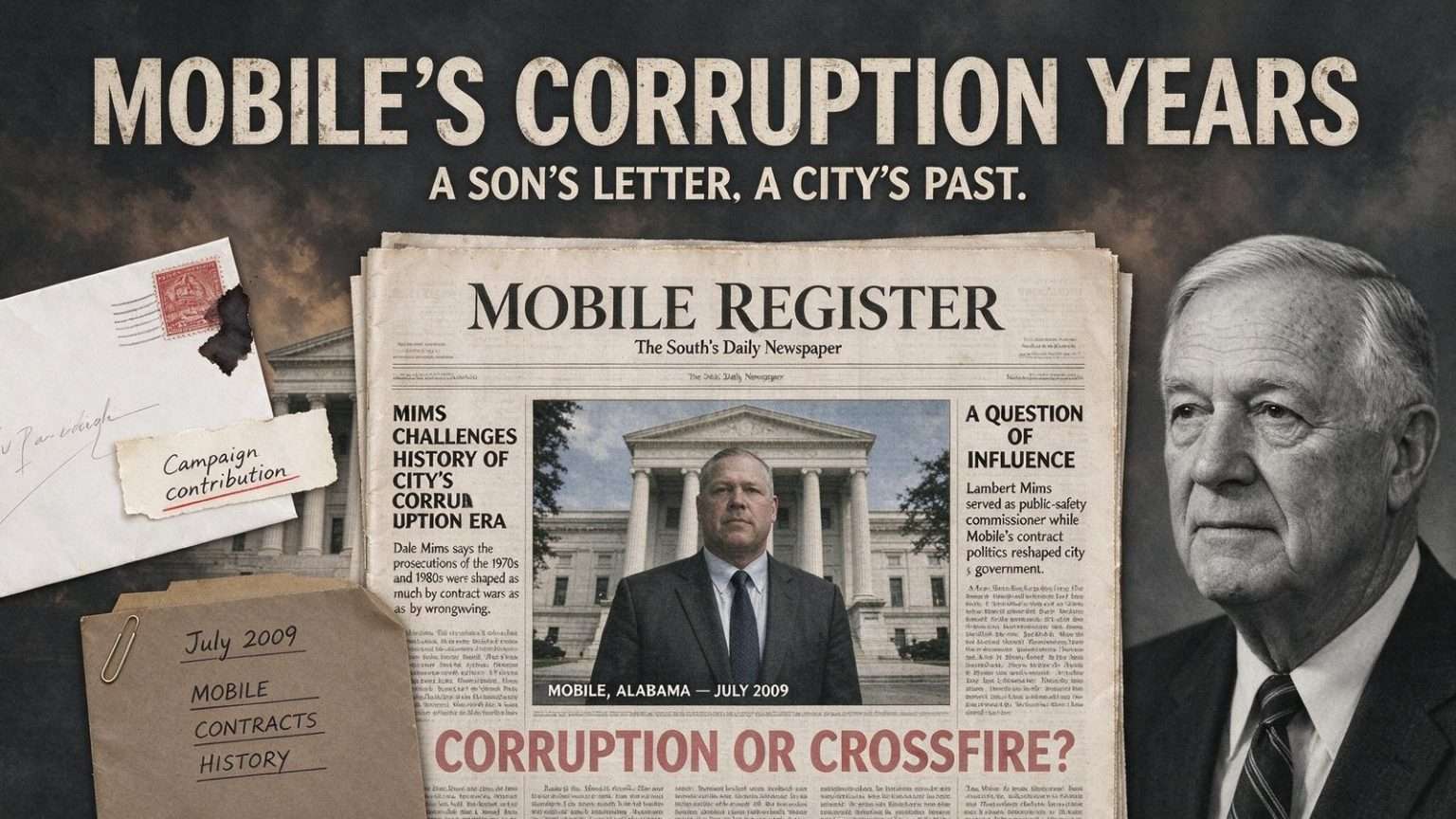
A son of the late Mobile City Commissioner Lambert C. Mims came forward in late July 2009 with a lengthy letter challenging a widely read account of the city’s era of political indictments, arguing that the wave of prosecutions between the mid-1970s and the mid-1980s had been shaped as much by a struggle over municipal contracts as by any wrongdoing at City Hall. The letter was written by Dale Mims, a Mobile Realtor, in response to an article by John Robb published in the Sunday edition of the city’s daily newspaper, the Mobile Register.
Mims wrote that he did not dispute that corruption had existed. He disputed, he said, its nature and its source. The article by Robb, a longtime political reporter, had revisited the convictions of three city commissioners — Mims, Greenough, and a third commissioner — and framed the period as a cleanup of systemic graft. Dale Mims argued that the reality was more complicated, and that his father had been caught in a political crossfire that had as much to do with who controlled the city’s lucrative contracting apparatus as with personal venality.
A Personal Denial
Mims took direct issue with what he described as an implication that his father had received money stolen from the Municipal Auditorium in connection with the case of former City Commissioner Gary A. Greenough. Greenough was convicted in 1985 on federal charges related to the misappropriation of auditorium funds. Mims wrote that he had picked up the envelope in question himself, from an assistant auditorium manager on the auditorium steps, and that it contained a campaign contribution his father knew nothing about until afterward.
It was routine, he wrote, for supporters to telephone campaign headquarters offering money and for him to collect the contributions around town and deliver them to headquarters to be recorded. He said he was carrying four or five other envelopes at the time. Any suggestion that auditorium money was disbursed to his father, he wrote, was “patently false.” The envelope, he said, was from a known supporter who had called the campaign office pledging a contribution, and the assistant manager was simply delivering it as a courtesy.
Mims stressed that he had no direct knowledge of the Greenough case itself and had neither heard the evidence nor attended the trial. His account was based on his own actions that day and conversations with his father in the years since. He acknowledged that the appearance of impropriety — a commissioner’s son picking up an envelope at a municipal facility — was damaging, but he insisted the substance was innocent.
The Backdrop, as Mims Described It
Much of the letter was devoted to setting the period in context. Mobile in those years was a city under strain, Mims argued: Brookley Field had closed, taking a large share of the local economy with it; the civil rights movement had brought thousands of Black voters into the electorate; the University of South Alabama was in its infancy; and downtown was emptying as commerce followed the new interstate highways toward the suburbs. The city’s power structure — white, conservative, and accustomed to operating without scrutiny — was being challenged on multiple fronts.
Brookley Air Force Base’s closure in 1969 had eliminated 13,000 jobs and ripped $250 million from the local economy. The city’s leadership, including Lambert Mims, had fought the closure unsuccessfully. The economic vacuum created desperate competition for the remaining public dollars — construction contracts, service agreements, concession deals. Mims argued that the federal investigations that followed were driven in part by rival factions seeking to use law enforcement as a weapon in that competition.
The Commission Form of Government
Mobile operated under a three-member city commission from 1911 until 1985, when a federal court ordered a change to a mayor-council system after finding that the at-large commission structure diluted Black voting strength. Under the commission system, each commissioner headed a department — public safety, finance, public works — and the three collectively set policy. The concentration of executive and legislative power in three individuals made the commissioners gatekeepers for virtually every city contract.
Lambert Mims served as commissioner of public safety from 1965 until his defeat in 1985. In that role, he oversaw the police and fire departments, the municipal jail, and the city’s emergency management functions. He was known for a hands-on management style — showing up at fire scenes, walking beats with patrol officers, and maintaining a network of informants across the city. His critics called it micromanagement; his supporters called it accountability.
The commission system’s vulnerability to corruption was structural. With no city manager to buffer political decisions from administrative execution, commissioners could direct contracts to favored vendors with minimal oversight. The FBI’s “Operation Gulf Coast,” which began in the late 1970s, targeted this dynamic. Wiretaps, cooperating witnesses, and a grand jury sitting in Mobile produced indictments against Commissioner Gary Greenough (finance), Commissioner Robert “Bob” Doyle (public works), and eventually Lambert Mims himself, who was acquitted of federal charges in 1987 but convicted on state ethics violations in 1989.
The Contract Wars
Dale Mims’s letter emphasizes a dimension that received less attention in the press coverage: the battle over the city’s garbage collection contract. In the early 1980s, Mobile’s waste disposal was handled by a private hauler with close ties to the Doyle administration. A competing company, backed by business interests aligned with Mims, sought the contract when it came up for renewal. The ensuing fight, Mims wrote, “was not about trash. It was about who controlled a revenue stream worth millions over the life of the contract.”
The garbage contract was not the only prize. The Municipal Auditorium, where the disputed envelope originated, was itself a source of patronage. Its management concession, its booking agreements, its food and beverage contracts — all flowed through the commissioner of finance, Greenough. When Greenough was indicted for skimming auditorium receipts, the prosecution’s theory was that he had used his position to divert cash to himself and his allies. Mims’s letter suggests an alternative: that the money moved in multiple directions, and that the investigation focused on Greenough because he had lost the internal power struggle.
This interpretation aligns with the testimony of several cooperating witnesses who received immunity in exchange for implicating specific targets. The selective nature of the prosecutions — why some figures were charged while others who moved in the same circles were not — has been a subject of speculation in Mobile legal circles for decades. Dale Mims’s letter does not name names beyond his father and Greenough, but its implication is clear: the cleanup was partial by design.
Lambert Mims’s Later Years
Lambert Mims left office in 1985 after losing the first mayoral election under the new council system. He was convicted in 1989 on state charges of using his office for personal gain — specifically, accepting a $5,000 payment from a wrecker service owner in exchange for influencing the city’s towing contract. He served 14 months in state prison. The conviction ended a 20-year career in city government.
In retirement, Mims remained a presence in Mobile politics, endorsing candidates and writing occasional op-eds for the Press-Register. He died in 2008 at the age of 78. His funeral at the Cathedral of the Immaculate Conception drew a crowd that included political allies and former adversaries alike — a testament to the complicated legacy of a man who had dominated Mobile’s public life for a generation.
Dale Mims’s 2009 letter was not his first public defense of his father. He had written to the newspaper before, and he spoke at his father’s sentencing hearing. But the 2009 letter was the most detailed and the most directly responsive to a specific published account. It arrived at a moment when Mobile was again grappling with questions of political ethics — a county commissioner had recently been indicted, and the city’s lobbying disclosure ordinance was under review.
The Historical Record
Historians of Mobile’s political development tend to view the 1970s and 1980s prosecutions as a genuine, if imperfect, reckoning. The FBI’s investigation was part of a broader federal push against municipal corruption in the South that also produced cases in New Orleans, Birmingham, and Jackson. The shift to a mayor-council system, mandated by the Voting Rights Act litigation, fundamentally altered the city’s governance and opened the door for Black political representation — Mobile’s first Black city council members took office in 1985, and the city elected its first Black mayor, Sam Jones, in 2005.
But Dale Mims’s letter reminds us that the line between corruption and politics is not always bright. The same system that produced indictments also built the Civic Center, expanded the port, brought the University of South Alabama to Mobile, and kept the city functioning through the loss of Brookley. Whether the prosecutions cleaned up City Hall or simply cleared the way for a new set of power brokers is a question that Mobileans still debate. The envelope on the auditorium steps — campaign contribution or payoff, innocent handoff or smoking gun — remains, in the absence of a confession, a Rorschach test for how one views that era.