The ‘Yella Fella’ Signs On: Jimmy Rane to Chair Bradley Byrne’s Run for Governor
Timber executive and television pitchman Jimmy Rane agreed to serve as statewide campaign chairman for Bradley Byrne, giving the Mobile-area Republican fundraising muscle as he opened a Montgomery headquarters.
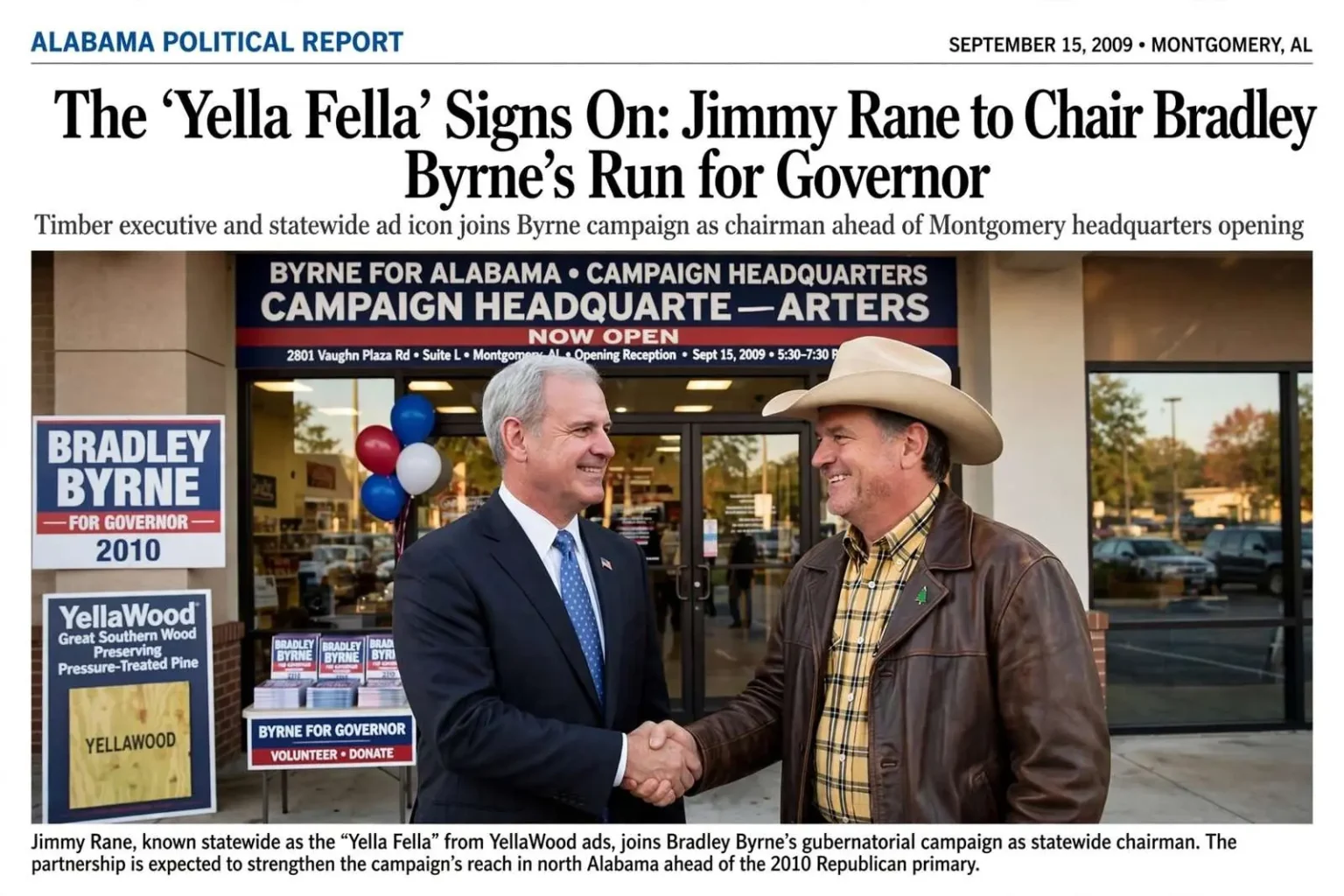
Bradley Byrne’s campaign for governor picked up one of the most recognizable names in Alabama business in September 2009, announcing that timber executive Jimmy Rane — known to television viewers across the state simply as the “Yella Fella” — had agreed to serve as statewide campaign chairman. The announcement was timed to the opening of the Byrne for Alabama headquarters in Montgomery, scheduled for 5:30 to 7:30 p.m. Tuesday at 2801 Vaughn Plaza Road, Suite L.
For a candidate making his first bid for statewide office, planting a flag in the capital city and putting a household name at the top of the letterhead amounted to a single, coordinated statement of seriousness. Montgomery headquarters serve a practical function in a governor’s race — the capital is where the state parties, the press corps and the donors converge — but the symbolism is the point. A campaign that opens a shop in Montgomery in September, with a chairman whose face is known in every county, is announcing that it intends to be standing when the votes are counted.
Chairman is an unpaid title with no fixed duties, and campaigns accumulate them the way walls accumulate posters. What made this one different was what Rane brought with him: a donor network built over decades in Alabama business, a marketer’s instinct honed in front of the camera, and a biography that plays identically in a Cullman feed store and a Mobile country club. Few chairman announcements in the 2010 field would generate comparable attention.
Why Rane mattered
Rane is the architect of the success of Great Southern Wood Preserving, the Alabama company behind the YellaWood brand of pressure-treated pine, and he is also the company’s pitchman, appearing in its long-running advertisements as a laconic cowboy character. That dual role — chief executive and folk figure — gave him a kind of statewide recognition that money alone rarely buys.
The Yella Fella spots, with their slow drawl and deadpan delivery, ran for years during local news and syndicated programming across the Southeast, and they accomplished what political consultants spend millions trying to buy: near-universal name identification with warmth attached. Viewers who could not name their state senator knew the man in the cowboy hat selling yellow pine. For a gubernatorial campaign, borrowing that familiarity is worth more than any single endorsement.
Three things in particular made him attractive to the Byrne campaign: his ability to raise money, his marketing instincts, and his connections in north Alabama, a region where a candidate from the Gulf Coast begins at a disadvantage. The fundraising piece was self-evident — Rane’s decades at the head of a growing company had made him a fixture in Alabama’s business-donor world, and a chairman who can open doors is worth more than one who merely signs letters. The marketing piece meant the campaign would get a professional’s eye on its messaging without the consultant markup.
Rane had himself flirted with entering the governor’s race earlier in the year before deciding against it. His decision to back Byrne instead removed a potential rival and added an ally in one motion — the rare announcement that improves a campaign’s position twice.
The shape of the 2010 Republican field
The 2010 Republican primary for governor was already crowded, and it would grow more so. Byrne, an attorney who had served on the state school board and then led Alabama’s two-year college system through a period of aggressive reform, was running as the candidate of institutional change. His work at the two-year colleges — including the fight over so-called double-dipping, in which community college employees also held seats in the Legislature — had earned him both a reform reputation and a set of enemies in Montgomery.
The two-year college fight was the defining credential of Byrne’s candidacy. The system had been at the center of a sprawling scandal over legislators drawing college paychecks for little or no visible work, and Byrne, as chancellor, had pushed the ban that ended the practice and forced lawmakers to choose between their college salaries and their legislative seats. To primary voters weary of Montgomery’s ways, that record was a calling card; to the legislators and their allies he had crossed, it was a grudge. Both reactions shaped the race to come.
Others in the field included Tim James, the businessman and son of former Gov. Fob James; State Treasurer Kay Ivey; and former Riley cabinet member Bill Johnson. Each was courting the same conservative primary electorate, and the winner would face a Democratic nominee at a moment when Alabama’s politics were shifting decisively toward the GOP.
The field’s composition told the story of the state’s changing political geography. A statewide race that a generation earlier would have been contested largely among Democrats now drew every serious ambitious Republican in the state into a primary expected to decide the election outright. The candidates divided along regional and stylistic lines — the son of a former governor with a business resume, a veteran state treasurer from Montgomery, a former Riley cabinet member with his own network, and the reformist chancellor from the coast — and all of them needed the same thing: name identification and organization outside their home territory.
Tim James’s presence carried particular weight in south Alabama, where the family name had deep Gulf Coast roots and where his own business story — including his role in developing the Foley Beach Express toll road — overlapped with Byrne’s base. Ivey, as the only woman in the field and a statewide officeholder, brought her own donor and county network. The primary would test which organization could convert familiarity into votes across seven media markets.
A coastal candidate’s statewide problem
For south Alabama, Byrne’s campaign carried a particular significance. Mobile and Baldwin counties had not sent one of their own to the governor’s office in a very long time, and coastal candidates historically struggled to build the north Alabama organization a statewide primary demands. Media markets, party structures and county-level machines in the Tennessee Valley and the Birmingham suburbs operate largely independent of the coast.
The state’s media geography makes the problem concrete. A gubernatorial primary is fought across seven or more television markets, and a south Alabama candidate starts with a natural advantage in only the Pensacola and Mobile markets, which reach the state’s two southernmost counties and little else. Huntsville, Birmingham, Montgomery, the Shoals, Dothan — each requires separate advertising, separate visits, and separate county chairmen, and each has its own local power brokers whose support cannot be imported. Voters in the Tennessee Valley have historically been skeptical of Gulf Coast candidates they know only from television, and the distances involved make the retail campaigning that wins small-town Alabama an expensive proposition for a Mobile-based campaign.
Rane’s recruitment was, in that sense, an answer to the central strategic problem of the campaign. A chairman who is instantly recognizable in Cullman, Decatur and Dothan alike offers a coastal candidate a shortcut to credibility, and one whose company’s advertising had spent years making his face familiar in exactly the living rooms Byrne needed to reach.
Rane’s own base reinforced the point. His company’s operations and his civic standing gave him standing across the state’s small-town business communities — the lumber yards, hardware stores and contractors who constitute the natural constituency of the YellaWood brand and the natural precinct-by-precinct organizers of an Alabama primary campaign. A chairman who can put a familiar face and a credible voice on a campaign from Huntsville to Baldwin County collapses months of introductions into a single announcement.
The timing also fit the rhythm of an Alabama primary. September announcements, fall fundraising and holiday-season organization all precede the hard campaigning that begins after New Year’s, and a campaign that waits until spring to build its north Alabama operation usually finds the best local operatives already committed. By pairing the headquarters opening with Rane’s appointment, the Byrne campaign compressed what is normally a season of quiet assembly into a single public statement of readiness.
Campaign headquarters openings are, in the ordinary course, minor events — a ribbon, a few hundred supporters, some folding chairs. The Montgomery opening was intended to do more than that: to show that a candidate from the Eastern Shore had assembled a statewide operation with statewide backing, nine months before Alabama Republicans would go to the polls in the June 2010 primary.
Whether the strategy converts to votes will depend on the ground game Rane’s name helps build — county chairs, sign crews, church lists and the volunteer networks that decide low-turnout primaries. But the September announcement made the campaign’s theory of the race plain: a coastal reformer can compete statewide, provided he borrows the most familiar face in Alabama business to do it.