University of South Alabama Dauphin Island
Mobile Rotarians Hear a Firsthand Report From China and Honor Two Young Athletes
The Sunrise Rotary Club of Mobile devoted its first June 2009 meeting to a report on China by two local portfolio managers, days after honoring high school athletes from McGill-Toolen and Baker.
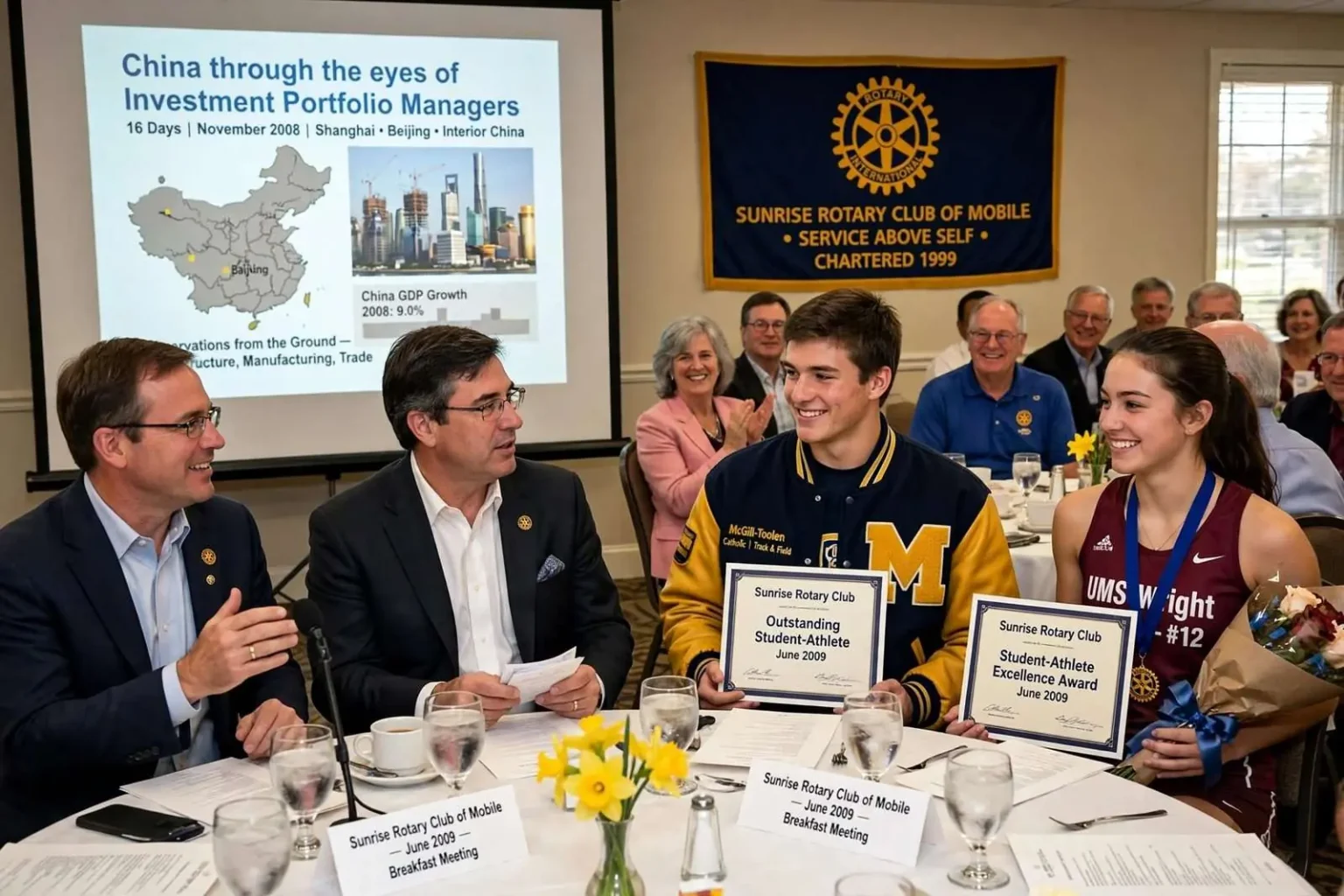
The Sunrise Rotary Club of Mobile opened June 2009 with a program that carried its early-rising members a long way from their weekly meeting: a firsthand account of 16 days spent traveling through China, delivered by two Mobile money managers who had gone to look at the world’s fastest-growing economy for themselves. The speakers, Scott M. Koser and Mark E. Davidson, are partners in Cornerstone Investment Management and Consulting, the Mobile firm they founded together in 2003.
Their talk, titled “China through the eyes of Investment Portfolio Managers,” drew on a trip the pair made across the country in November 2008 — a moment when American investors were still reeling from the collapse of the credit markets and were watching Asia closely for signs of what would come next.
The timing gave the presentation an urgency few club programs carry. Weeks earlier, Lehman Brothers had failed, credit markets had frozen worldwide, and American household portfolios had taken losses that made every investor question the assumptions behind their allocations. Two portfolio managers choosing to spend two weeks of a collapsing autumn walking through Shanghai, Beijing and the interior of China sent a message of its own: that the answers to the crisis — and to what would come after it — were as likely to be found on the ground in Asia as in the pages of a research report.
Club programs like this one are a fixture of Rotary culture. Each week the Sunrise club, which meets at breakfast hour to accommodate members’ working days, brings in speakers whose subjects range from local charity drives to international affairs. The June gathering doubled as a lens on both: a local firm’s partners describing a global economy from the vantage point of Mobile, a port city whose own fortunes are tied to world trade.
Two local money managers, one long trip
Davidson, the firm’s director of investments, is a chartered financial analyst whose day-to-day work covers equity analysis, portfolio management, securities trading, performance review and macroeconomic analysis. He earned a bachelor’s degree in mathematics from Samford University in 1992 and a master’s degree from the Krannert Graduate School of Management at Purdue University in 1994, and received his CFA designation in 1999. At the time of the program he was serving as president of the Samford University Alumni Association and belonged to the Rotary Club of Downtown Mobile, Mobile United and Leadership Mobile. He had also taught finance as an adjunct professor at the University of South Alabama.
Koser, a second-generation investment manager, serves as Cornerstone’s director of research, leading the firm’s work in macroeconomics, global asset allocation and securities analysis. A 1992 finance graduate of Auburn University, he spent a decade as vice president and portfolio manager at Diaz-Verson Capital Investments in Columbus, Georgia, before joining the Chartered Financial Analyst Institute in 1997. He and his family live in Daphne, where he has been active in community and civic organizations on the Eastern Shore.
The pairing of their backgrounds is typical of small independent advisory firms: one partner grounded in research and macro analysis, the other in security selection and portfolio construction, together serving clients who in Mobile’s market range from retirees to business owners to institutions. Founding their own firm in 2003 — rather than remaining inside a bank or brokerage wirehouse — reflected a model that spread across the industry in that era: independent advisors free to select from the full universe of investments without a parent company’s product list.
What they saw in China
A November 2008 trip through China landed the two managers in a country processing the same global crisis from the other side. The world’s fastest-growing economy had built its expansion on exports to the very consumers whose spending had just collapsed, and Chinese authorities were responding with their own enormous stimulus program — infrastructure spending on a scale that reshaped cities, highways and rail lines while Western economies were still counting their losses.
Traveling for 16 days gave the partners what no research report could: the pace of construction, the density of new urban development, the scale of manufacturing that even in a downturn continued humming, and the contrast between coastal cities racing into the future and interior provinces still catching up. For an audience of Mobile Rotarians — members of a port city whose own economy rides on shipping lanes that connect directly to Chinese trade — the description of that world carried practical weight.
Their conclusions, as portfolio men, framed the lesson they brought home: that China’s growth story was real but uneven, that its integration with the American consumer economy made the two nations’ fortunes inseparable, and that investors entering 2009 needed to think globally about where growth would come from while their own market repaired itself. In a club whose members included bankers, attorneys and business owners absorbing the same crisis, the talk turned a distant topic into a local one.
Honoring two young athletes
The June meeting also carried the club’s tradition of recognizing outstanding young people from the community, with two local student-athletes honored before the membership for their achievements in competition and in the classroom. The recognition program, a longstanding Rotary custom across the Gulf Coast, puts high school standouts in front of the business and civic leaders who make up the club’s rolls — a handshake moment designed to tell promising young people that their community is watching and approves.
Rotary clubs have long treated student recognition as core work rather than ceremony. The organization’s service ethic — built around the idea that community leaders owe their communities visible investment in the next generation — expresses itself in scholarships, youth exchange, leadership camps and, at the weekly-meeting level, the simple act of honoring a seventeen-year-old in front of forty professionals. For the students, the morning includes breakfast with the club, an introduction of their accomplishments and, often, contacts that follow them into college applications and first jobs.
Pairing the recognition with the China program gave the June meeting its full range: the club’s future, represented by two young athletes just beginning their adult lives, and the world’s present, represented by two investment managers reporting on the largest economy in transformation. That range — local honor and global perspective in the same hour — is the formula clubs like Sunrise have used for decades to keep their breakfast meetings worth the early alarm.
Rotary in Mobile
The Sunrise club belongs to a Rotary tradition that runs deep in Mobile, where multiple clubs — downtown, West Mobile, and the breakfast-hour Sunrise club among them — divide the city’s civic calendar between them. Rotary International, the global service organization founded in Chicago in 1905, has made eradication of polio its signature worldwide campaign, while local clubs concentrate on scholarships, youth programs, park improvements and support for the city’s charities. Membership in Mobile’s clubs historically reads like a roster of the city’s professional class: bankers, attorneys, physicians, contractors, educators and, as this program showed, investment managers.
The club’s early-morning format sets it apart. Members gather over breakfast before the workday, which draws those whose afternoons and evenings belong to clients, family and other commitments. The format also shapes programming: speakers who can hold an audience at 7 a.m. tend to bring substance rather than slides, and a two-part program like the June meeting — global finance and student recognition — is built to make the early hour pay.
For Koser and Davidson, the invitation closed a loop of the kind Rotary runs on: two members of the city’s investment community, one of them a Rotarian in another Mobile club, bringing back a report from a trip that had begun as due diligence for their clients and ended as civic education. For the two young athletes honored that morning, the program offered a different lesson in the same room — that a city watches its own, that excellence gets noticed at a breakfast table as well as on a field, and that the world they were entering extends well past Mobile Bay.
The month’s program also reflected where the club’s members’ minds had been all spring. The financial crisis of 2008-2009 touched every Rotary roster in America — members whose retirement portfolios, businesses and client relationships had absorbed the losses of the crash — and a presentation by professional money managers about how the world’s second-largest economy was responding carried more than academic interest. For the club’s younger members and guests, the discussion introduced the vocabulary of global investing at the very moment markets were beginning their long recovery; for its older members, it offered a reasoned account of what had happened and what was coming next, delivered by neighbors whose own clients were living through the same upheaval.
The meeting closed with the club’s usual reminders of the season’s service calendar — committee assignments, upcoming fundraisers and the youth programs the club supports through the summer. June marks the start of the Rotary year’s transition, when incoming officers prepare to take their seats and the club’s plans for scholarships and community projects are set in motion. Between the athlete honors, the China report and the club’s own business, the morning ran the full length of what a Rotary meeting is built to be: recognition, education and organization in a single breakfast hour.