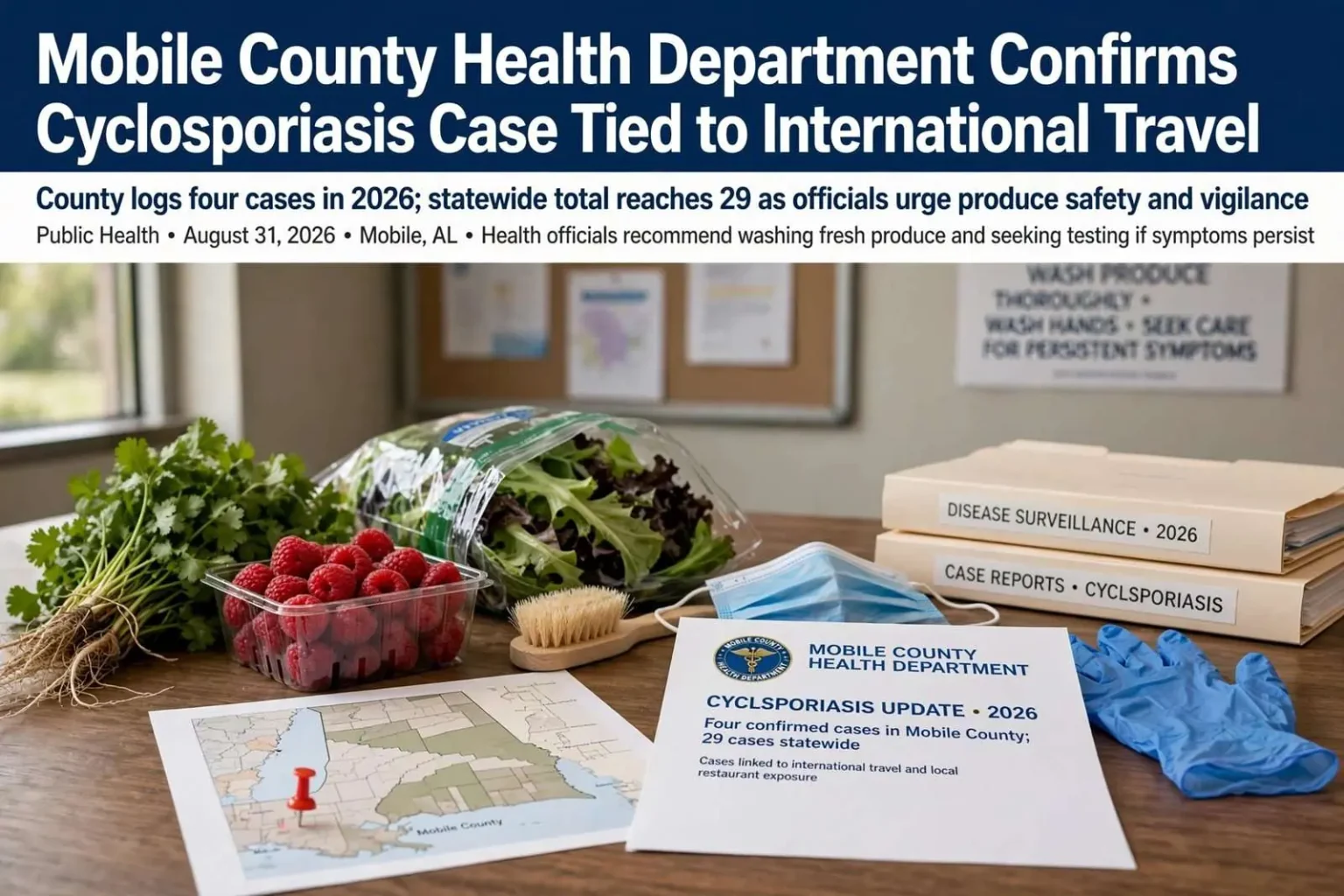
Mobile County Health Department Confirms Cyclosporiasis Case Tied to International Travel
Mobile County's cyclosporiasis case count has grown to four in 2026 as Alabama's statewide total climbs to 29, with health officials pointing to contaminated produce and both travel-related and local exposures.
The Mobile County Health Department has confirmed a case of cyclosporiasis in the county that may be tied to recent international travel. Cyclosporiasis is an intestinal illness caused by the parasite Cyclospora and is typically spread through food or water contaminated with the parasite.
“We have one local case now,” said Dr. Kevin Michaels, Health Officer for Mobile County. He said the health department’s investigation indicated the patient may have contracted the illness while traveling internationally.
State health officials have also reported a broader increase in cases. The Alabama Department of Public Health announced this week that 11 additional cyclosporiasis cases have been reported statewide, with most concentrated in the state’s Northern District, which recorded nine cases, while one case each was reported in the Northeastern and Southwestern districts. Two of those cases may be related to international travel, while a third could be associated with a foodborne outbreak at a Mexican-style restaurant, according to the state health department.
Alabama’s public health districts divide the state geographically for disease surveillance, and the concentration of cases in the Northern District — the region around Huntsville and the Tennessee Valley — drew attention because it suggested a common thread rather than scattered, unrelated infections. Travel history, restaurant exposure and produce sources are the first questions epidemiologists ask in every cyclosporiasis cluster, because the parasite’s long incubation period means patients were exposed weeks before they got sick.
Dr. Tommie Walker IV, epidemiologist and director of data analytics and epidemiology at the Mobile County Health Department, said the illness spreads when food or water becomes contaminated with small amounts of stool containing the parasite and is then eaten or consumed. Unlike many foodborne bugs, Cyclospora is not usually passed person to person; it needs time outside the body to become infectious, which is why contamination traces back to produce and water at the source.
He recommended washing fruits and vegetables thoroughly under running water before eating, cutting or cooking them, scrubbing firm produce with a clean produce brush, and washing hands thoroughly with soap and water before preparing or eating food, after handling raw food, and after using the restroom.
That advice matters more than usual with this parasite. Cyclospora has repeatedly been linked in national outbreaks to fresh produce — cilantro, mesclun lettuce, raspberries, snap peas and bagged salads among them — items that are often eaten raw and cannot be made safe by cooking. Washing reduces risk substantially, though health officials caution it may not remove every parasite from delicate produce, which is why trace-back investigations remain the backbone of outbreak control.
No hospitalizations or deaths tied to cyclosporiasis have been reported in Alabama so far, and nationally the Centers for Disease Control and Prevention says it has received more than 1,600 reports of the illness since May 1. Anyone experiencing frequent, watery diarrhea for more than 48 hours, particularly alongside symptoms such as stomach cramps, bloating, nausea, fatigue, loss of appetite or weight loss, is encouraged to see a healthcare provider for testing and appropriate treatment.
Case Count Climbs to Four Locally as Statewide Total Reaches 29
The county’s case count has continued to grow since that initial report. As of the health department’s most recent disease surveillance update, Mobile County has now confirmed four cyclosporiasis cases in 2026, and statewide, the Alabama Department of Public Health has recorded 29 cases so far this year.
Dr. Michaels said the county has already logged more cases this year than it typically records in an entire 12-month period. Not every case has an obvious link to travel, he said, complicating efforts to pin down a single common source.
“It’s not unusual when a lot of times people travel overseas, they may eat high risk food,” Michaels said. “And then we have some people that really haven’t gone anywhere.” Those local patients, he said, have instead pointed investigators toward specific restaurants or produce purchases as possible sources of exposure — echoing the earlier statewide case linked to a Mexican-style restaurant.
Symptoms typically take one to two weeks to appear after exposure, Michaels said, often starting with bloating and vomiting before progressing to watery diarrhea. “If you don’t get treatment, you can go on for months,” he said, adding that antibiotics are effective at clearing the parasite once it’s diagnosed. He again urged residents to avoid recalled produce and to wash fresh fruits and vegetables carefully to reduce the risk of infection.
The long course of untreated illness is one of the features that distinguishes cyclosporiasis from more familiar stomach bugs. Where a common case of viral gastroenteritis burns out in a day or two, Cyclospora infections can settle into a relapsing pattern — watery diarrhea alternating with apparent recovery, fatigue and weight loss that linger for weeks or months if the parasite is never identified. Standard over-the-counter remedies do not clear it; specific antibiotic therapy does, once testing confirms the diagnosis.
What Residents Should Know
For Mobile County residents, the practical guidance from local health officials has stayed consistent throughout the summer. Produce should be washed under running water before eating or cutting it, firm-skinned fruits and vegetables scrubbed with a brush, and hands washed with soap before food preparation and after handling raw produce. Anyone who experiences watery diarrhea lasting more than two days — particularly with cramps, bloating, fatigue or weight loss — should see a healthcare provider and mention any recent travel or restaurant meals, since that history helps investigators connect cases.
Testing matters beyond the individual patient. Cyclosporiasis requires a specific laboratory test that is not part of a routine stool panel, so infections can go unidentified unless a provider thinks to order it. Each confirmed case feeds the surveillance system that state and county epidemiologists use to spot clusters, trace contaminated produce to its source and trigger recalls before more people are exposed.
The Centers for Disease Control and Prevention tracks cyclosporiasis nationally during the summer and early fall, when most cases and outbreaks occur. The timing is not accidental: warm, wet conditions favor the parasite’s survival on produce, and summer brings the peak season for imported fresh herbs, berries and salad greens that have anchored past outbreaks. Travelers to tropical and subtropical regions face the highest overall risk, since the parasite is endemic in many countries where sanitation infrastructure differs from the United States.
Local health departments such as Mobile County’s serve as the front line of that national system. Investigators interview each patient, build a timeline of meals and purchases, and compare notes across jurisdictions to find the overlaps — a single restaurant, a single distributor, a single farm — that turn isolated cases into a traceable outbreak.
The absence of hospitalizations and deaths in Alabama so far is consistent with the disease’s usual course, which is miserable but rarely dangerous for otherwise healthy adults. The risk is greater for infants, older adults and people with weakened immune systems, for whom prolonged diarrhea and dehydration can require hospital care — one more reason officials urge residents not to simply endure symptoms that persist past a couple of days.
For now, the message from both the state and the county remains the same: avoid recalled produce, wash everything fresh, and get tested if symptoms linger. The case counts are expected to keep climbing until the summer produce season and the outbreaks tied to it wind down, and the health department will continue updating its surveillance reports as new confirmed cases are logged.
The Mobile County Health Department, which serves the county’s roughly 415,000 residents from clinics and offices across the area, runs one of the larger county public health operations in Alabama, combining disease surveillance, restaurant inspection, immunization and environmental health programs under one umbrella. Its epidemiology team is the unit that fields reports of unusual illnesses, conducts patient interviews and coordinates with the state health department in Montgomery when a case pattern suggests something bigger than a one-off infection.
That coordination is what turned a single local case into a statewide picture. County health departments report confirmed cases of cyclosporiasis — one of dozens of notifiable conditions in Alabama — to the state, which aggregates them by district and publishes surveillance updates. When the same pathogen starts appearing in multiple districts within a short window, investigators at both levels look for the connections: shared travel itineraries, shared restaurants, shared grocery suppliers.
Summer is the season when those connections matter most. Nationally, cyclosporiasis cases have clustered in the warm months every year for decades, and federal investigators have repeatedly traced outbreaks to imported produce that arrives in volume during the summer supply chain. The pattern repeats often enough that health officials pre-position their public messaging each year: wash produce, watch for symptoms, report persistent illness.
Local restaurants and grocers, for their part, rely on their suppliers’ documentation during outbreak investigations. When a case cluster points to a specific establishment, inspectors review where the implicated produce came from, how it was washed and stored, and whether any other customers reported illness. Establishments are generally cooperative in those reviews, since identifying a contaminated lot quickly — and removing it — protects both the public and the business.
For households, the prevention routine costs almost nothing. Running water and a clean brush handle most of the risk on firm produce; soap and water before and after food handling cover the rest. Officials emphasize washing even bagged, pre-washed salad greens, since bagging does not guarantee the absence of contamination — a point underscored by several national outbreaks tied to packaged salads in recent years.
The advice extends to recalled items as well. When a produce recall is announced, health officials urge consumers to check their refrigerators, discard or return the implicated product, and wash any surfaces it touched. Recalled produce that sits forgotten in a crisper drawer has been the source of illness long after the recall notice faded from the news.
Michaels’ broader message to county residents has been one of measured concern rather than alarm. The local case count — four confirmed so far this year, in a county of the Mobile’s size — remains modest by national standards, and no Alabama patient has required hospitalization. But the trend line matters: more cases in a few months than the county typically logs in a year, with sources that include both international travel and homegrown restaurant exposure, means the parasite is circulating in ways that reach ordinary residents.
Health officials will keep updating the surveillance reports as cases are confirmed, and the summer’s totals will ultimately feed into the national picture the CDC compiles each year. In the meantime, the department’s guidance stands: wash produce thoroughly, avoid recalled items, and see a healthcare provider if watery diarrhea lasts more than 48 hours — especially alongside cramps, bloating, fatigue, appetite loss or weight loss. Early testing shortens the illness, protects the people around the patient and gives investigators the data they need to shut down whatever source is still spreading the parasite.