Some Mobile Public Pools Remained Closed for Repairs in 2009
Several Mobile public pools remained closed after Memorial Day in 2009 while the city addressed federal safety requirements and repairs estimated at about $25,000 per pool.
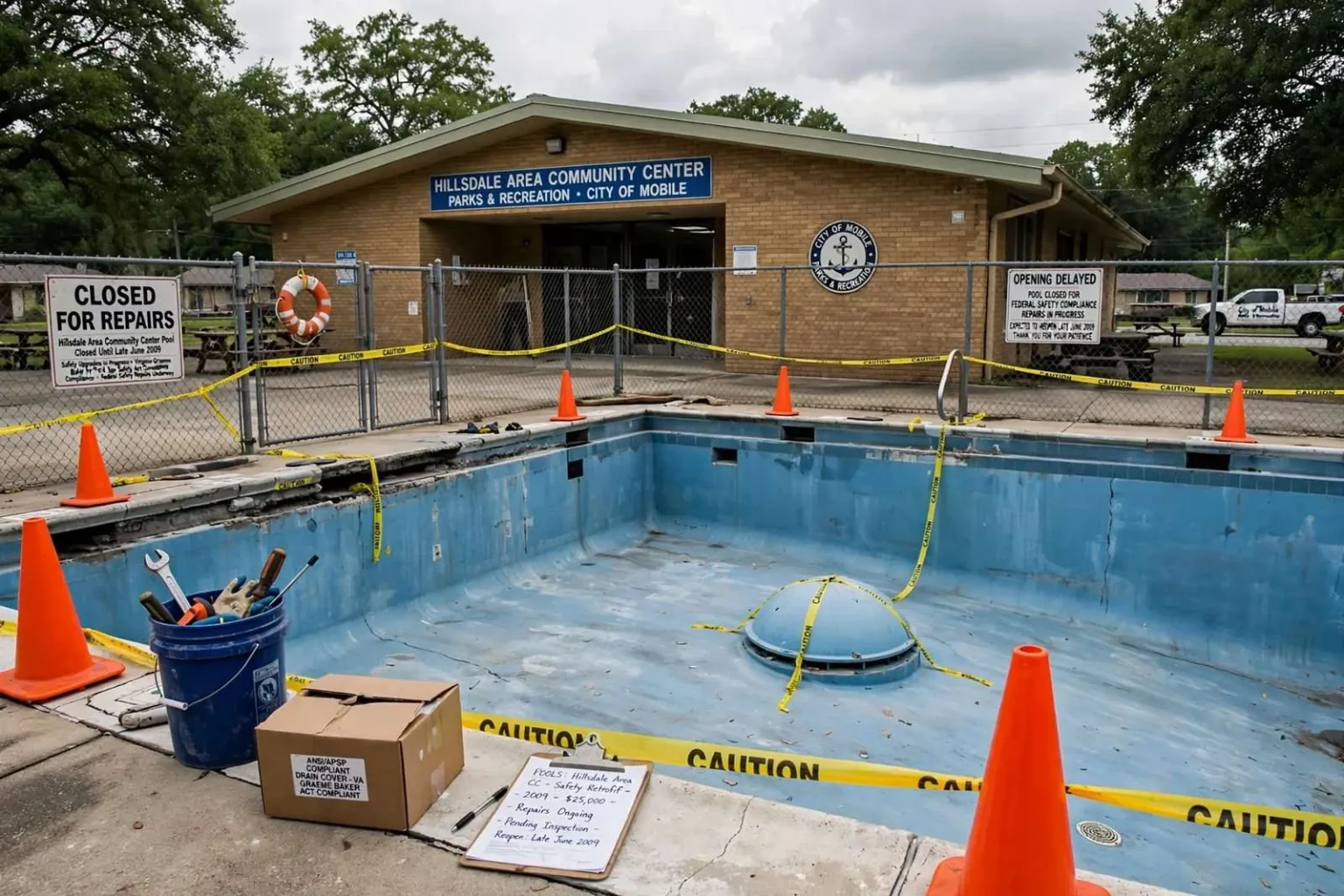
Several Mobile public pools remained closed after the Memorial Day opening weekend in 2009 while repairs were completed to meet federal safety standards. Residents near Hillsdale Area Community Center and Kidd Park said neighborhood pools were important during the summer, especially for families without transportation to more distant facilities.
The delays stemmed from safety work that the city had scheduled as the summer season began. Mobile architectural engineer Jay Isacks said some pools needed repairs to comply with newer federal requirements — rules that tightened pool safety after a wave of child entrapment incidents at pools nationwide, including the 2002 drowning of a seven-year-old that prompted Congress to act. The work was estimated at about $25,000 per pool, a cost that accumulated quickly across a system with multiple neighborhood pools.
Residents interviewed for the report wanted pools reopened but also emphasized that facilities should be safe before children returned to the water. Officials expected some sites to remain closed until later in June, meaning several neighborhoods would go without pool access for the first weeks of the season while the repairs were finished.
The Federal Rules Behind the Repairs
The federal requirements that forced the delays trace to the Virginia Graeme Baker Pool and Spa Safety Act, named for the granddaughter of former Secretary of State James Baker, who drowned in 2002 after being trapped by a hot tub drain’s suction. The law, passed in 2007 and enforced with deadlines that hit public pools at the end of 2008, required all public pools to install anti-entrapment drain covers and, in many cases, additional safety systems to prevent swimmers from being held underwater by drain suction.
The drain problem was more than theoretical. Suction entrapment occurs when a swimmer — usually a small child — sits on or near an uncovered single drain and the pump’s suction pins the swimmer in place, a hazard that has caused drownings and serious injuries in pools across the country. The federal law mandated dome-shaped, compliant covers and required public facilities to retrofit their circulation systems, and municipal pool systems like Mobile’s spent 2008 and 2009 working through the compliance requirements.
For a city the size of Mobile, the retrofit wave arrived with real costs. Each pool required inspection of its drain configuration, purchase and installation of compliant covers or safety vacuum release systems, and sometimes structural work to bring the plumbing into line. The roughly $25,000-per-pool estimate reported in 2009 reflected that scope, and the timing — repairs still unfinished at the Memorial Day opening — meant the compliance calendar collided with the swim season itself.
What the Closures Meant for Neighborhoods
The closures fell hardest on the neighborhoods around the facilities that remained shut. Families near Hillsdale Area Community Center and Kidd Park told reporters that the neighborhood pool was a summer anchor — a free, walkable place for children to swim, and for many households the only realistic option. Mobile’s public pool system exists precisely to serve families who lack transportation to private pools, beach outings, or the suburban facilities across the bay, and a closed neighborhood pool removes the only swimming access within walking distance.
Parks and recreation officials faced the standard municipal bind: open the pools on schedule and risk non-compliance with federal safety law, or keep them closed into June while the work was finished. The residents’ reaction, as reported, leaned toward patience with safety — the families wanted their pools, but they did not want children back in the water until the drain hazards were fixed. Still, every week of closure during a Mobile summer, when temperatures climb into the nineties and school lets out, is a week of lost programming for a neighborhood.
Public pools in Mobile carry a long history as neighborhood institutions. The city’s system has included pools at community centers and parks across the peninsula and into West Mobile for decades, operating through the summer with free or low-cost admission, and for generations of Mobilians the neighborhood pool was a defining summer memory. The 2009 closures, though temporary, touched that community network directly.
The City’s Pool System in 2009
Mobile’s public swimming pools in 2009 were operated by the city’s Parks and Recreation Department, scattered among community centers and parks so that most residential areas of the old city had a facility within reach. The system included pools at centers like Hillsdale and at parks such as Kidd Park, and the summer season traditionally opened on Memorial Day weekend, running into August when schools prepared to return. Lifeguards, swim lessons, and free-swim hours made the pools among the most-used facilities in the recreation inventory.
The city’s pools had also aged into a maintenance cycle by 2009. Many dated to the mid-twentieth century, and annual opening rituals included resurfacing, filtration work, and code updates layered on top of the ordinary wear that outdoor pools accumulate in a Gulf Coast climate. The federal retrofit requirements of 2008-2009 arrived on top of that backlog, and the repairs reported in June 2009 — roughly $25,000 per pool — represented the safety portion of a larger, ongoing obligation to keep aging facilities operating.
The staffing and budgeting of the pool system followed the city’s fiscal calendar, and 2009 was itself a difficult budget year nationwide, with municipal revenues squeezed by the recession that followed the 2008 financial crisis. Cities across the country were trimming summer programs that year, and Mobile’s ability to fund the pool repairs at all — rather than simply keeping pools closed for the season — reflected the priority the recreation system held even in a tight budget climate.
Heat, Safety, and the Summer Calendar
June in Mobile is a period when swimming access moves from luxury to necessity in the public-health sense. The city’s summer heat and humidity push outdoor activity into the water, and pediatricians and recreation directors alike treat structured swimming as an alternative to unsupervised water play — creeks, ponds, and drainage canals — that produces drownings every summer along the Gulf Coast. A closed neighborhood pool during June does not stop children from seeking water; it changes where they seek it, which is why the residents’ emphasis on reopening was grounded in more than convenience.
The same period produced the annual warnings about swimming safety: swim lessons, lifeguard supervision, and the reminder that drowning remains a leading cause of accidental death for young children, with minority communities historically showing higher drowning rates tied directly to unequal access to swim instruction. Public pools are the front line of that equation in cities like Mobile, where free or cheap swim lessons at neighborhood pools reach children whose families could not otherwise afford them.
Against that backdrop, the 2009 closures were a short-term safety trade with long-term stakes. Compliance with the federal drain standards protected against one of the rarest but most horrific pool accidents; keeping pools open and guarded protected against the far more common hazards of unsupervised swimming. City officials chose to complete the compliance work before reopening the affected sites, and expected the doors to open later in June — later than swimmers wanted, sooner than if the work had been abandoned.
Historical Facilities Note
This account reflects the condition and projected repairs reported in June 2009. It does not state the final reopening dates or the later condition of any Mobile public pool. The repairs described here were part of the nationwide compliance effort under the Virginia Graeme Baker Act, and the per-pool cost estimate came from the city’s own engineering staff at the time. Readers researching the current status of Mobile’s public pools should consult the city’s Parks and Recreation Department, whose facilities, schedules, and programming have changed in the years since this report was filed.
Memorial Day Openings and the Season’s Start
The Memorial Day weekend opening is the traditional start of the municipal swim season across the Gulf Coast, timed to the unofficial beginning of summer and the last school weeks before the break. In 2009, Mobile’s partial opening — some pools ready, several still under repair — meant families planning around the holiday learned which neighborhood facilities would be available and which would wait. The city’s expectation that the repaired sites would open later in June gave the season a staggered start rather than the simultaneous citywide opening the calendar promised.
The pattern of opening delays is a recurring feature of municipal pool operations, because the months between the summer seasons — fall through spring — are when the major work happens, and contractors’ schedules and equipment lead times do not always cooperate with a fixed holiday weekend. When federal compliance mandates enter the equation, with specific technical requirements and inspection steps, the schedule pressure multiplies. Mobile’s 2009 experience was repeated in cities across the country that year, as pool systems everywhere raced the same compliance clock.
How Neighbors Weighed In
The interviews with residents near Hillsdale and Kidd Park captured a practical, rather than political, response. The families were not calling for the city to abandon the repairs or for officials to be replaced; they were describing what the pool meant to their summer and saying plainly that safety came first. That combination — eagerness for the facility, insistence that it be safe — is the typical stance of neighborhoods around public pools, which depend on the city’s maintenance both for their recreation and for the credibility of the facility as a safe place to send children.
The transportation dimension the residents raised is central to how public pools function in a city like Mobile. A family with a car can reach any pool in the system, a water park, or the beach; a family without one is bounded by walking distance and bus routes. When the neighborhood pool closes, the options for those households shrink to almost nothing, which is why the closure of even one or two sites draws immediate attention from the surrounding streets. The residents’ comments about transportation reflected that arithmetic: the pool was not one option among many, it was the option.
Community centers with pools also function as more than swim venues in the summer. Their sites host camps, youth programs, and informal gathering, and the pool is the anchor that draws children into the rest of the center’s schedule. A pool closed into June pulls participation out of the whole complex, and recreation staff typically scramble to shift programming when it happens. The 2009 closures rippled in that way beyond the water itself, touching the summer schedules built around each facility.
What the Summer Cost
The measurable costs of the 2009 repairs were the $25,000 per pool that the city’s engineer cited, but the fuller ledger included the lost swim days, the rescheduled lessons, and the staffing adjustments that a delayed opening forces. Lifeguards hired for a Memorial Day start wait out the repairs; swim sessions planned for June shrink; and the city’s summer recreation calendar absorbs the gaps. Those costs do not appear in the repair estimate, but they are the reason pool operators work so hard to finish compliance work before the season rather than during it.
For the city’s Parks and Recreation Department, the summer of 2009 stands as a case study in the collision of aging infrastructure, federal safety law, and a Gulf Coast summer that waits for no repair schedule — a collision the residents around Hillsdale and Kidd Park experienced one closed pool at a time.