Senior Bowl Reached Long-Term Mobile Agreement in 2009
Senior Bowl officials and the Ladd-Peebles Stadium board reached a proposed long-term agreement in October 2009 to keep the annual game in Mobile through 2018.
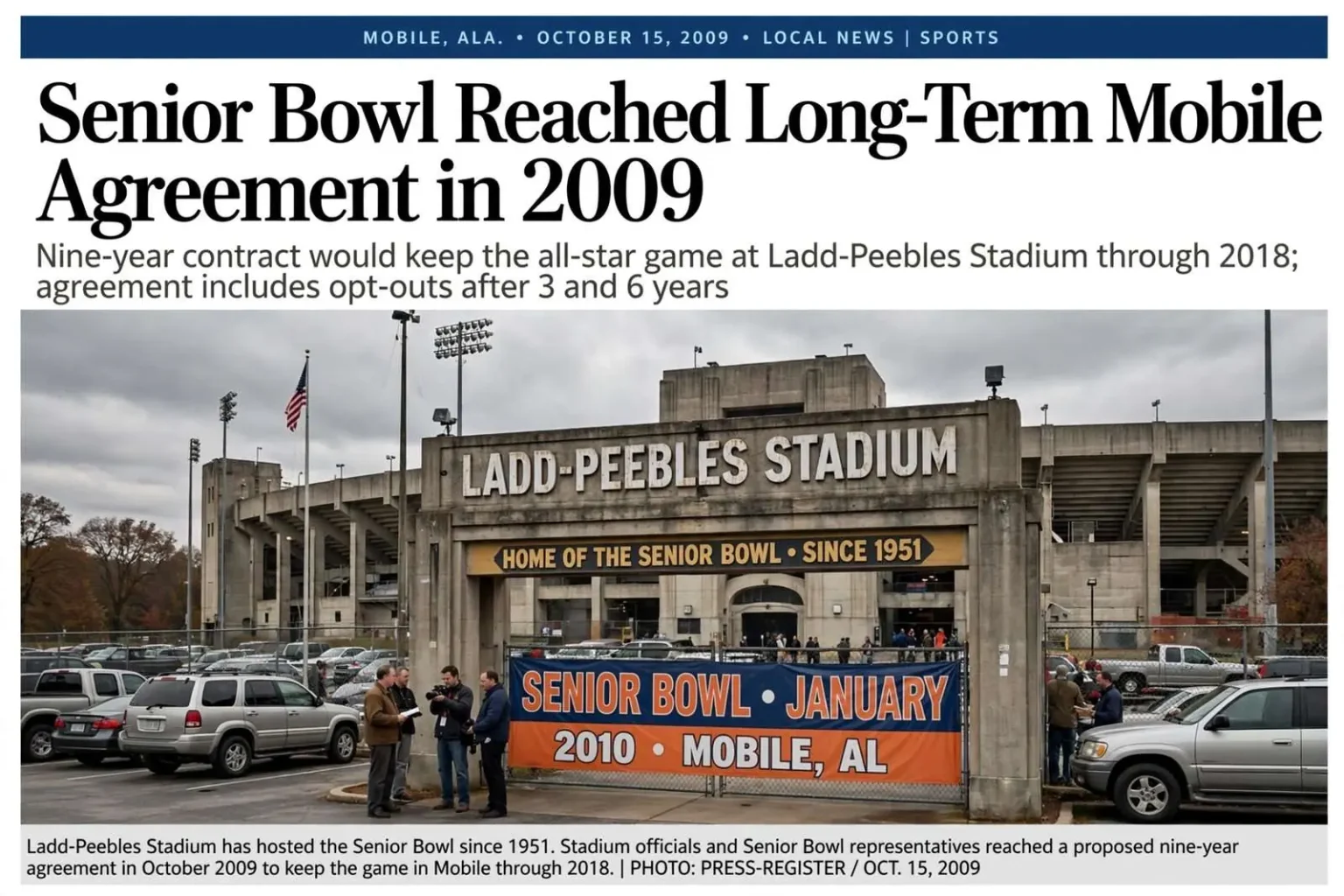
Senior Bowl officials and the Ladd-Peebles Stadium board reached a proposed long-term agreement in October 2009 to keep the annual all-star football game in Mobile through 2018, a nine-year contract that would secure the event’s future in the city where it had been played since 1951.
Milton Joyner, chairman of the stadium board, said the nine-year contract still required signatures before it could take effect. The agreement included options for the Senior Bowl to leave after three years and again after six years, escape hatches that gave the game’s organizers flexibility while extending the commitment well beyond the one-year deals that had governed recent seasons.
The negotiations followed an expiring contract between the two sides. The Senior Bowl and the stadium had already reached an agreement covering the 2010 game while continuing talks about a longer commitment, and the proposed deal would have layered nine more years on top of that arrangement, stretching the partnership through the 2018 game.
An event inseparable from Mobile
The Senior Bowl had been played in Mobile since 1951, making the city synonymous with the game that closes out the college football season and opens the NFL draft process each year. But its contract with Ladd-Peebles Stadium had expired in January, leaving the event’s future uncertain and opening the door for other cities to make their pitch.
Other cities, including Jacksonville, Florida, had been discussed as possible hosts before the negotiations concluded in Mobile’s favor. Jacksonville, with its NFL stadium and established infrastructure for hosting major football events, represented the kind of bidder that could plausibly pull the game away, and the possibility gave Mobile officials a clear sense of what was at stake in the talks.
For Mobile, keeping the Senior Bowl meant preserving an event with decades of history, national television exposure and an annual economic infusion from the fans, scouts and media members who descend on the city each January. The game brings hundreds of NFL coaches, executives and evaluators to the Gulf Coast for a week of practices, interviews and the contest itself, an audience no other event on the local calendar can match.
The negotiation also reflected the Senior Bowl’s own standing in the football world. By 2009, the game had grown into the premier college all-star showcase in the country, the event where NFL draft hopefuls work out in front of every team’s staff, and its value as a Mobile institution had never been higher. Cities across the South had long eyed the game, and its leadership had options that made a long-term homecoming commitment anything but automatic.
The terms on the table
The proposed agreement’s structure — nine years with exit options after three and six — balanced continuity with flexibility. The Senior Bowl would remain at Ladd-Peebles through at least the 2012 game, with the ability to reassess midway through the deal and again before its final years, while Mobile gained the stability of a documented commitment rather than a year-to-year existence.
Joyner’s public description of the deal made clear that signatures were still outstanding, a detail that mattered because proposals of this kind require board approvals on both sides before they become binding. Until the papers were executed, the agreement remained what both parties described it as: a proposal that reflected the terms they had reached at the negotiating table.
The sides had already secured the near term with the separate agreement for the 2010 game, which meant that whatever happened with the long-term talks, the Senior Bowl would play at Ladd-Peebles that January. That arrangement took the immediate deadline pressure off the negotiations and allowed both sides to work through the details of a nine-year commitment without the threat of a near-term departure hanging over the process.
Ladd-Peebles and its longtime guest
Ladd-Peebles Stadium, the 40,000-seat venue in the heart of Mobile, has been the city’s signature football facility for generations. Opened in 1948, it has hosted high school championships, college games and professional exhibitions, but no event is more closely identified with the stadium than the Senior Bowl, which has used its sideline as the stage for decades of future NFL stars.
The game’s history in Mobile dates to 1951, when the all-star contest settled in the city after its early years elsewhere. Over the decades it became woven into Mobile’s civic identity — a January tradition that draws visitors during the relative lull of the winter calendar and gives the city an annual national spotlight ahead of the NFL draft.
The prospect of Jacksonville or another city landing the game was treated locally as more than a scheduling matter. The Senior Bowl’s week of practices, its weeknight events and its game day fill hotels, restaurants and venues across Mobile, and the event’s charitable and community programs touch the city well beyond the football calendar. Losing it would have meant losing a piece of the city’s sports identity as well as its economy.
The options written into the proposed contract acknowledged the realities of the modern event business. All-star games around the country had relocated in search of better facilities or stronger guarantees, and a nine-year term without flexibility would have been difficult for any event to sign. The escape clauses let the Senior Bowl commit to Mobile while preserving its ability to respond if circumstances changed.
What the proposal did and did not settle
This account reflects the proposed October 2009 agreement and the terms publicly described at that time. It does not state later contract amendments or the event’s current hosting arrangement, and readers should consult current sources for where the Senior Bowl plays today.
What the proposal settled in 2009 was the immediate question facing the game and the stadium: whether Mobile would retain an event it had hosted for nearly six decades, or watch it move to a city with newer facilities and a larger offer. The negotiators’ answer, at least as proposed, was to extend the partnership through 2018 with structured checkpoints along the way.
For the stadium board, led by Joyner, the talks capped a period of uncertainty that began when the old contract lapsed in January. For Senior Bowl officials, the deal secured the venue that generations of draft prospects had made famous. And for Mobile, the proposal represented the city’s best argument for itself — that the Senior Bowl belonged where it had always been, on the field at Ladd-Peebles, with the signatures to prove it once the documents were signed.
Why the Senior Bowl matters to the NFL calendar
The Senior Bowl occupies a unique position in the football calendar. Played each year after the college season ends, it gathers the nation’s top senior prospects for a week of coached practices that NFL teams treat as a working draft evaluation — every team sends coaches, general managers and scouts to Mobile, and the practice fields at Ladd-Peebles become as consequential as the game itself.
For players, the week is an audition with league-wide stakes. Seniors from smaller programs compete directly against stars from national powers, and strong practices have lifted countless players into higher rounds of the draft. The game’s alumni list runs through decades of Pro Football Hall of Famers, a history that gives the event credibility no marketing budget could buy.
That is the asset Mobile was negotiating to keep in 2009. The game’s brand had been built in the city, and its organizers weighed that heritage against the physical limitations and financial terms of the stadium that hosted it. Cities bidding against Mobile offered newer venues, but they could not offer six decades of continuity, and the talks tested how the two sides of the ledger balanced.
The October 2009 proposal suggested the balance favored staying. A nine-year term through 2018 would carry the partnership to its seventh decade, giving both the Senior Bowl and Ladd-Peebles a long horizon for planning improvements, sponsorships and the community events that surround game week.
The stadium’s role in Mobile’s sports economy
Ladd-Peebles Stadium anchors a sports economy that extends well beyond one game each January. The venue hosts Mobile County high school football throughout the fall, including rivalry games and playoff contests that fill its stands every Friday night, and it has served as the site of championship events and other showcases across its history.
That calendar depends in part on the facility’s flagship tenant. The Senior Bowl’s presence has supported maintenance investments and kept the stadium in the public eye, and the event’s national profile lends prestige to the venue that other bookings draw on. A departure by the game would have left a January hole in the schedule and raised questions about the stadium’s long-term role in the region’s sports landscape.
The negotiations of 2009 captured both sides of that relationship at a moment of decision. The Senior Bowl needed a home with history and community support; the stadium needed an anchor tenant with national standing. The proposed agreement to continue through 2018, with its three-year and six-year options, was the framework both sides put forward to keep that relationship alive.
Mobile’s victory in the talks — concluded in the city’s favor after competition from Jacksonville and other cities had entered the discussion — preserved a tradition that began in 1951, when the game first came to town and began its transformation into the draft-season institution it is today. The signatures still to come in October 2009 would turn the proposal into a contract, and the contract into another chapter of the longest-running partnership in Mobile sports.