Theodore Fleet-Service Business Reopened After 2009 Arson Fire
After an August 2009 arson fire destroyed three Theodore automotive businesses, American Fleet Service reopened at a new location while its owner faced layoffs and financial strain.
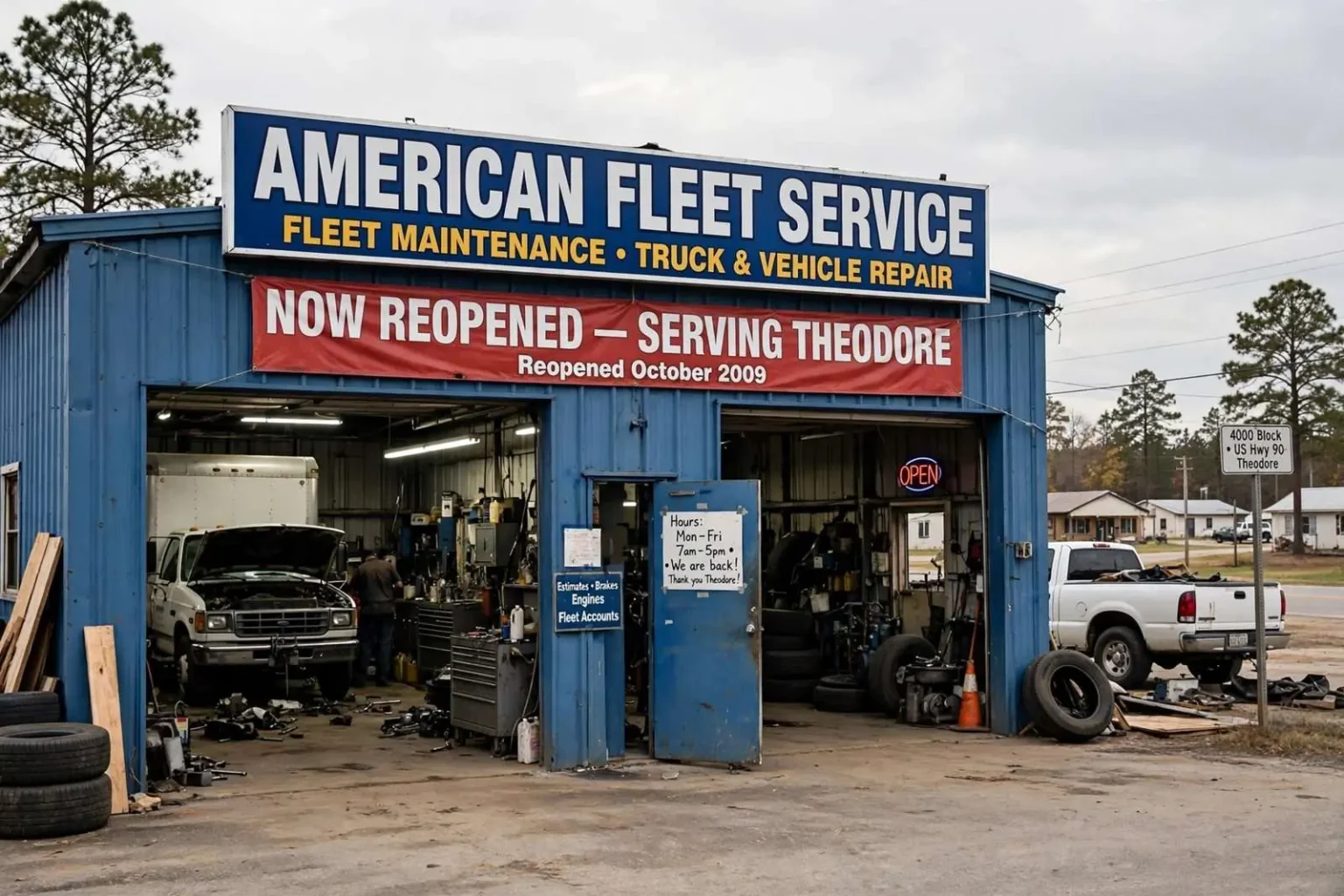
Less than two months after a fire destroyed three Theodore automotive businesses, one of the affected operations was working to restart in a new location — while another was gone for good. The Aug. 14, 2009 blaze leveled Candy City Paint and Body, American Fleet Service and Fat Boyz Choppers, and fire officials had determined that the fire was arson, according to the follow-up report.
The fire struck a stretch of the Theodore community where automotive work has long been a fixture of the local economy. Three businesses in one fire meant three sets of equipment, tools, customer vehicles and records destroyed in a single night, and for the owners it meant sorting through insurance, relocation and survival questions while investigators continued working a case that had been ruled deliberately set.
One business restarted; another closed
Freddie Goodman, who owned American Fleet Service and Fat Boyz Choppers, said the motorcycle shop was gone for good. The decision to close Fat Boyz Choppers permanently reflected the arithmetic many small proprietors face after a catastrophic loss: rebuilding a specialty business — custom motorcycle work depends on specialized equipment, a customer base and momentum — from nothing is a different proposition than restarting a service operation with steadier demand.
American Fleet Service, however, had found a new home and was trying to continue operating. Fleet-service work — maintaining and repairing the trucks and vehicles that businesses depend on — builds its value on relationships with commercial customers, and Goodman’s attempt to restart in a new location was an effort to preserve those relationships rather than lose them to competitors while the shop was dark.
Goodman said the restart was difficult. Recent hardships had forced him to lay off several employees while the fleet-service business worked to get back on its feet. For a small shop, layoffs of that kind are the last resort taken after the owner has exhausted easier options, and they meant skilled workers with knowledge of the business’s customers were lost at exactly the moment a rebuilding operation needed every hand it could keep.
A snapshot of recovery after the fire
The October 2009 report documented the immediate business impact of the fire and the practical challenge of rebuilding a local operation. It captured a moment typical of the aftermath of commercial fires: one owner scaling back to essentials, another walking away, and the physical scars of the fire still visible at the site where three businesses had operated.
The report did not identify a person responsible for the arson or report a later outcome of the investigation. That absence left the community with an unresolved question that followed the economic one — who set the fire, and whether anyone would ever be charged. Commercial arson investigations can run for months or years without an arrest, particularly when the evidence itself burned, and no break in the case was reported at the time.
The recovery story playing out in Theodore was, in miniature, the story every small business faces after a disaster. Insurance proceeds rarely arrive quickly enough to cover payroll, and the gap between the fire and a functioning operation is where small businesses are won or lost. Goodman’s decision to restart American Fleet Service while letting Fat Boyz Choppers go was a triage decision of exactly that kind — choosing the business with the stronger path to survival and accepting the permanent loss of the other.
Theodore’s automotive economy
Theodore, an unincorporated community in southern Mobile County along U.S. Highway 90 west of Mobile, has historically been home to exactly the kind of businesses the fire destroyed. The community’s economy grew around its port facilities at nearby Theodore Industrial Canal, the shipbuilding workforce in the area, and the commercial strips that serve residents of the surrounding neighborhoods. Automotive repair, paint and body work, and specialty shops are the backbone of that commercial base — businesses that employ a handful of skilled workers each and serve customers who rely on them daily.
That profile is also what makes fire so destructive to a community like Theodore. Unlike a chain retailer, a family-owned paint and body shop or a custom motorcycle business cannot shift its operations to another branch; its equipment is specialized, its customer files are local, and its skilled employees cannot easily be replaced. When three such operations burn at once, the loss extends beyond the owners to the employees, the commercial customers who depended on fleet service, and the everyday customers whose vehicles were inside the buildings.
The determination that the fire was arson added a further layer to the loss. A business owner whose shop burns accidentally can at least close the chapter; an arson case leaves questions open indefinitely. Investigators treat commercial fires of this scale with full forensic workups — origin analysis, accelerant detection, interviews — but the process is slow, and by the time of the October 2009 follow-up report it had produced no publicly named suspect.
What the months after the fire showed
The roughly eight weeks between the August fire and the October report told much of the story. In that window, Goodman had already located a new home for American Fleet Service, made the decision to close Fat Boyz Choppers permanently, and laid off employees — a compressed sequence that illustrates how quickly the aftermath of a commercial fire resolves into permanent consequences.
The layoffs, in particular, showed the collision between disaster and payroll that defines small-business recovery. Fleet-service work runs on contracts and repeat commercial customers, and those customers need their trucks serviced whether or not their provider has a building. Every week without an operating shop is a week customers spend finding another provider, and the expense of restarting — new lease, equipment replacement, rehiring — arrives before any revenue resumes. Laying off several employees was a signal that the restart was consuming resources faster than they could be replaced.
This article is a historical account based on information available at the time of the report. It documents the immediate business impact of the fire, the determination by fire officials that the blaze was arson, and the recovery decisions made in the weeks that followed — not the eventual outcome of the investigation or the long-term fate of the businesses involved, which the October 2009 report did not address.
The broader pattern for small shops
Stories like Theodore’s repeat across the Gulf Coast every year, and they follow a familiar arc: fire, insurance delay, triage among the affected businesses, and a recovery that is never complete. The businesses that survive a catastrophic loss tend to be the ones with steady commercial demand — as fleet service had — while specialty retail and custom operations, like the motorcycle shop, often do not reopen. The October 2009 report captured that sorting process in its early weeks, with one operation already restarted and another already conceded.
Arson investigations on the Gulf Coast
The determination that the Theodore fire was deliberately set placed the case in the hands of investigators whose work rarely moves at the speed of the businesses it affects. Commercial arson investigations in Mobile County typically involve the local fire marshal’s office working alongside other agencies, and the first weeks are consumed by scene analysis: identifying the point of origin, reading burn patterns, collecting debris samples for laboratory testing and interviewing anyone connected to the properties.
Three businesses sharing a fire scene complicates that work considerably. Investigators must establish where the fire started and how it spread through multiple structures, and each additional building multiplies the variables. Insurance companies run their own parallel investigations, since arson determinations affect coverage decisions, and their findings can add pressure or produce information that criminal investigators do not share publicly. By October 2009, none of that process had produced a named suspect or any reported outcome, and the report made a point of noting that fact rather than speculating.
The absence of an arrest also left the affected owners in a difficult position with their insurers and their neighbors. Without a suspect, there was no explanation to give customers wondering whether the fire was related to anything at the businesses themselves, and no closure for owners deciding whether to rebuild at the same site or move on entirely. Goodman’s choice to restart American Fleet Service in a new location rather than rebuild on the old site may well have reflected exactly that uncertainty.
The employees behind the businesses
For the workers at the three destroyed businesses, the fire’s consequences arrived faster than any insurance settlement could. Automotive technicians, painters and motorcycle mechanics are skilled trades whose livelihoods depend on their tools and their employer’s shop, and a fire takes both at once. The layoffs at American Fleet Service meant experienced employees entering a job market during the worst economic downturn in a generation, when 2009’s recession had already depressed demand for automotive work across the Gulf Coast.
That context matters for understanding why the restart was so difficult. The 2009 economy gave a struggling shop almost no cushion: commercial customers were cutting their own fleets’ maintenance budgets, consumers were repairing rather than replacing vehicles but deferring discretionary work, and credit for small-business recovery was tight nationwide. A fleet-service operation restarting in a new location in that environment was fighting the recession and the fire at the same time.
The report’s account of Goodman laying off several employees while working to get back on his feet captures that squeeze in a single detail. The reconstruction of a small business after a fire is rarely a straight line, and in 2009 Theodore it was happening against economic headwinds that had nothing to do with the blaze — headwinds that determined how quickly customers returned, how much revenue the restarted shop could count on, and whether the employees laid off during the gap could ever be hired back.
Remembering the fire as history
Fifteen years on, the Aug. 14, 2009 fire stands as a case study in what disaster does to a small commercial district. Three businesses destroyed in a single arson fire; one owner closing permanently within two months; another restarting against the odds and the recession; an investigation that produced no publicly reported resolution. The October 2009 report preserved that snapshot — the facts as they stood at the time, without the hindsight that later years might have provided — and it remains the fullest public account of how Theodore’s business community absorbed the loss.