Mobile Fire Officials Investigated 2007 Child Fatality in Home Fire
Mobile fire officials investigated a 2007 house fire in which a 2-year-old child died, according to an archived WKRG report.
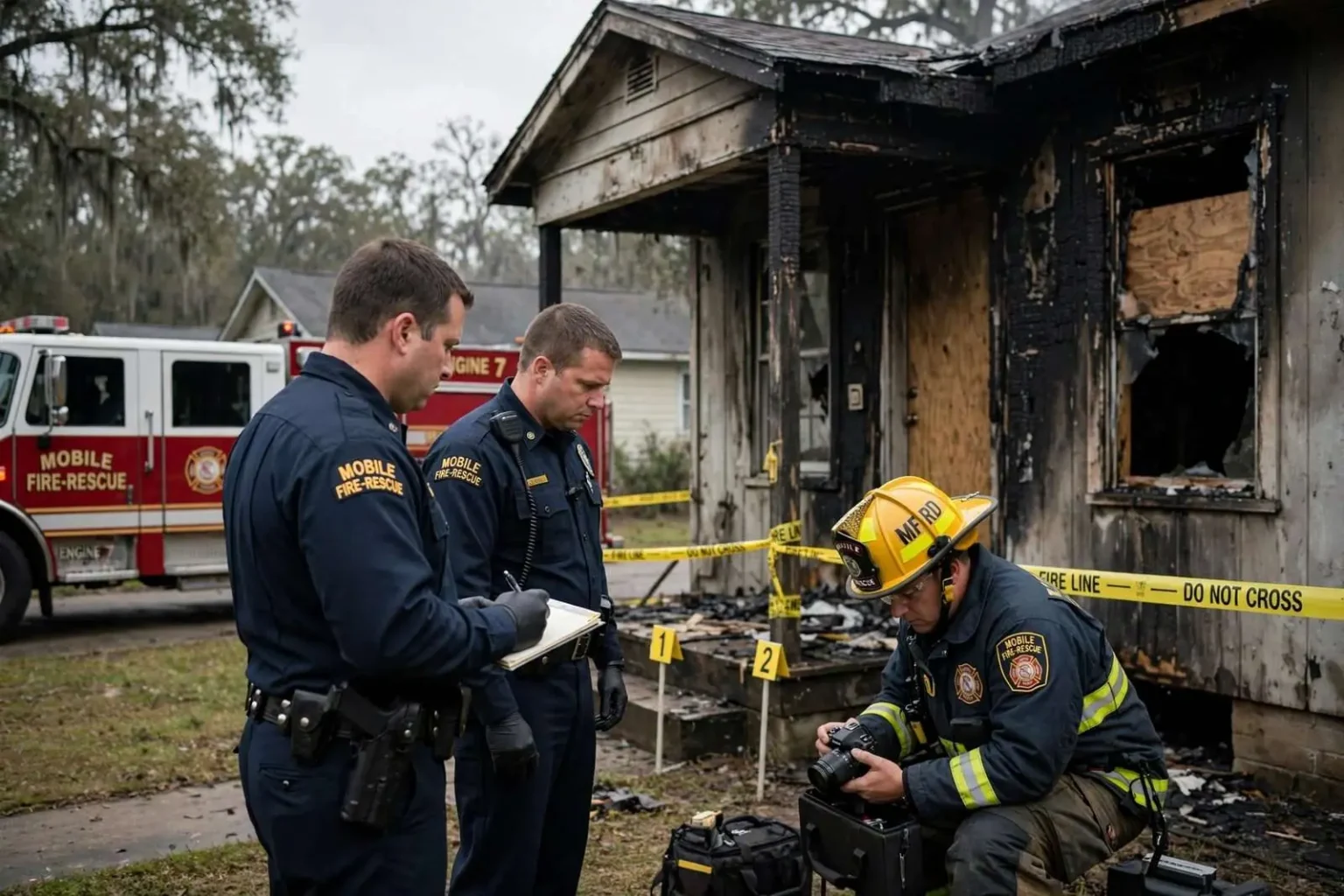
MOBILE, Ala. — Mobile fire officials investigated a house fire in 2007 in which a 2-year-old child died, according to an archived local news report preserved from the era. Firefighters responded to the residence after the blaze was reported, and an investigation into the fire followed, as is standard practice whenever a fire claims a life. This account intentionally omits identifying and graphic details out of respect for the family, and it records the historical incident without stating any later investigative findings.
When a fire kills, the response that follows is necessarily twofold. Firefighters confront the blaze itself — attacking the flames, searching for anyone inside, and doing everything possible to pull victims out alive. Afterward, investigators take over the slower and equally urgent work of determining where the fire started, how it spread, and why it turned deadly. That investigation, undertaken by Mobile fire officials after the 2007 tragedy, serves two purposes: it can answer questions for a grieving family, and it can identify hazards that might otherwise claim more lives.
House fires remain among the most dangerous emergencies families face, and the youngest members of a household are the most vulnerable of all. Very young children cannot escape on their own, cannot understand smoke alarms or instructions, and are often asleep in bedrooms far from an exit when fire breaks out. Fire safety advocates have long emphasized that the deaths of young children in residential fires are, in the overwhelming majority of cases, preventable events — and that the tools of prevention are simple, inexpensive, and within reach of every household.
What investigators look for
Fire investigation is a discipline of patient science. Investigators examine burn patterns to trace a fire back to its point of origin, test for the presence of accelerants, inspect electrical systems and appliances, and interview occupants, neighbors, and first responders. In cases involving a fatality, the medical examiner’s office also plays a role in determining the cause of death. The resulting findings can close a case as accidental, point to a dangerous product or practice, or, in some instances, uncover a crime.
The public record of the 2007 Mobile fire, as preserved in the archived report, describes only the response and the investigation itself. The report did not state later investigative findings, and no conclusions about the fire’s cause are part of this account. That restraint is deliberate: out of respect for the family, and because the value of remembering an incident like this lies not in relitigating its details but in the lessons it holds for every household that hears about it.
For the firefighters and paramedics who responded, calls involving children are the ones that stay with them. Fire service professionals across the country describe pediatric fatalities as among the most difficult calls of a career, and departments invest in peer support and counseling precisely because the weight of such incidents accumulates. Behind every archived news report like this one stands a crew that ran toward the fire, and a family whose life changed in a single morning or night.
The lessons that save lives
The hard statistics of home fire safety in the United States point to a short list of measures that make the difference. Working smoke alarms cut the risk of dying in a home fire roughly in half, yet a substantial share of home fire deaths occur in homes with no working alarm — often because batteries were removed or dead ones never replaced. Safety agencies recommend alarms inside every sleeping room, outside each separate sleeping area, and on every level of the home, tested monthly and replaced on schedule.
Escape planning is the second pillar. Families are urged to draw a simple map of their home, identify two ways out of every room, agree on a meeting place outside, and practice the drill with children — including the lessons that matter most for the youngest: the sound of the alarm, staying low under smoke, feeling doors for heat before opening them, and never hiding from firefighters. In the middle of the night, when most fatal home fires occur, a rehearsed plan is the difference between seconds wasted and seconds saved.
Prevention completes the picture. Most deadly home fires start in ordinary places: cooking left unattended, space heaters placed too close to bedding and curtains, cigarettes, overloaded electrical circuits, and, in colder months, alternative heating used without care. Parents of small children are reminded that matches and lighters must be kept out of reach, that children should never be left alone near cooking or heating equipment, and that a child’s bedroom door — closed at night — can buy precious minutes against smoke.
In Mobile, as across the country, fire departments make free or low-cost smoke alarms available to residents and conduct outreach aimed at exactly these lessons. The Mobile Fire-Rescue Department has long been active in public education, and the memory of incidents like the 2007 fire gives that work its urgency. Every alarm installed, every drill practiced, and every heater moved away from the curtains is a small act of protection against a repetition.
More than a decade and a half later, the 2007 loss recorded in the archived report stands as a quiet marker of why that work continues: a 2-year-old child gone in a single fire, a family’s grief preserved in a few lines of newsprint, and a community reminded — as often as such reports must be written — that fire is fast, that the young are its most helpless victims, and that the measures which prevent these tragedies are simple, cheap, and available to everyone.
Understanding how a fatal house fire unfolds helps explain why prevention matters so much. Fire scientists describe a modern phenomenon known as flashover — the moment when every combustible surface in a room ignites nearly at once. Decades ago, furnishings of wood, cotton, and wool burned slowly, giving occupants many minutes to escape. Today’s homes are filled with synthetics that burn faster and hotter, and research has shown that the window to escape a house fire has shrunk dramatically, from what was once estimated at many minutes down to as little as two or three.
That compressed timeline is why smoke alarms carry such weight in fire safety. An alarm’s value is measured in the seconds it gives a family before conditions in the house become unsurvivable. It is also why firefighters urge residents never to investigate an alarm or pause to gather belongings: the modern fire gives no time for either. Get out, stay out, and call for help from outside — the advice bears repeating because in the moment, human instinct pulls in the other direction.
The fire service on the front line
The Mobile Fire-Rescue Department, which responded to the 2007 fire, operates a network of stations across the city and stands among the region’s major fire services, protecting a port city of nearly 200,000 people with a force trained in firefighting, emergency medical response, hazmat, and technical rescue. The department’s paramedic-level response means that on calls like the 2007 one, the crews arriving at the scene are both firefighters and emergency medical providers — capable of fighting the fire and, tragically when necessary, attempting resuscitation of its victims.
Departments across the Gulf Coast confront a fire environment shaped by the region’s housing stock, its climate, and its cycles of poverty and aging infrastructure. Older homes with outdated wiring, homes without adequate smoke protection, and mobile homes — which burn faster than site-built houses and account for a disproportionate share of fire deaths relative to their numbers — all figure in the region’s fire loss. Winter months bring their own spike, as heating equipment comes into use, but deadly fires occur in every season.
After a fatal fire, departments typically review the incident for operational lessons as well. Response times, hydrant locations, building construction, and the effectiveness of the first-arriving companies all feed into after-action review. That internal work rarely makes the news, but it is part of how a fire service honors a loss — by extracting from it every improvement that might save the next family.
How communities remember
Archived news reports like the one preserving the 2007 incident serve as the community’s memory. Decades later, most residents will not recall the individual fire, but the record remains: a child lost, a family’s catastrophe, and a department’s response. Such records also serve researchers and safety advocates, who track fatal fire patterns across years to target prevention programs where they are needed most — neighborhoods with older housing, areas with low alarm ownership, seasons and circumstances where the risk concentrates.
Nationwide, fire death rates have fallen substantially over the decades as smoke alarms became universal, building codes improved, and public education spread. But the decline has been uneven, and children, older adults, and residents of low-income households remain at elevated risk — the groups least able to escape on their own and least likely to have working protection in place. Every community’s fatal fires, including Mobile’s, map onto those same demographics, which is why fire departments put such emphasis on free alarm programs and neighborhood outreach.
For the family connected to the 2007 Mobile fire, the passage of years does not soften the loss. Communities that experience such tragedies often channel grief into action — alarm drives, memorial efforts, donations to burn centers and to the families left behind. That transformation of loss into protection is the most constructive remembrance a community can offer, and it is the reason reports like this one end not with the fire itself but with what every household can still do.
Check the smoke alarms tonight. Practice the escape plan this weekend. Keep lighters and matches locked away, keep a watchful eye on every cooking surface and heater, and make sure every child in the house knows the sound that means get out now. Those small acts are the living answer to tragedies like the one recorded in 2007 — the way a community says, with action rather than words, that a 2-year-old’s death will not be repeated in its own homes.