Theodore Auto Businesses Destroyed in 2009 Fire
Three Theodore automotive businesses were destroyed in an August 2009 fire, leading Mobile Fire-Rescue and federal investigators to examine the cause.
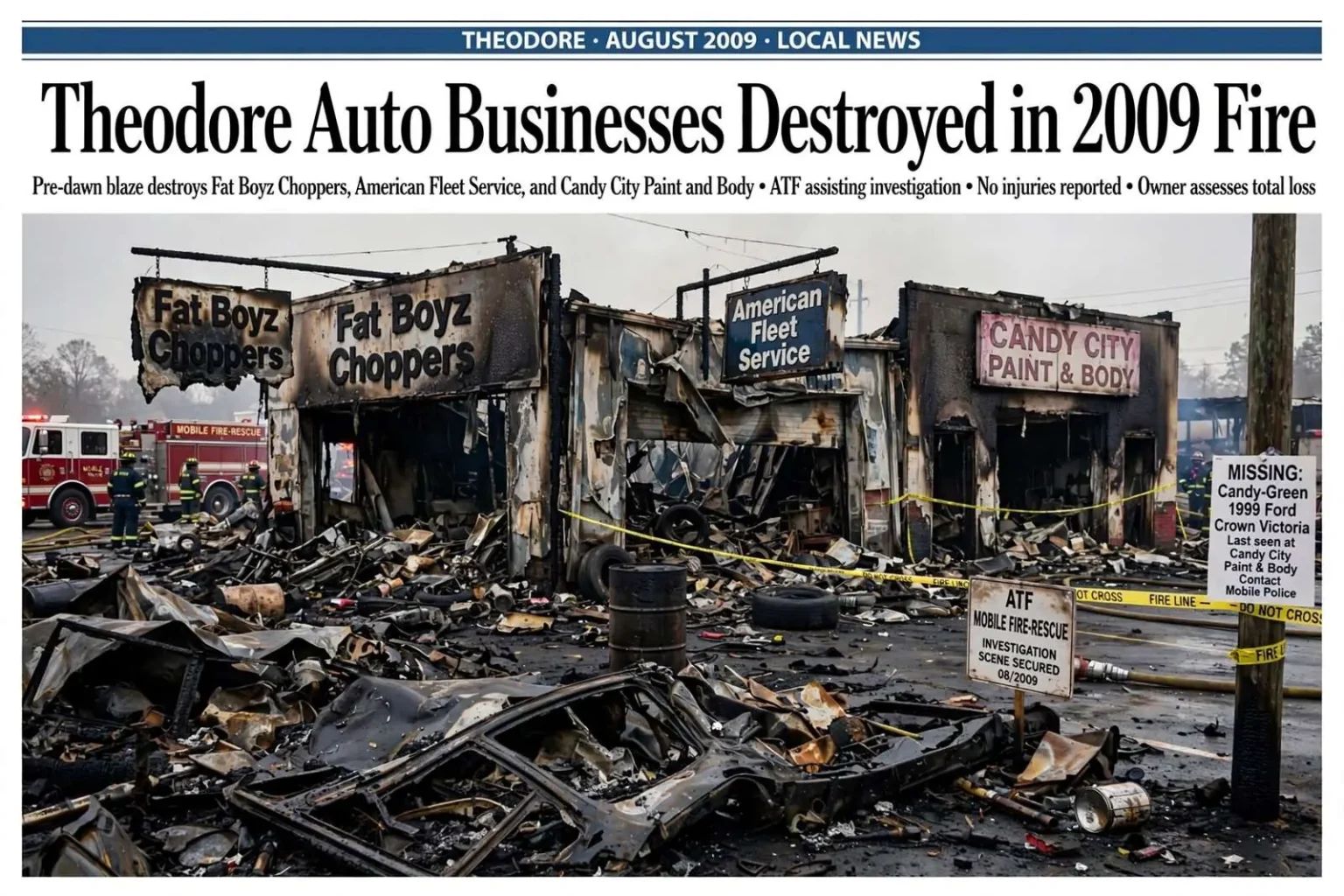
Three automotive businesses in Theodore were destroyed by an early-morning fire in August 2009, leaving their owner to assess the loss of enterprises he had spent years building. Fat Boyz Choppers, American Fleet Service and Candy City Paint and Body were all damaged beyond repair, according to the initial report, and the blaze left investigators with one of the more complicated fire scenes the area had seen. No injuries were reported — the one piece of good news in a night that erased three businesses and their inventory in a single morning.
The fire struck in the pre-dawn hours, the window when commercial fires do their worst damage because no one is present to catch them early. By the time crews arrived, flames had moved through structures filled with the materials any automotive compound accumulates: paint, solvents, oils, fuels and the stock-in-trade of a custom motorcycle shop, a fleet-service operation and a paint-and-body business operating side by side.
Investigators Examined a Difficult Scene
Mobile Fire-Rescue said the buildings contained numerous automotive chemicals, complicating efforts to determine the fire’s cause. Chemical storage of that kind does two things to an investigation: it raises the danger to firefighters and investigators working the scene, and it accelerates destruction of the physical evidence fire marshals depend on to reconstruct where and how a blaze began. Structures consumed that thoroughly leave little of the pattern evidence investigators normally read.
Because of that difficulty, the Bureau of Alcohol, Tobacco, Firearms and Explosives was asked to assist. The federal agency brought specialized tools for exactly that type of investigation — accelerant detection, laboratory analysis of fire debris and the deep experience of a bureau whose agents investigate commercial fires nationwide. The ATF’s involvement signaled the scene’s complexity rather than any conclusion; the bureau routinely assists local agencies on fires where the cause cannot be quickly established, and its fire research capabilities are among the most advanced available to any investigating agency.
During the investigation, Mobile Police also reported that a candy-green 1998 or 1999 Ford Crown Victoria was missing from Candy City Paint and Body. The distinctive vehicle — its unusual color making it immediately recognizable — became a public ask as police sought information about where the car had gone. The report did not establish a connection between the missing vehicle and the fire, and officials treated the two threads separately while both investigations proceeded.
The missing-car detail gave the case one of its enduring public questions: whether the Crown Victoria had been taken before the fire as part of an unrelated theft, or whether its absence meant anything at all. Neither the initial fire investigation nor the police report resolved it. What the report did establish was the fact of the disappearance — a paint-and-body shop with a bright green full-size Ford missing from its lot, in the same days the shop itself burned beyond recognition.
A Major Loss for a Local Owner
Owner Freddie Goodman said he had spent nearly a decade building Fat Boyz Choppers and American Fleet Service, the two businesses anchored by the compound that burned alongside the neighboring paint-and-body shop. Nearly ten years of customer relationships, equipment purchases and shop reputation were consumed in one morning — the specific, grinding loss that follows a commercial fire: lifts and tools ruined by heat, customer vehicles destroyed, records gone, and a workforce suddenly without a workplace.
The fire destroyed those businesses along with the neighboring paint-and-body shop, wiping out a small automotive campus that had grown into a full-service operation over the years. In communities like Theodore — the unincorporated Mobile County community between Mobile and the industrial corridors to the south — independent automotive shops serve as neighborhood institutions, the places where residents build long relationships with the people who keep their vehicles running. The loss of three at once was felt across the area’s car-and-truck community.
Theodore’s Commercial Landscape
Theodore’s automotive businesses cluster along the corridors that connect the community to Mobile, serving both local drivers and the heavy traffic that moves through the area toward the port facilities, shipyards and industrial plants of south Mobile County. A compound combining a custom chopper shop, a fleet-service garage and a paint-and-body operation under one ownership reflected the practical economics of the trade: the three businesses fed one another, with fleet customers, custom builds and collision work moving between them.
Fires of this kind — early-morning, commercial, and involving chemical-heavy contents — are among the most difficult a fire department faces. The August 2009 blaze in Theodore fit the pattern: structures fully involved on arrival, hazardous materials complicating suppression, and an origin-and-cause investigation that would need federal assistance to untangle. Mobile-area agencies have long cooperated on such scenes, with Mobile Fire-Rescue’s investigators, Mobile Police and federal partners each taking the piece of the puzzle their expertise fits.
For business owners along the corridor, the destruction of three shops in one night was a reminder of the exposure that comes with automotive work. Paint shops and garages carry flammable inventory that no amount of care eliminates, and the insurance and fire-prevention practices that follow a loss like Goodman’s tend to spread through the local business community as owners review their own facilities.
What the Record Shows — and What It Doesn’t
This account reflects the information released during the initial August 2009 response. It does not state a final determination of the fire’s cause, the outcome of the vehicle investigation or the businesses’ later recovery. Those questions — what the ATF’s investigation concluded, what became of the candy-green Crown Victoria, and whether the businesses reopened — belong to the record that followed the first days, and the initial reports did not answer them.
What the initial record does preserve is the shape of the loss: three businesses, one owner, a decade of work, and a Mobile County community watching a familiar compound burn in the dark. Freddie Goodman’s Fat Boyz Choppers and American Fleet Service, alongside Candy City Paint and Body, were fixtures of the Theodore automotive scene until the early morning in August 2009 when fire took all three — and the investigation that followed became one of the area’s most technically challenging fire cases.
How Commercial Fire Investigations Work
The Theodore scene illustrated why commercial fires demand a different investigative approach than house fires. Fire investigators read a structure the way detectives read a crime scene: the depth of burning, the direction of smoke staining, the melt patterns on metal — all of it pointing backward toward the origin. Chemical-heavy automotive compounds scramble that record, because solvents and fuels burn hotter and faster than ordinary contents, erasing the gradients investigators rely on. That is precisely why the ATF’s accelerant-detection resources, laboratory capacity and fire-scene modeling were requested, and why such investigations often take months rather than days before any public conclusion is possible.
The parallel missing-vehicle report added a second investigative track. When a distinctive vehicle disappears from a fire-damaged business, detectives must determine whether the car left before the fire began, during the chaos of the response, or whether records of its location were simply wrong. Each possibility carries different implications, and none could be settled from the initial report. The candy-green Crown Victoria — a color and model combination almost impossible to misidentify — became the most visible piece of the case’s unanswered questions.
For south Mobile County residents who followed the story in 2009, the case combined elements that made it memorable: a dramatic pre-dawn blaze, three familiar businesses gone by sunrise, a federal agency joining the investigation, and a bright green Crown Victoria missing into the same morning. The initial record captured all of it, and left the conclusions to the work that followed.
The economics of the loss deserve their own note. A custom motorcycle shop like Fat Boyz Choppers represents years of specialized equipment — lifts, machining tools, paint booths and the customer relationships that keep bays full. Fleet-service operations hold contracts and accounts that take years to establish and can be lost in weeks of downtime. And a paint-and-body shop’s value lives in its booths and its reputation for finish work. Fire insurance can replace buildings and some equipment; it cannot restore a decade of accumulated goodwill or the customer vehicles inside the building when the fire started.
Goodman’s public accounting of the loss — nearly ten years of work across the two flagship businesses — framed what the August 2009 fire took, and it explains why commercial fires of this scale resonate beyond the property line. A community’s independent businesses are its working fabric, and when one morning removes three of them, the effect reaches every driver who depended on them.
The investigation continued from there.