Mobile Murder Suspect’s Bond Revoked After Thanksgiving Domestic Violence Arrest; DA Cites Case in Push for Aniah’s Law
A judge revoked the bond of Jeremiah Allen, charged in a 2019 killing at a Mobile Citgo station, after his Thanksgiving-morning domestic violence arrest. The Mobile County DA's office cited the case in urging support for Aniah's Law, which voters would ratify in November 2022.
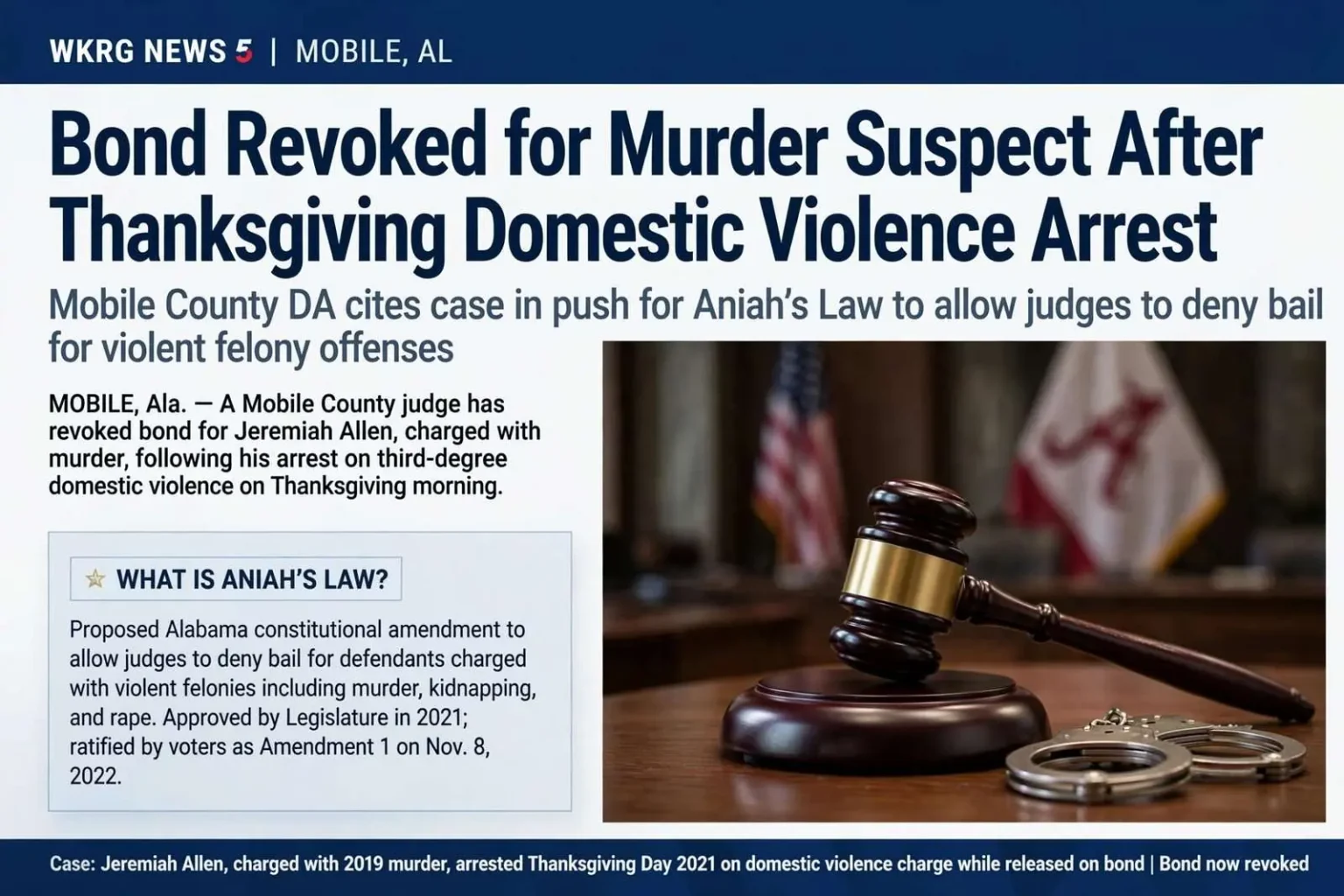
MOBILE, Ala. — A Mobile County Circuit Court judge has revoked the bond of a murder suspect who was arrested on a domestic violence charge on Thanksgiving morning while he was free awaiting trial, and the Mobile County District Attorney’s Office is pointing to the case as an example of why Alabama needs Aniah’s Law.
Arrested while out on bond
Jeremiah Allen is charged with murder in the death of 33-year-old Marcus Gordon, who was found shot at a Citgo gas station on Dauphin Island Parkway on Nov. 10, 2019. Allen was arrested and charged with murder the next day, Nov. 11, 2019.
His bond was originally set at $350,000 in April 2020 and was later reduced to $150,000. Court documents show he was eventually released on a $75,000 bond, and court records show he was released June 29, according to WKRG News 5.
Just before 4 a.m. on Thanksgiving Day, Nov. 25, Allen was arrested and booked into Mobile Metro Jail on a charge of third-degree domestic violence (harassment).
Bond revoked
A Mobile County Circuit Court judge has since revoked Allen’s bond, according to a Facebook post from the Mobile County District Attorney’s Office, which used the case to make its argument for Aniah’s Law.
“This constitutional amendment will allow judges to deny bond for individuals charged with violent felony offenses,” the DA’s office wrote. “Too many defendants who are accused of violent crimes are receiving bond and committing new crimes.”
What Aniah’s Law would do
Aniah’s Law is a proposed amendment to the Alabama Constitution that would allow judges to deny bail to defendants charged with certain serious violent offenses, including murder, kidnapping, rape and terrorism. Currently, the state constitution guarantees bail in nearly all cases except capital offenses.
The amendment, sponsored by Rep. Chip Brown, passed the Alabama House 102-0 in February 2021 and the Senate 30-0 in April 2021, with the House giving final approval to the Senate’s version on April 15, 2021. Because it amends the constitution, it will not take effect unless Alabama voters approve it on the November 2022 general election ballot.
The measure is named for Aniah Blanchard, a 19-year-old Southern Union State Community College student from Homewood who disappeared in October 2019 and was later found dead. The man charged with her kidnapping and murder, Ibraheem Yazeed, was free on bond at the time despite pending charges that included attempted murder, kidnapping and robbery.
Editor’s note: An earlier version of this story said voters approved Aniah’s Law in February 2022 and described it as already in effect. That was incorrect. The Legislature approved the amendment in 2021, and Alabama voters ratified it on Nov. 8, 2022, as Amendment 1, with about 80% voting yes. WKRG News 5 reported at the time that the judge revoked Allen’s bond “using Aniah’s Law,” but the amendment had not yet been ratified when the bond was revoked.
Sources: WKRG News 5 (Nov. 25 and Dec. 10, 2021); Mobile County District Attorney’s Office Facebook post, as quoted by WKRG; Alabama Reporter and Ballotpedia on the legislative history and 2022 vote on Amendment 1.