Mobile and Baldwin Counties Reported Rising H1N1 Cases in August 2009
Mobile County reported 81 confirmed H1N1 cases and Baldwin County 29 in August 2009 as local health officials prepared for vaccine availability.
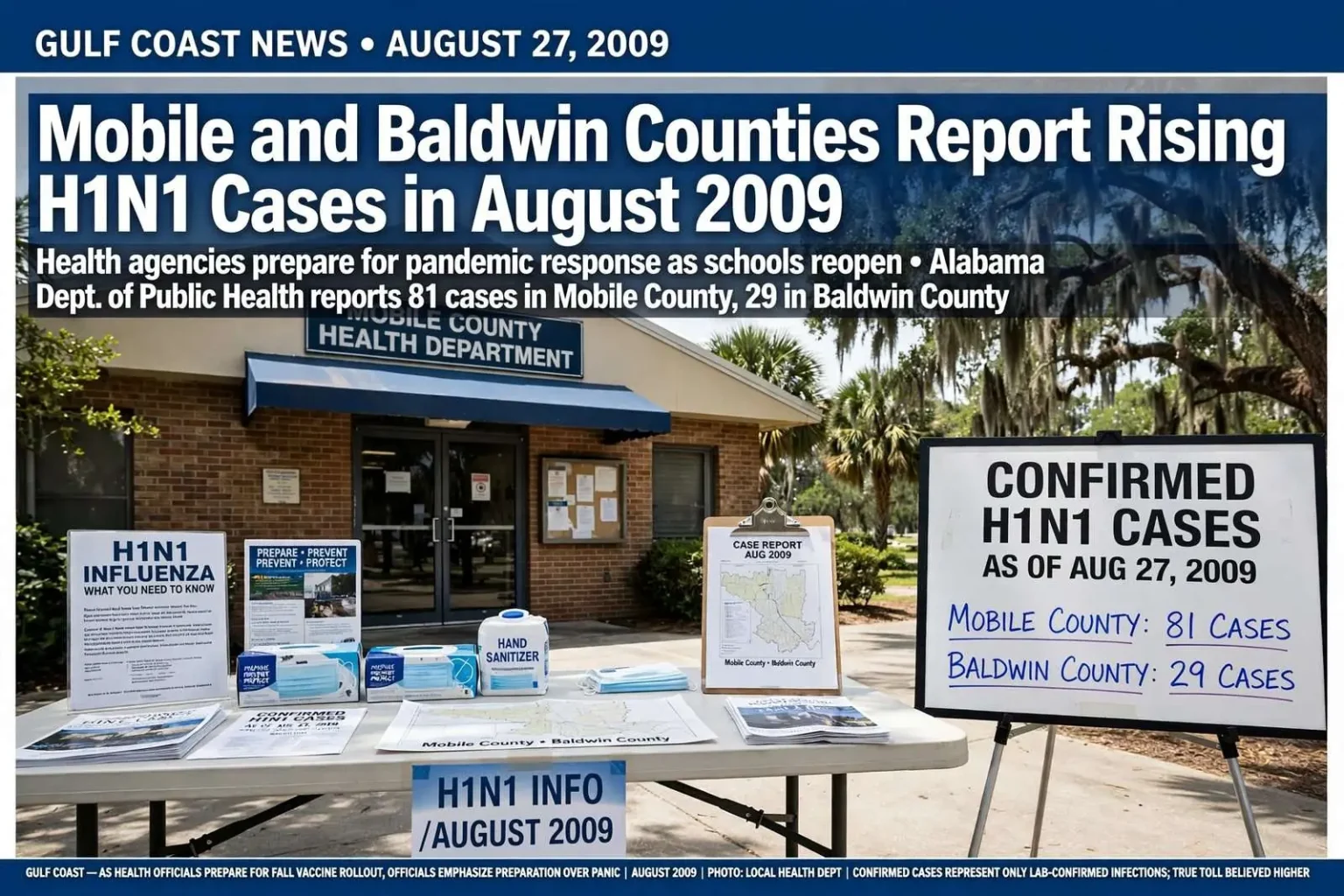
Mobile and Baldwin counties reported additional confirmed H1N1 influenza cases in August 2009 as health agencies prepared for the next stage of the pandemic response. The late-summer tally arrived in the weeks before schools reopened their full schedules and flu season loomed, placing the two Gulf Coast counties squarely inside a national story that would dominate public health planning through the fall.
Figures cited from the Alabama Department of Public Health listed 81 confirmed cases in Mobile County and 29 in Baldwin County. Confirmed cases represented only the fraction of actual infections that reached laboratory testing, a reality health officials acknowledged at the time; the true scope of spread was understood to be considerably wider than the counts suggested.
Local health officials emphasized preparation rather than panic as residents watched the case numbers and considered vaccination plans. The message — repeated across press briefings, school letters and clinic notices — was that H1N1 was serious but manageable, and that the response to it would run on the ordinary machinery of public health: surveillance, education and, eventually, vaccination.
The 2009 pandemic and the Gulf Coast
The 2009 H1N1 pandemic, caused by a novel swine-origin influenza A virus first identified that spring, spread rapidly after emerging in North America. Unlike seasonal flu, which hits older adults hardest, the new strain disproportionately affected children and younger adults — a pattern that made school-age populations the focus of both concern and planning from the pandemic’s earliest weeks.
For Mobile and Baldwin counties, the demographic pattern had particular meaning. Schools along the Gulf Coast had already experienced the first wave’s disruptions in the spring, when suspected cases prompted temporary closures and a crash course in hand-washing signage, and the August numbers confirmed what officials expected: the virus had not gone away with the school year.
Alabama’s Department of Public Health served as the state’s reporting hub during the pandemic, consolidating confirmed-case figures from county health departments and coordinating with the federal Centers for Disease Control and Prevention. The county-level counts — 81 in Mobile, 29 in Baldwin — were part of that data chain, offering local officials and residents alike a running picture of the outbreak’s footprint.
The two-county figures also reflected the region’s population geography. Mobile County, with its larger urban population, logged the bigger count; Baldwin County’s growing but smaller population produced a correspondingly smaller number. Both counties’ health departments were already coordinating with state planners on the response to come.
Behind the numbers, the region’s healthcare infrastructure was running its own preparations. Hospitals reviewed surge plans, emergency departments sharpened their triage protocols for respiratory complaints, and clinics stocked the protective equipment the response would demand. The summer weeks, with case counts still comparatively low, were understood to be the last quiet window before the fall wave.
The summer of 2009 also taught the region’s health agencies the communication rhythms that would carry them through the fall. Weekly updates replaced ad hoc announcements, school superintendents and health officers appeared together at briefings, and the phrase “novel H1N1” entered the everyday vocabulary of parents, teachers and employers across both counties.
Preparing for a vaccine rollout
The Mobile County Health Department said state and local agencies were planning for an H1N1 vaccine expected later that fall. At the time, officials anticipated a two-dose H1N1 series, with doses separated by about three weeks, alongside the seasonal influenza vaccination program — a double rollout that public health planners described as the most complicated vaccination campaign in decades.
The two-dose expectation shaped every part of the planning: how much vaccine to order, how clinics would schedule second appointments, and how schools and workplaces would track who had completed the series. Planners also had to keep the H1N1 campaign from colliding with the ordinary fall push for seasonal flu shots, which draws its own crowds to pharmacies and clinics across the Gulf Coast each autumn.
Residents interviewed by the station expressed mixed views about whether they planned to receive a vaccine. The hesitation captured in those interviews mirrored national polling of the period, which found substantial segments of the public unsure about the new vaccine’s safety, its priority tiers, or whether they would bother getting it at all.
The discussion reflected the public uncertainty that accompanied the 2009 H1N1 outbreak, especially as schools and families monitored flu activity in their communities. Local officials worked to answer the practical questions — who would be vaccinated first, where clinics would operate, what symptoms should send someone to the doctor — as the fall campaign approached.
Priority planning across the country targeted the groups the virus hit hardest: children, young adults, healthcare workers and people with underlying conditions. School-aged children sat near the top of every list, which is why the region’s school systems factored so heavily into the planning — from potential school-based clinics to the letters home that would later invite parents to consent.
Employers along the Gulf Coast were drawn into the planning as well. Health officials circulated guidance for workplaces on handling sick employees, disinfecting shared spaces and planning for absences, while childcare centers and summer programs fielded the same questions from parents weighing every sniffle against the news cycle.
The vaccine ultimately arrived in Alabama that fall in stages, with the first shipments going to priority groups and the supply broadening through the autumn as production ramped up. The campaign that unfolded — with its scheduling complexities and its supply debates — began with exactly the planning work that Mobile County and Baldwin County health officials were doing in August.
A dated public-health snapshot
The 2009 report captured an early local stage of a broader national response to H1N1. Health agencies were communicating case counts, encouraging planning and preparing for vaccine distribution while many details of the rollout were still developing. The eventual scale of the pandemic — tens of millions of cases nationally by the CDC’s later estimates — was still ahead; August’s numbers were a snapshot of the ramp-up, not the peak.
Looking back, the episode became a formative experience for the agencies involved. The 2009 campaign’s lessons — about vaccine logistics, public communication and the value of school partnerships — flowed into the planning documents that Gulf Coast health departments carried into every crisis that followed, including the far larger test of 2020.
Historians of medicine rank 2009 alongside the flu pandemics of 1918, 1957 and 1968 — the recurring global reminders that influenza remains among the most unpredictable of the world’s recurring viruses. What distinguished 2009 was its comparatively mild severity for most who caught it, and the unprecedented speed with which a vaccine was developed, tested and manufactured — a scientific achievement that still required a public health system to deliver, dose by dose, into the arms of a sometimes-hesitant public.
These numbers and vaccine expectations are historical. They describe conditions reported in August 2009 and should not be used as present-day medical advice, current case data or current vaccination guidance. Readers with questions about influenza vaccination today are directed to the Alabama Department of Public Health and their healthcare providers for current recommendations.
For the families who lived through it, though, the summer of 2009 remains a specific memory: case counts in the news, two-dose schedules on the fridge calendars, and a fall in which the ordinary flu season arrived stacked on top of an extraordinary one — the moment when a novel virus first made itself at home on the Gulf Coast, and local health officials began the work of answering it.
Confirmed-case counts of the era came with standing caveats that health officials repeated in every briefing: laboratory confirmation lagged actual infections, testing was prioritized for the sickest patients and healthcare workers, and the counts were a measure of the response’s reach as much as the virus’s. Officials urged residents to treat the numbers as planning tools rather than precise tallies.
Mobile County Health Department, one of the oldest county health agencies in Alabama, anchored the local response with its network of clinics and its long-running surveillance programs. Baldwin County’s health department ran a parallel effort across the bay, with the two agencies’ work coordinated through the state’s pandemic planning structure.
In the end, the August 2009 report stands as the moment when the pandemic moved from breaking news to routine planning in Mobile and Baldwin counties — the point at which the extraordinary became operational. The counts would climb, the vaccine would arrive, the fall would run its course, and the agencies on both sides of the bay would file the experience away as practice for a bigger day. But it began here, with two numbers and a promise to be ready.
The full record of the 2009 response — case counts, planning documents and the vaccine campaign’s after-action reports — remains available through the state and county health agencies for readers researching the period.