Mobile County Reported Its First Confirmed H1N1 Case in 2009
Alabama health officials confirmed Mobile County’s first H1N1 case in May 2009 as the state expanded its capacity to verify swine flu infections.
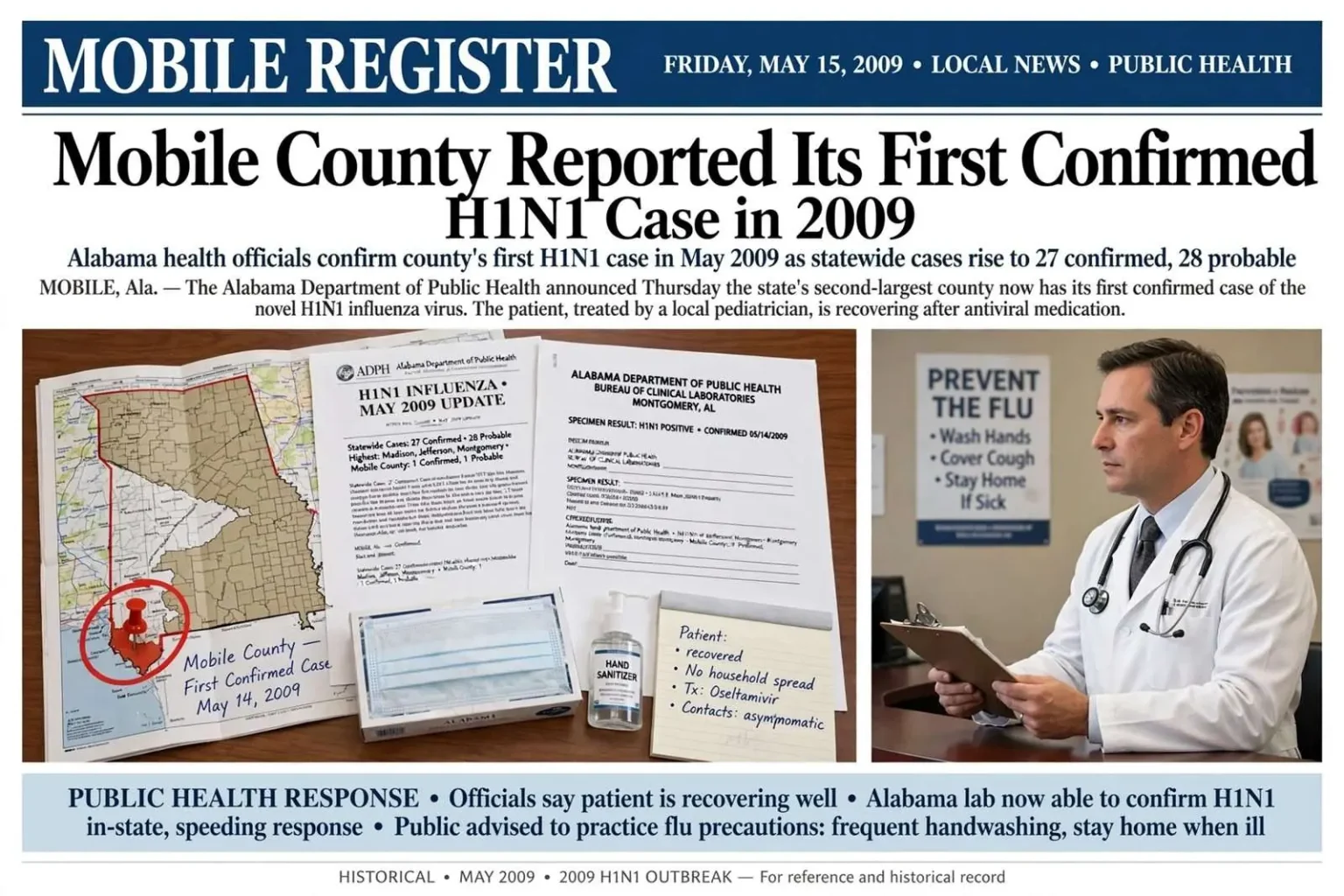
Alabama health officials confirmed Mobile County’s first case of H1N1 influenza in May 2009 as the state tracked the spread of the novel strain commonly called swine flu. The case was identified by a local pediatrician and confirmed by the Alabama Department of Public Health laboratory in Montgomery. The young patient was reported to be recovering after treatment, and no identifying information is included here. The confirmation placed Alabama’s second-largest county formally on the list of places the new virus had reached, weeks after the strain first surfaced in North America and set off a worldwide public health response.
The 2009 H1N1 virus was a new influenza strain, a reassortant combining genetic material from swine, avian and human influenza lineages. Because virtually no one had immunity to it, public health agencies treated its arrival with unusual urgency even though, as became clear over the following months, most cases were relatively mild. The outbreak first drew international attention in April 2009 when cases were identified in Mexico and the United States, and within weeks the World Health Organization had raised its pandemic alert level as the virus spread person to person across borders. Travel-associated and then community cases appeared state by state, and Alabama’s case counts began climbing through May.
For the Mobile County patient, the course of illness followed the pattern health officials were describing nationwide. A physician reported that the patient improved quickly after antiviral treatment and that close household contacts did not develop symptoms. That detail mattered to investigators, because household contacts are the first circle tracked around any confirmed case; whether the virus spreads within a household tells epidemiologists a great deal about its transmissibility. Antiviral medications such as oseltamivir and zanamivir were effective against the 2009 strain, and early treatment was among the principal recommendations for patients at higher risk of complications.
A growing statewide case count
At the time of the confirmation, Alabama had 27 confirmed cases and 28 probable cases. Madison County accounted for the largest share of the reported total, followed by Jefferson, Montgomery, Limestone, Pike, Mobile, Shelby, Calhoun and Etowah counties. The geographic spread across the northern, central and southern parts of the state indicated that the virus was no longer tied to a single introductions point or travel cluster. Health officials also reported another probable case in Mobile County, underscoring that the local outbreak was still developing and that additional confirmations were likely as testing caught up with suspected cases.
The distinction between confirmed and probable cases shaped how the numbers were reported. A probable case was one that showed laboratory evidence suggesting the new strain but had not yet been verified through the confirmatory testing process, while a confirmed case had been verified by a qualified laboratory. In the early weeks of an emerging outbreak, the probable category functions as a leading indicator, and public health officials cautioned that the real number of infections was almost certainly higher than either figure, since only a portion of people with flu-like illness were being tested.
The state had recently received certification from the Centers for Disease Control and Prevention to conduct its own confirmations, allowing Alabama to process results more directly. Before that certification, suspected samples had to be shipped to the CDC’s laboratory in Atlanta for final confirmation, adding days to the process at exactly the moment when speed mattered most. With the Alabama Department of Public Health’s Bureau of Clinical Laboratories authorized to confirm H1N1 itself, results could be turned around in-state, letting epidemiologists investigate cases and notify close contacts while the information was still actionable.
How the response worked
The 2009 H1N1 outbreak prompted schools, doctors, health departments and families to monitor symptoms and follow changing public-health guidance. The Alabama Department of Public Health, operating through county health departments including the Mobile County Health Department, one of the oldest county health organizations in the state, coordinated surveillance, case investigation and public messaging. Physicians were asked to consider H1N1 in patients presenting with fever and respiratory symptoms and to submit specimens from likely cases, while laboratories were flooded with samples from a public newly alert to every cough and fever.
Schools occupied a central place in the response because influenza transmits efficiently among children and because school closures were among the earliest tools recommended when the outbreak began. Federal guidance on when to close a school shifted as the spring progressed and the virus proved less severe than initially feared, moving from aggressive closures toward a focus on keeping sick students and staff home, emphasizing hand hygiene and respiratory etiquette, and cleaning commonly touched surfaces. For families in Mobile County, the practical advice was familiar flu-season counsel: stay home when ill, wash hands frequently, cover coughs and sneezes, and contact a health care provider if symptoms worsened.
The episode also tested the communication machinery that public health depends on in an era of round-the-clock news. Because the new virus carried the label swine flu, it drew questions about pork products that health officials worked to correct, since the virus was not spread through properly handled and cooked food. Officials balanced the need to inform the public against the risk of alarming them, and the evolving case counts, presented as combined confirmed and probable figures, became the daily measure by which Alabamians tracked the outbreak’s progress.
Mobile County’s place in the outbreak
Mobile County’s position made it a logical early stop for a virus spreading through the Gulf South. The county anchors a metropolitan area of several hundred thousand people, sits on a state line, hosts one of the nation’s busiest deepwater ports, and draws thousands of visitors to its beaches in Baldwin County just across Mobile Bay. Its population also reflects the flows of the region, with residents crossing into Mississippi for work and travel and visitors arriving from Florida, Louisiana and Texas, all states that were reporting cases in the same weeks. A novel respiratory virus moving through the Southeast would predictably reach Mobile’s population centers early.
The fact that the first confirmed case was identified by a local pediatrician rather than through a hospital or mass screening effort reflected how the surveillance system was designed to work. Primary care providers sit at the front line of outbreak detection; when they know what to look for and how to report it, cases surface quickly and the public health apparatus can respond while the disease’s footprint is still small. The quick recovery of the patient and the absence of illness among household contacts was the kind of outcome officials hoped to repeat as more cases appeared, since the fatality risk from H1N1 was concentrated in people with underlying conditions, pregnant women and other vulnerable groups rather than distributed evenly across the population.
This account records the county’s first confirmed H1N1 case and the statewide situation reported in May 2009. It is historical information only; readers seeking current flu guidance should consult today’s public-health authorities and medical professionals. The spring of 2009 has since taken its place in the region’s public health history as a rehearsal of sorts, a time when Alabama’s agencies, school systems and health care providers traced a novel virus case by case, closed schools where warranted, and communicated daily with a watchful public, all in advance of the pandemic that arrived the following autumn when H1N1 returned with the regular flu season and eventually affected communities in every Alabama county.
Antivirals and medical practice in the early weeks
The treatment picture in May 2009 was defined by a practical constraint: the seasonal flu vaccine then in circulation offered no protection against the new strain, and a specific H1N1 vaccine would not be developed, produced and distributed until the fall. That left antiviral medications as the principal medical tool. Public health guidance directed clinicians to treat suspected and confirmed cases promptly in patients at elevated risk of complications, including young children, adults over sixty-five, pregnant women and people with asthma, diabetes, heart disease and other chronic conditions. Early treatment appeared to shorten illness and reduce the severity of complications, which was consistent with what the Mobile County physician had observed in the county’s first confirmed patient.
Physicians also learned to ask about travel and exposures, questions that had rarely mattered in routine flu seasons. A child with fever and cough whose household had recently hosted visitors from a state with confirmed cases, or whose schoolmates had similar symptoms, was a candidate for testing under the case definitions in use at the time. Pediatric offices, urgent care clinics and emergency rooms adjusted their intake procedures, with some offering masks at the door and separate waiting areas for patients with respiratory complaints. None of these measures was dramatic on its own, but together they changed the texture of a routine medical visit across the state during those weeks.
The laboratory transition and what it meant
The CDC’s certification of Alabama’s state laboratory deserves particular attention, because it changed the tempo of the whole response. Under the earlier arrangement, a suspected case identified in Mobile might wait for shipping, batch processing and out-of-state confirmation before the count officially moved, while the patient and the patient’s contacts had long since been identified and advised. Once the Bureau of Clinical Laboratories in Montgomery could confirm cases directly, the interval between suspicion and confirmation shrank, and the daily tallies published by the department became a more faithful reflection of what was happening on the ground rather than a record of what had happened a week earlier.
Certification also reflected confidence built over years. State public health laboratories had expanded their molecular testing capacity substantially through preparation for other emerging threats, and the surge in demand that spring, with hundreds of specimens submitted from across Alabama, tested that capacity in real time. Counties with large populations, including Madison, Jefferson, Mobile and Montgomery, generated the heaviest specimen volumes, and laboratory staff worked to distinguish the novel strain from the seasonal influenza viruses still circulating at low levels, since the tests involved distinguish between influenza A subtypes and require additional steps to identify the specific pandemic strain.
By late May, the initial alarm was giving way to a longer view. National and international investigators had concluded that most people who caught the virus recovered without hospitalization, and the emphasis in guidance shifted toward protecting the vulnerable and preparing for a probable second wave rather than containing the first. Alabama’s counts continued to rise through the summer at lower intensity, and the state health department used the interval to plan vaccination campaigns, stockpile distribution and public messaging for the fall. For Mobile County, the confirmation of its first case in May 2009 marked the beginning of that arc: an ordinary pediatric illness, quickly recognized, quickly treated, and quickly confirmed, that signaled the arrival of a virus which would define the influenza seasons that followed and leave the region’s public health system, schools and families better practiced for the next time a new strain appeared.