Mobile School Chief Considered Revising 2009 Closure and Consolidation List
Mobile County school leaders said in March 2009 that some proposed campus closures or consolidations could be reconsidered after public hearings and funding news.
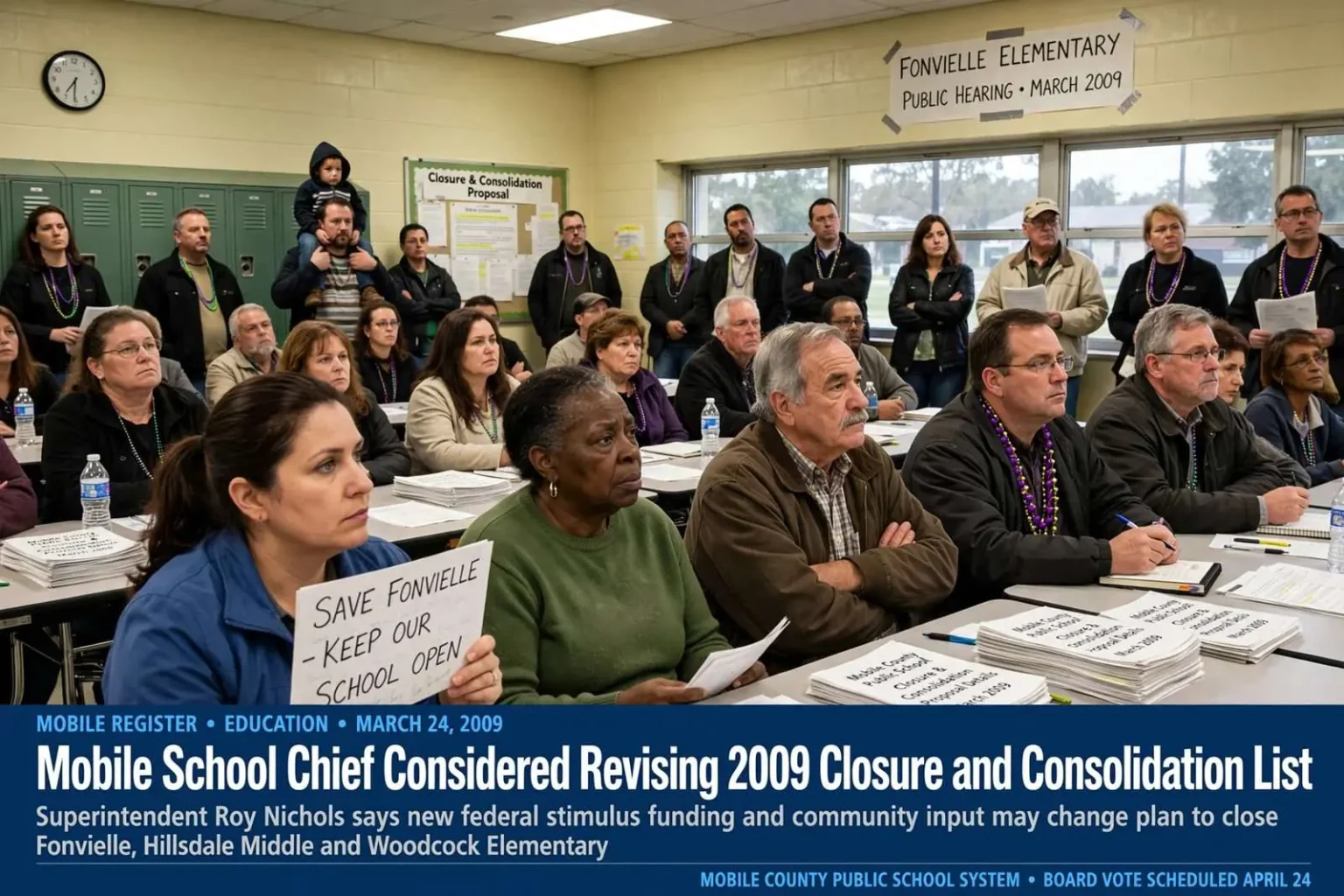
Mobile County school leaders said in March 2009 that some proposed campus closures and consolidations could be reconsidered after public hearings and new information about federal stimulus funding. Superintendent Roy Nichols had proposed possible closures of Hillsdale Middle School, Fonvielle Elementary and Woodcock Elementary. His plan also included consolidating Old Shell Road, Dunbar, Chickasaw and Clark Magnet schools. The announcement set off weeks of public debate across Alabama’s largest school system, as parents, teachers and neighborhood leaders pressed administrators to explain how each recommendation had been made and what it would mean for the children involved.
The proposal arrived at a difficult moment for school budgets everywhere. The national recession that began in late 2008 had weakened sales tax collections, which along with property taxes form the backbone of public school funding in Alabama. The Education Trust Fund, the state budget that pays for teachers and classroom operations, had been trimmed as lawmakers confronted falling revenue, and systems as large as Mobile County’s were searching for ways to reduce operating costs without hollowing out instruction. Consolidating small campuses and closing under-enrolled buildings is one of the few levers available to a superintendent facing that kind of squeeze, because each closed or merged site can save money on utilities, maintenance, transportation and administrative staffing.
At the same time, Washington was preparing an unusual infusion of help. The American Recovery and Reinvestment Act, the federal stimulus package signed into law in February 2009, included tens of billions of dollars for education nationwide, with money directed toward stabilizing teaching jobs, supporting special education and aiding schools that serve low-income students. How much of that money would flow to Alabama, and how much freedom districts would have in spending it, remained an open question in the spring of 2009. That uncertainty was precisely why Nichols said he wanted to wait before finalizing any list of closures.
The hearing on Fonvielle Elementary
More than 150 people attended a hearing focused on the future of Fonvielle Elementary, one of the three campuses Nichols had placed on the closure list. Parents and community members described the school’s academic role, transportation challenges and the long-standing need for building repairs. For many families in the attendance zone, the school functioned as more than a classroom site; it was a neighborhood institution where children could walk to campus and where teachers knew multiple generations of the same families.
Some speakers argued that the school’s condition reflected years of neglect. They told officials that deferring maintenance had allowed small problems to grow into the kind of expensive deficiencies that were now being cited as a reason to close the building, and they questioned why the answer to a maintenance backlog was to shut the school rather than repair it. Others said a closure would create practical burdens for families, especially those concerned about travel costs and getting children to school while also maintaining work schedules. In communities where many households rely on hourly jobs with little schedule flexibility, a longer bus ride or a longer drive across town is not an inconvenience but a genuine hardship, and speakers asked the board to weigh that reality alongside the budget spreadsheets.
The hearing also surfaced the broader question that shadows every consolidation debate: what happens to a neighborhood when its school leaves. A closed campus is a visible vacancy on a street corner, a building that sits empty and sometimes deteriorates, and a symbol to residents that their community has been written off. Speakers from the Fonvielle area made that argument explicitly, telling district leaders that the school’s survival and the neighborhood’s stability were intertwined.
The scale of the Mobile County system
Any discussion of closures in Mobile County has to account for the sheer size of the district. The Mobile County Public School System is the largest school system in Alabama, serving tens of thousands of students across dozens of elementary, middle and high schools spread from the city of Mobile into Prichard, Saraland, Satsuma, Chickasaw, Citronelle, Mount Vernon, Bayou La Batre, Grand Bay and the communities in between. Its footprint covers most of the county, and that geography matters: a district that spans the entire southern end of the state cannot consolidate campuses without lengthening rides for some children, because the next school is rarely just around the corner.
The campuses on Nichols’ list reflected that variety. Hillsdale Middle School, Fonvielle Elementary and Woodcock Elementary were the proposed closures, while the plan called for consolidating Old Shell Road, Dunbar, Chickasaw and Clark Magnet schools, a grouping of long-standing programs that have historically drawn students from across the district rather than from a single neighborhood walk zone. Magnet programs complicate closure math in a different way than neighborhood schools do. Their enrollments depend on the appeal of a specialized curriculum and on transportation arrangements that bring in students countywide, and consolidating them can change program identity, feeder patterns and the choices available to families who deliberately selected a magnet over their zoned school.
Each of the proposals carried its own arithmetic of savings and its own constituency willing to fight it. That is typical of large-district consolidation plans, and it explains why districts usually stage public hearings before a final vote. Hearings give administrators a chance to correct misunderstandings and give communities a formal way to put new information on the record, whether that information concerns a building’s condition, a program’s enrollment trend or a funding change that alters the financial case for closure.
Funding and final decisions
Nichols said he might remove some schools from the list, but did not identify which ones. He said public comments and the expected effect of the federal stimulus package would factor into the decision. That posture was notable because superintendents under budget pressure rarely reopen a closure list once it is public; doing so invites every affected community to lobby for the same treatment. The superintendent appeared to be deliberately holding the door open, signaling that the hearings were substantive rather than ceremonial.
He was scheduled to meet with the state superintendent in Montgomery to learn more about how much stimulus funding Mobile County might receive. The meeting underscored how much of the local decision rested on figures nobody yet controlled. If the Recovery and Reinvestment Act delivered enough flexible stabilization money, the district could preserve campuses and programs it would otherwise have had to cut; if the money came with narrow restrictions or arrived too late to matter for the coming year’s budget, the closures would be harder to avoid. School officials across Alabama were making the same calls in the same weeks, and state education leaders were trying to translate the federal statute into allocations that local boards could actually plan around.
The school board was expected to vote on the proposed closings and changes at its April 24 meeting. That timeline gave the district roughly a month between the March hearings and the decision, a window in which parents organized, board members fielded calls and the administration refined its recommendations. School boards in Alabama are elected bodies, and members answer directly to the neighborhoods in the districts they represent, so a controversial closure list reliably produces intense constituent contact in the weeks before a vote.
What was at stake for the county
The March 2009 hearing showed how school-closure decisions extended beyond budgets and enrollment. Families, students and community leaders raised questions about equity, facility investment and the impact of consolidation on neighborhoods across Mobile County. The pattern was familiar to anyone who had watched other large Southern districts through the same era: when money gets tight, the campuses most often placed on closure lists tend to serve communities with the least political leverage, and the hearings become the one venue where those communities can make their case before the paperwork becomes final.
The equity questions raised at the Fonvielle hearing fit that mold. Speakers asked why buildings in some neighborhoods had received periodic maintenance and renovation while others had been allowed to decline to the point that closure seemed the only option. They asked how the district would measure the effect of longer travel on attendance, tardiness and participation in after-school activities, and whether the savings projected from a closure would survive contact with the real costs of transporting displaced students. They also raised the reverse concern: that a district holding an empty building would eventually face pressure to sell or abandon it, removing any chance the property could again serve a public purpose.
For the magnet programs facing consolidation, the stakes were framed differently. Parents of magnet students had chosen those schools for specific curricula, and any merger raised questions about whether the specialized identity would survive, whether teachers with particular expertise would be retained, and what would happen to the transportation arrangements that made the programs accessible to families across the county. A consolidation that saves money by folding two small programs into one building can still lose students in the process if families conclude that what made the school distinctive has been diluted.
Waiting on Washington
The weeks between the March announcement and the April 24 board meeting became a waiting game on two fronts. Locally, communities organized speakers, petitions and questions for board members. In Montgomery, state and district officials were trying to pin down the federal numbers, since the Recovery and Reinvestment Act’s education components were flowing through existing programs and through a new stabilization fund that state legislatures had to accept. For a district the size of Mobile County’s, even a modest share of the stabilization money could offset the savings expected from one or more closures, which is exactly why Nichols declined to treat his original list as final.
The episode also illustrated a structural tension in public education finance in Alabama. School systems derive operating revenue from the state Education Trust Fund and from local property taxes, but capital needs, the repair and maintenance of buildings, are funded differently and less reliably, which is how maintenance backlogs build up over years. When a district then proposes closing a school in part because the building is in poor condition, residents hear a painful irony: the same district that let the roof and the wiring go now says the building must be abandoned. That dynamic was on full display in the Fonvielle hearing room, and it is one reason closure debates so often turn into arguments about past decisions rather than future budgets.
Whatever the board ultimately decided in April, the March hearings had already changed the conversation. A list that began as an administrative proposal had become a public reckoning over which communities the district intended to invest in, how federal money would reshape local choices, and what the county’s neighborhoods could expect from their largest public institution. Families left the hearing with no guarantees, but with a clear statement from the superintendent that the final list was not yet written, and that what was said in the hearing room would be part of the decision.