Baldwin County Considered Closing Vaughn Elementary in 2009
Facing a projected $47 million shortfall over two years, Baldwin County schools considered closing Vaughn Elementary in 2009, a move officials said could save millions.
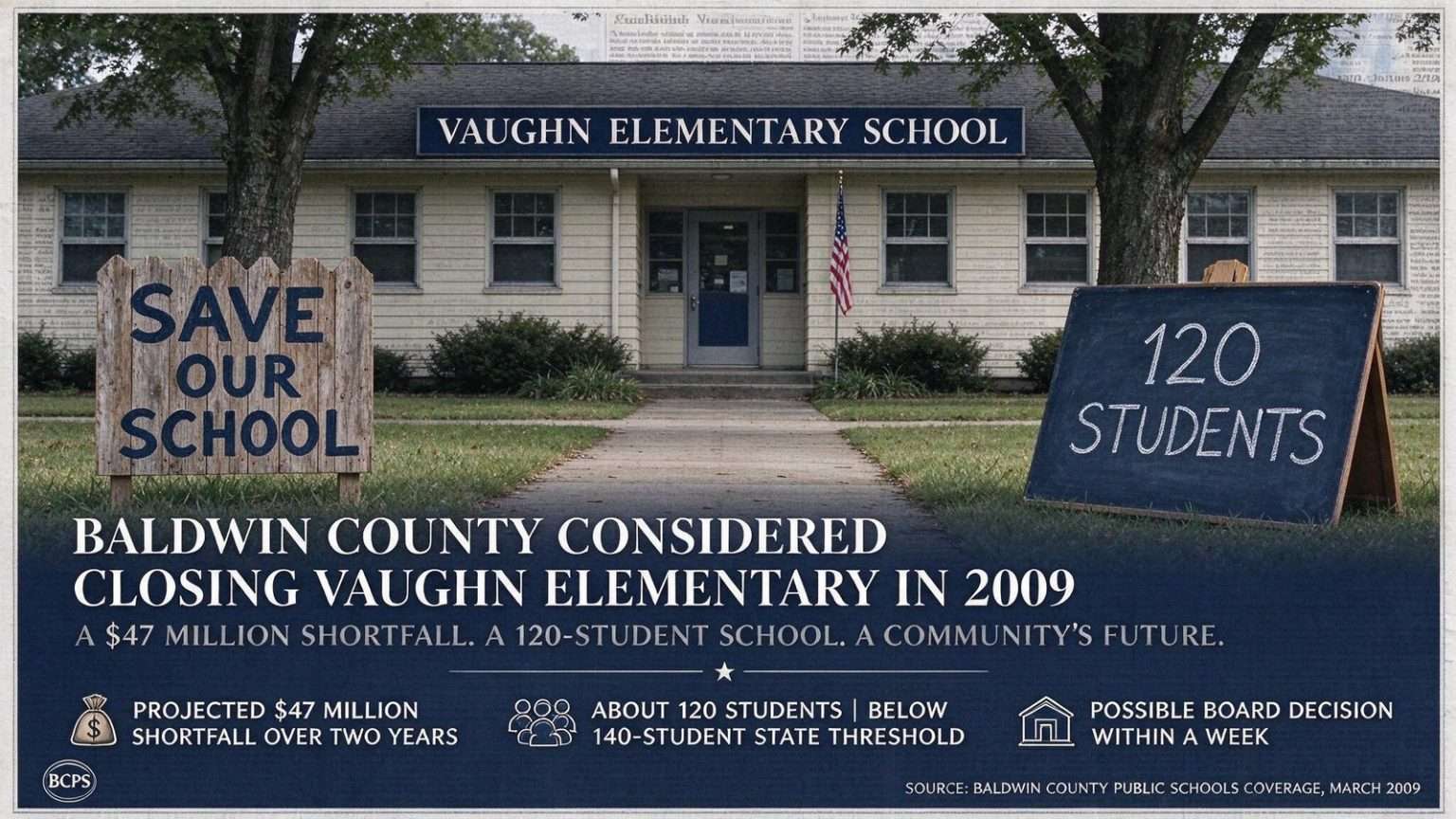
Baldwin County school leaders considered closing Vaughn Elementary School in March 2009 as part of efforts to address a projected $47 million budget shortfall over two years, a proposal that put the county’s smallest school at the center of one of the largest financial crises in the district’s history.
Officials said closing the school could save millions, a figure that loomed large against the shortfall projected across the two-year budget window. The district, facing deep cuts in state funding as the national recession battered Alabama’s education budgets, was examining every option, and small schools with high per-pupil costs were among the most obvious targets.
With about 120 students, Vaughn was the district’s smallest school and was below the 140-student threshold Alabama law used at the time for an approved elementary learning center. That status created a legal vulnerability for the school, since state rules on minimum enrollment gave officials a concrete basis for considering closure rather than merely a budget argument.
The financial crisis behind the proposal
The $47 million projected shortfall emerged as Alabama school systems confronted the collapse of state education revenue in the late 2000s. The Education Trust Fund, which pays for public schools across the state, draws its revenue from income taxes and sales taxes, and the recession cut deeply into both streams, forcing districts statewide to plan for proration and multi-year gaps.
Baldwin County’s response included staffing reductions, budget trims and facility reviews, with the Vaughn proposal representing the facility side of that arithmetic. A school of roughly 120 students carries fixed costs — administration, utilities, maintenance, transportation and staff — that are spread across too few pupils to be efficient, and closing it consolidates those students into larger, less expensive campuses.
Saving millions by closing one school would have addressed a meaningful slice of a $47 million hole, which is why the idea survived beyond the brainstorming stage. District leaders had a legal framework for the closure in the state’s enrollment threshold, a financial case built on consolidation savings, and a timeline that could produce a board decision as early as the following week.
The proposal landed in a community that had watched the district grow rapidly for years. Baldwin County’s population boom along the Interstate 10 corridor had filled suburban schools while rural campuses like Vaughn held steady or shrank, and the recession forced the system to confront the uneven geography of its own growth — booming schools in some areas, under-enrolled ones in others.
What closure would have meant
If the school closed, students would be bused to Bay Minette and tenured teachers would be transferred to other schools in the district, according to the report. The bus ride to Bay Minette would have lengthened the school day for children who had previously attended classes minutes from home, and the change would have reached every family in the Vaughn community at once.
For the staff, a closure meant displacement rather than unemployment — tenured teachers would follow the district’s transfer rules into other schools, but not necessarily into the roles or communities they had known. Support staff positions would have been consolidated as well, and the building itself would have joined the list of closed schools that rural Alabama counties manage after consolidation decisions.
Teacher Cynthia Morrissette opposed the proposal, citing the individualized attention students received at the small school. Her argument captured the case small schools make wherever closures are discussed: that a 120-student campus delivers something larger schools cannot, with teachers who know every child by name and class sizes that allow instruction tailored to each student.
That individualized attention is precisely what draws loyalty to schools like Vaughn. In a campus that size, teachers teach siblings across years, parents know the principal personally, and struggling students are noticed before they slip through. Morrissette’s opposition framed the closure question not as a line item but as a choice about what kind of education the county was willing to buy for its smallest communities.
Baldwin County’s schools and the enrollment threshold
Alabama’s 140-student threshold for approved elementary learning centers, the standard cited in the Vaughn discussion, placed the school on the wrong side of state rules that were designed to push districts away from maintaining very small campuses. Schools below the threshold operate in a gray zone, eligible for closure arguments whenever budgets tighten, because the state has already signaled that such enrollments do not justify a standalone campus.
Baldwin County Public Schools operates the third-largest district in Alabama, spanning the entire county from the Gulf shores to the northern farmlands around Bay Minette. That scale cuts both ways: the system’s size gives it resources small city systems lack, but its geography means it must serve communities separated by long rural distances, where every closure concentrates students and bus routes toward fewer centers.
Bay Minette, the destination for Vaughn’s students under the proposal, is the county seat and one of the older communities in the county, with established schools that could absorb an influx of roughly 120 students. The consolidation logic pointed to Bay Minette precisely because its campus capacity and distance made it the practical landing spot, even though the bus ride would redefine the daily routine for the Vaughn community.
The school board could have made a decision as early as the following week, a timeline that compressed the public discussion into days and gave supporters of the school little opportunity to organize before the board weighed the option. Budget-driven closures move quickly, and March 2009 was shaping up as the moment when Vaughn’s future would be decided.
A snapshot of a hard year
This account reflects the proposal and public discussion in March 2009, not a final closure decision or the later status of the school. What the episode captured was a district at a financial crossroads, weighing the efficiency of consolidation against the value of a school that its community saw as irreplaceable.
The Vaughn debate became a case study in the tensions that recession-era budgets created across Alabama. State funding formulas reward enrollment efficiency, small communities rally around their schools, and superintendents and boards are left to balance the two under the pressure of a shrinking Education Trust Fund. Baldwin County’s $47 million two-year shortfall was among the larger gaps in the state, and every option on the table carried a human cost.
For the roughly 120 students at Vaughn, the weeks of March 2009 meant uncertainty about where they would sit in class the following fall. For their teachers, the proposal threatened the working relationships that small schools are built on. And for the district, the decision represented one piece of a much larger equation — how a growing county school system absorbs a historic funding collapse without dismantling the campuses that hold its rural communities together.
Morrissette’s argument for individualized attention stood as the community’s answer to the numbers, a reminder that behind every closure proposal is a school where children are known, and that the savings officials counted in millions are measured against something harder to price.
Rural schools and consolidation across Alabama
The questions raised in the Vaughn debate were playing out in rural counties across Alabama during the same period. Small enrollment totals, aging buildings and long bus routes define the economics of country schools, and every budget crisis reopens the same argument about whether the state can afford to keep classrooms open in communities where student counts have fallen below the thresholds the funding system favors.
Research on small schools consistently notes the trade-offs both ways. Consolidation saves money on administration and facilities and can widen the course offerings available to students, but it lengthens commutes, weakens community identity and can reduce the early-warning attentiveness that small campuses provide. Baldwin County officials weighing the Vaughn closure were navigating exactly that balance, with a recession pressing on the financial side of the scale.
The timing intensified the pressure. In the spring of 2009, districts across Alabama were bracing for state proration — the mid-year funding cuts the Legislature mandates when revenue falls short — and the uncertainty made multi-year planning treacherous. A $47 million projection over two years reflected the district’s need to plan for the worst while hoping revenue would stabilize.
Communities facing closure proposals typically respond with enrollment appeals, community meetings and campaigns to highlight what the school means locally. The speed of the Vaughn timeline — a possible board decision within a week of the report — limited how much of that response could develop, which is a recurring criticism of closure processes when budgets drive the calendar.
Whatever the board decided, the March 2009 discussion left the Vaughn community with the knowledge that its school’s future rested on numbers as much as need. The episode remains a clear example of how a statewide recession reaches into a small Baldwin County campus, and how the teachers, parents and students of a 120-student school become the human face of a district’s budget arithmetic.