Mobile School Board Prepared to Vote on Closures and Magnet Program Move in 2009
The Mobile County School Board prepared to vote in April 2009 on proposed campus closures and a move for the math and science middle-school magnet program.
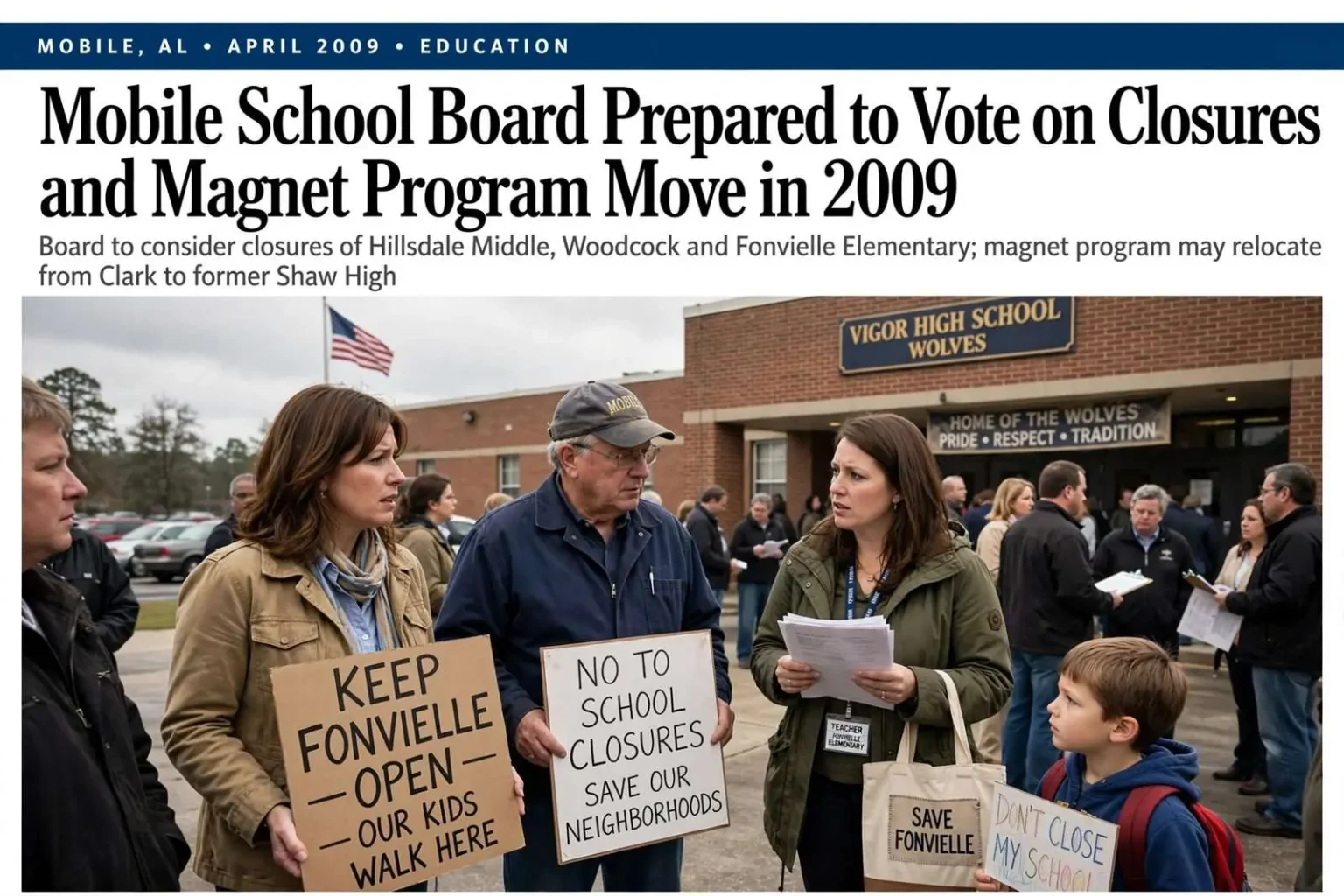
MOBILE – The Mobile County School Board prepared to vote in April 2009 on proposed school closures, consolidations and a move for the system’s math and science middle-school magnet program. The agenda included possible closures of Hillsdale Middle School, Woodcock Elementary and Fonvielle Elementary.
Board members were also set to consider relocating the math and science magnet program from Clark to the former Shaw High School, a proposal that would move one of the district’s most selective academic programs into a building that had stood largely empty since its own students were reassigned.
The package of proposals was the product of months of study by district staff, who had been charged with matching the system’s inventory of buildings to a shrinking student population and a maintenance backlog measured in tens of millions of dollars. By the time the April meeting was scheduled, the proposals had already circulated through community meetings and parent briefings, and the crowd expected at the board session reflected how deeply the decisions would cut.
A district under pressure
The Mobile County Public School System, the largest school district in Alabama, had spent much of the decade wrestling with the arithmetic of decline. Enrollment across the system had drifted downward as families moved to suburban areas in western Mobile County and beyond, leaving behind older school buildings in the city’s established neighborhoods that were increasingly expensive to operate and maintain.
That imbalance drove the reorganization debate of 2009. Buildings that once served full neighborhoods were operating well below capacity, while the cost of roofs, air conditioning systems and electrical work mounted on campuses where fewer students used fewer classrooms. District officials argued that every dollar spent propping up a half-empty building was a dollar unavailable for instruction elsewhere in the system.
For the neighborhoods on the closure list, the logic carried a different weight. A school is often the last fixed institution in an older community – the place where generations of families learned to read, where churches and civic groups meet, and where the identity of a neighborhood is anchored. Closing one, residents said, accelerates the very decline that justified the closing.
Fonvielle supporters make a final appeal
Students, parents and teachers gathered before the vote to urge the board to keep Fonvielle open. Families cited transportation concerns, including the difficulty of getting children to other campuses and fears about students crossing Martin Luther King Jr. Avenue and Three Mile Creek.
The concerns were practical, not sentimental. Martin Luther King Jr. Avenue carries some of the heaviest traffic in central Mobile, and the creek that winds through the area complicates any walking route between the school’s neighborhoods and the campuses that would receive its students. Parents described children as young as five and six facing crossings and walks that no adult would choose for them.
Supporters also argued that facility needs at Fonvielle were the result of years of inadequate investment. In their telling, the building had landed on the closure list because the district had let maintenance slip – a self-fulfilling sequence in which a school is underfunded, deteriorates, and is then condemned for deteriorating. That argument resonated with delegation after delegation that had appeared before the board during the reorganization review.
Teachers from the school joined parents in the appeal, describing small class sizes and close relationships between staff and families that they said could not simply be transferred to a larger campus. For many of the families, Fonvielle was within walking distance of home, and its loss would convert a neighborhood school into a bus ride.
The district’s case
Board President Ken Megginson said studies of the building found that repair costs did not justify keeping the campus open. The district’s facilities assessments had catalogued the Fonvielle building’s deficiencies, and the price of bringing it to standard, in the administration’s estimate, exceeded what the system could responsibly spend on a campus of its size.
Megginson, a longtime member of the board, had taken a leading role in framing the reorganization proposals, and he acknowledged the tension between the district’s fiscal arguments and the community’s attachment to its schools. The board’s position, as he presented it, was that the studies spoke for themselves: the money required at Fonvielle would do less good than the same money invested in campuses that could serve students for decades.
Old Shell Road recommendation changed
Old Shell Road Magnet School had originally appeared on the closure list, but Superintendent Roy Nichols later recommended that it remain open.
The change was one of the most closely watched revisions to the reorganization plan. Old Shell Road, a magnet school housed in a historic building near Midtown Mobile, had drawn objections from parents across the city when its name surfaced, and the administration’s revised recommendation reflected a reconsideration of how the building fit into the district’s long-range plans.
Megginson said the board had concluded that moving Old Shell Road to Dunbar was not the appropriate step at that time, while leaving open the possibility of revisiting the building in later years. The distinction mattered to magnet families, who had chosen the school for its program and its location, and who had argued that consolidating it into another campus would disrupt a program that drew students from every corner of the county.
The Dunbar building, a landmark of the city’s educational history, had long housed performing arts programs, and earlier drafts of the reorganization plan had contemplated co-locating programs there. The decision to hold off preserved the status quo at Old Shell Road while leaving the district flexibility to reconsider the arrangement as conditions changed – a compromise that neither fully satisfied closure opponents nor committed the board to a future move.
The magnet program move
The other relocation on the agenda involved the system’s math and science middle-school magnet program, which board members were set to consider moving from Clark to the former Shaw High School.
Magnet programs occupy a distinctive place in the Mobile County system. Because they draw applications from across the county rather than from a fixed attendance zone, their placement is less bound to neighborhood demographics, and administrators weigh factors like building capacity, laboratory space and transportation patterns when a move is proposed.
The former Shaw High School offered a large, comparatively modern campus with room for the laboratories that a math and science program requires. Moving the program there would free the Clark building for other uses while giving the magnet room to grow – arguments district staff had advanced in presenting the plan. Parents of magnet students, however, weighed the promise of better facilities against the disruption of moving an established program and its teachers to a new part of the city.
The meeting at Vigor High
The scheduled meeting at Vigor High School marked a decisive point in the 2009 school-reorganization debate. Holding the session at the Prichard high school, rather than at the board’s downtown administrative offices, put the vote in the middle of the communities most affected by the proposed closures and gave families from the surrounding neighborhoods a shorter trip to be heard.
The choice of venue followed a pattern the board had used for contentious votes in the past: taking the meeting to the affected area signals that the district expects, and intends to accommodate, a large and invested audience. With closures and consolidations on the agenda, officials anticipated standing-room crowds, petitions and public comment stretching late into the evening.
The competing arguments focused on facility costs, neighborhood access, student safety and the fairness of how the district evaluated different campuses. Critics of the reorganization plan pressed the board to explain why certain schools had landed on the closure list while others with similar needs had not, and whether the criteria applied to Fonvielle, Hillsdale and Woodcock had been applied uniformly across the system.
Board members, for their part, balanced those objections against the fiscal realities that had driven the review in the first place. The system could not indefinitely defer maintenance on buildings it intended to keep, and every year spent studying the same closures was another year of resources flowing into campuses slated for consolidation.
Before the vote
This article records the proposals and public discussion before the vote. It does not state the board’s final action or the later status of the affected schools.
What the record makes clear is the shape of the debate as it stood in April 2009: a large urban-suburban district confronting declining enrollment and aging buildings; a board president making the case from facility studies; a superintendent revising recommendations in response to public pressure; and neighborhoods organizing around the schools that anchored them. The outcome would rest on how the board weighed the arithmetic of empty classrooms against the value of the institutions that held those classrooms – a calculation that Mobile County has revisited, with the same intensity, in nearly every decade since.