University of South Alabama Mobile
Nick Saban Spoke at Team Focus Dinner in Mobile in 2009
Alabama football coach Nick Saban was the featured speaker at Team Focus's 2009 dinner at the University of South Alabama's Mitchell Center in Mobile.
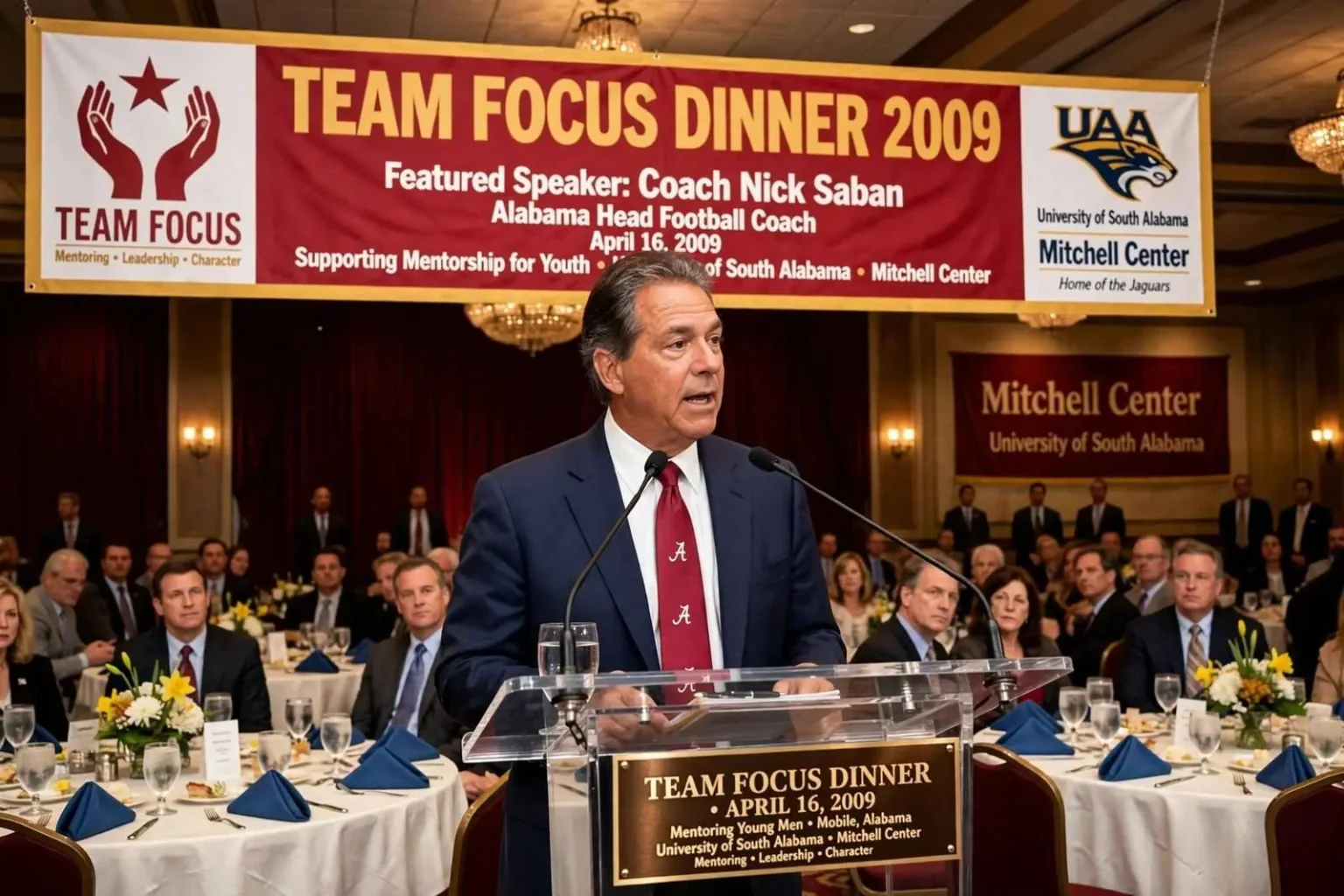
Alabama football coach Nick Saban traveled to Mobile in April 2009 as the featured speaker at the Team Focus Dinner, an annual fundraising gathering held at the University of South Alabama’s Mitchell Center. The event drew supporters of the mentoring organization from across the Mobile area and gave attendees a rare chance to hear one of college football’s most prominent coaches speak in person. For a program built on connecting young people with positive adult influences, the presence of a sitting Southeastern Conference head coach represented one of the most visible moments in the organization’s local calendar.
Saban’s appearance was arranged around the busy rhythm of spring practice in Tuscaloosa, when college programs split their weeks between workouts and public engagements. His visit underscored the pull that Mobile and the wider Gulf Coast hold within Alabama football’s recruiting footprint. Mobile has long produced a steady stream of Division I talent, and coaches from across the SEC make regular stops in the city during evaluation periods. A spring trip that doubled as support for a charity fit neatly into that routine.
The Team Focus mission and the Gottfried connection
Team Focus is a mentoring program founded by Mike and Mickey Gottfried, and it has operated with a mission centered on guiding young men who benefit from steady adult mentorship in their lives. The organization pairs its participants with mentors, runs leadership-focused programming, and uses community events to raise both money and awareness for its work. Its dinners and banquets have historically doubled as the group’s signature fundraising vehicles, bringing well-known speakers to the Gulf Coast while giving donors a direct look at the program’s purpose.
Mike Gottfried brought a deep sports background to the venture. Before founding Team Focus, he built a career as a college football head coach and later became a familiar voice to national audiences as an ESPN analyst, work that kept him connected to the game and to the coaches who staff its sidelines. That network proved valuable for an organization that relies on marquee speakers to anchor its fundraising calendar.
The family tie to Mobile runs deeper still. Mike Gottfried is the brother of Joe Gottfried, who served as the University of South Alabama’s athletic director at the time of the 2009 dinner. Joe Gottfried spent decades guiding Jaguar athletics through its growth as a program, and the family’s long presence in the city helped explain why Team Focus has been so firmly rooted in Mobile. The Mitchell Center, the university’s multi-purpose arena on the USA campus, provided a natural venue, large enough to host a banquet crowd while sitting at the heart of the institution where the Gottfried family’s local legacy was most visible.
Saban’s remarks after the dinner
After the dinner concluded, Saban spoke with reporters covering the event. His comments touched on three main subjects: the work Team Focus does for young people, the state of Alabama’s spring football work as the Crimson Tide moved through practice sessions in Tuscaloosa, and his earlier departure from the Miami Dolphins, the NFL stop that preceded his return to the college ranks.
The questions about the Dolphins were a familiar theme for Saban in that era. He had coached in Miami for two seasons before leaving to take over the Alabama program, and reporters routinely revisited that transition whenever he appeared in public settings. His remarks in Mobile were consistent with the way he had addressed the topic in other venues, acknowledging the decision while keeping the focus on his current program.
The spring practice questions gave Saban a chance to discuss the development of his roster between seasons. Spring workouts are the period when staffs evaluate returning players, integrate new arrivals, and install schemes for the fall, and head coaches are often asked to characterize the team’s progress. Saban’s willingness to discuss that work in front of a Mobile audience reflected the importance of the region to Alabama’s roster-building, with the city and its surrounding parishes and counties regularly supplying signees.
Why the appearance mattered locally
For Team Focus, the evening connected a nationally prominent college-football coach with a Mobile mentoring organization and its supporters, the kind of pairing that fundraising events depend on to fill banquet halls and generate donations. Speakers with name recognition give attendees a reason to buy tickets, and the money raised supports mentorship activities throughout the year. The organization’s leaders have long argued that consistent adult guidance changes the trajectory of young lives, and events like the April 2009 dinner provided both the funding and the public platform to make that case.
The dinner also highlighted the civic role that college coaches play across Alabama. In a state where football occupies a central place in public life, head coaches are among the most requested speakers for charity functions, banquets and community celebrations. Their appearances draw crowds that a typical fundraiser cannot match, and organizations serving young people frequently benefit from that drawing power. Mobile’s network of youth-serving nonprofits has historically leaned on such events to sustain their budgets.
The Mitchell Center setting added its own significance. Opened in the late 1990s on the South Alabama campus, the arena serves as the home floor for Jaguar basketball and as one of the largest indoor event spaces in Mobile, hosting graduations, concerts and community gatherings alongside athletic events. Its use for the Team Focus Dinner reflected the venue’s standing as a gathering place for major local functions, and the university’s willingness to support a mentoring organization with family ties to its own athletic administration.
A snapshot of Alabama football in the spring of 2009
The timing of Saban’s visit placed it in the middle of a defining stretch for his program. Saban had arrived in Tuscaloosa in January 2007 after his Miami tenure, inheriting a program in need of rebuilding. By the spring of 2009, the Crimson Tide was coming off an SEC championship game appearance the previous December and preparing for a season with expectations that had climbed steadily under his leadership. Spring practice sessions that April were part of the preparation for a fall campaign that Alabama fans followed closely.
For Mobile-area fans, the dinner offered a close-up look at a coach whose teams would continue to recruit the city heavily in the years that followed. High school programs across Mobile and Baldwin County have regularly sent players to Tuscaloosa, and the spring speaking circuit gives coaches a way to maintain those relationships in months when recruiting travel is limited by the college calendar.
A historical note on the event
This account reflects the April 2009 dinner and the remarks Saban made that evening. It does not describe later Team Focus activities, the fundraising totals generated by the event, or the results of Alabama’s subsequent season. What the evening captured was a moment when the priorities of a major college program and the needs of a local mentoring organization intersected in a single room, with a coach who had won national titles before arriving in Tuscaloosa lending his profile to a cause founded by a family with deep Mobile roots.
The broader lesson of the night endures in the way Gulf Coast communities support youth programs. Banquets, golf tournaments and speaker series remain the financial backbone of mentoring organizations across Mobile and Baldwin County, and the involvement of high-profile figures continues to be the surest way to fill seats. For the young people Team Focus serves, the April 2009 dinner was one more demonstration that their community, from the university’s arena to the coaches’ podium, was paying attention to the work being done on their behalf.
Mentoring organizations like Team Focus occupy a specific niche in the landscape of Gulf Coast youth services. Unlike programs that operate only during school hours or through a single institution, mentoring groups depend on volunteers who commit to relationships that stretch across months and years. That model keeps overhead relatively low but requires a steady stream of community support, which is why fundraising dinners carry so much weight on the organizational calendar. A single successful banquet can underwrite programming for a substantial portion of the year, covering mentor training, activity costs and the staff time needed to match volunteers with participants.
Mobile’s sports culture has consistently supplied both mentors and fundraising muscle for such efforts. The city has produced professional athletes, college stars and generations of high school coaches who understand firsthand what a steady adult presence can mean for a teenager deciding between divergent paths. Banquet audiences along the Gulf Coast tend to include many of those figures, and events built around football speakers routinely double as reunions for the local coaching community, extending the reach of the message being delivered from the podium.
Spring speaking engagements also serve a practical purpose for the coaches themselves. The period between the end of spring practice and the start of summer workouts offers one of the few windows on the college calendar when a head coach can travel for non-recruiting appearances. Organizations that secure a spring date often benefit from a coach who is relaxed, rested by comparison to the fall, and willing to linger for photographs and conversation with donors, all of which adds value to the tickets and sponsorships the event sells.
The University of South Alabama’s role as host site fit the broader pattern of the institution’s engagement with the city. The university has long positioned its facilities as community assets, and its leadership has historically encouraged campus venues to serve civic organizations alongside the academic calendar. For Team Focus, holding the dinner on a college campus carried a symbolic weight as well, placing young people’s futures inside a setting that represents the next step of an education, a visual reminder of what mentorship is meant to make possible.
The relationship between college athletics and charitable causes across Alabama runs through events like this one in hundreds of variations each year. Athletic departments coordinate appearances, coaches lend their names, and organizations handle the logistics of selling tables and courting sponsors. When the pieces come together, as they did at the Mitchell Center in April 2009, the result is an evening that raises money, rewards longtime supporters and sends a public signal that the state’s most visible sports figures take their community obligations seriously.