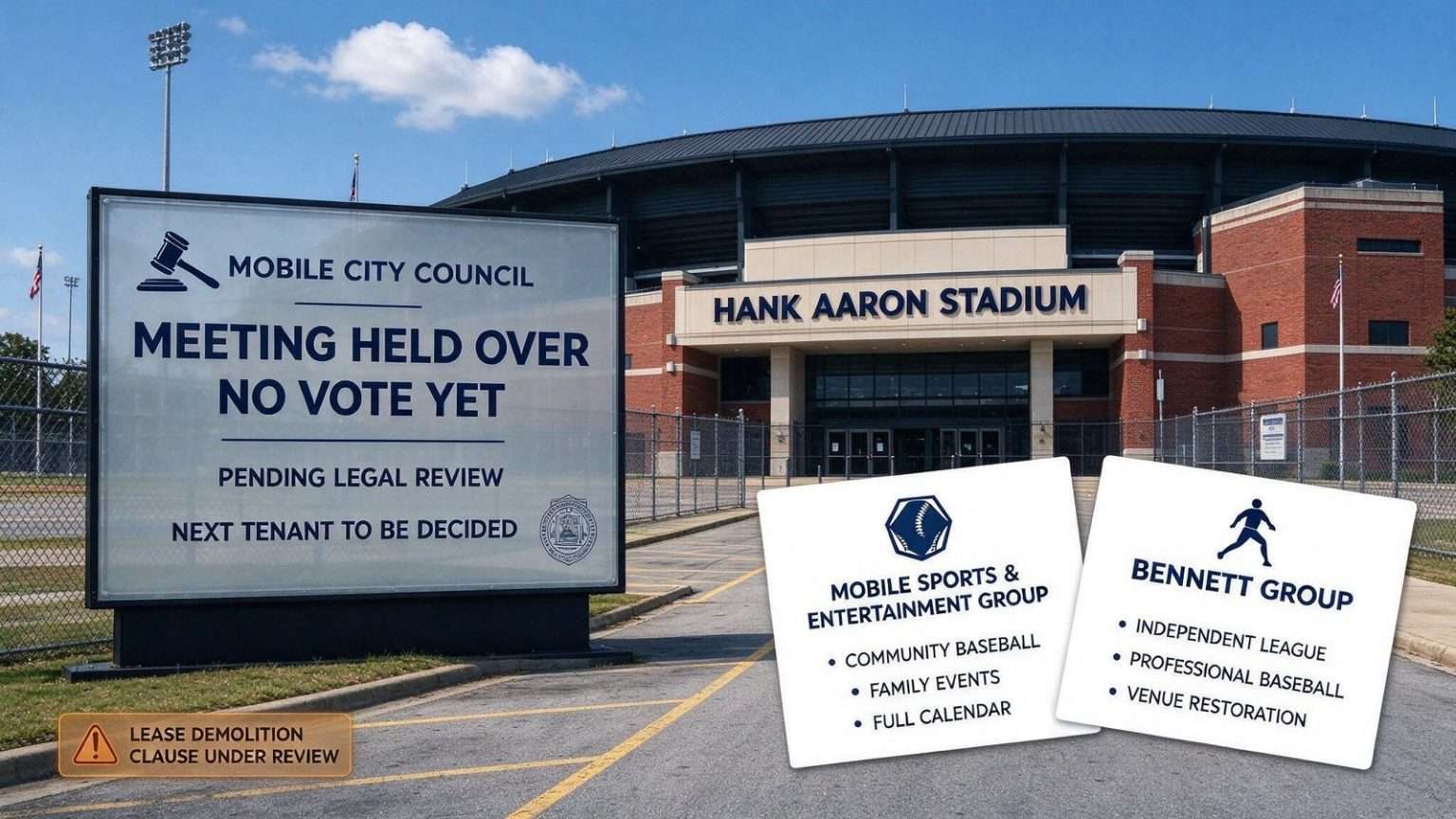
Mobile city leaders will need at least another week before settling who takes control of Hank Aaron Stadium for the final two years of its current lease term, after the City Council opted to hold over the matter at last week’s meeting. The delay leaves one of the city’s most visible public assets in limbo a little longer, but council members say the extra time is needed to untangle legal questions that surfaced only after representatives of both competing groups sat down with an ad hoc committee earlier this week.
The council is weighing two competing bids for the stadium. One comes from the Mobile Sports and Entertainment Group, made up largely of former Hank Aaron Stadium staff who want to fill the venue’s calendar with high school and college baseball games along with family-oriented entertainment. The other comes from a group led by Tim Bennett that hopes to land an independent league baseball club for the city. The two visions differ sharply — one centered on community events and amateur baseball, the other on restoring professional baseball to a city that has hosted it for decades.
Whoever wins out will inherit a lease that previously belonged to BallCorps LLC, the ownership group that purchased the Mobile BayBears and relocated the franchise to Madison, near Huntsville, rebranding it as the Rocket City Trash Pandas. That move left Hank Aaron Stadium without its longtime tenant and set off the search for what comes next at the ballpark. It also left the city holding a facility built for professional baseball but now without a professional tenant to fill it.
The BayBears’ departure marked the end of a long chapter of professional baseball in Mobile. The stadium was built to host the BayBears’ minor league games and has sat without a full-time professional tenant since the team’s move to north Alabama, where a new ballpark and an enthusiastic fan base greeted the rebranded franchise. In Mobile, the empty stadium became a symbol of what the city lost — and a question about what, if anything, should fill the calendar in its place.
What surfaced in the committee meeting
Councilman John Williams, who led an ad hoc committee that met Monday with representatives from both groups, said the session surfaced new details that led the council to hold off on a vote. Among them: a clause in the existing contract calling for the stadium to be demolished if no baseball — particularly minor league baseball — is played there before the lease runs out. That provision, previously little discussed in public, changes the stakes of the decision considerably, since inaction or the wrong tenant could set the city on a path toward losing the ballpark entirely.
“What transpired was a revelation of unknowns that changes the contracts,” Williams said. “We had some uncertainties as to who was going to do what and when. There was a lot of clarification, but all the legal stuff was put in place and now we’ve got to wait to review it.”
Williams said outgoing city attorney Wanda Cochran, who is stepping down at the end of December, will handle that review before the council moves forward. He added that he sees room for both groups to come away satisfied with however the lease is ultimately structured — an outcome that would allow the city to split or sequence the uses of the facility rather than choosing one vision and discarding the other.
“Wanda’s still on the job, and she’s doing it,” Williams said. “I think both parties may get something that they want. Who knows? It’s certainly possible, so I don’t think that anybody should be disappointed, and hopefully, we’ll be able to do some things that will increase the quality of life for Mobilians for the next two years.”
Council urges deliberation
Council President Levon Manzie said he welcomes having two serious proposals on the table and noted that revisions to the lease agreement are nothing new. “This was the fourth revision of the contract,” Manzie said. “As a result, the council’s attorney has not had the chance to review it. There’s no reason to rush the decision; we ought to be deliberate, because there are some very important decisions that have to be made.”
Manzie said he sees merit in both pitches. “We’re very fortunate to have two very promising proposals,” he said. “We built the stadium for the purpose for having baseball, as Mr. Bennett’s group is proposing, and I was impressed with the staff that the Mobile Sports Entertainment Group put together.”
His comments capture the council’s central tension. The city built the ballpark for professional baseball, and an independent league club would restore the facility to its intended purpose — but independent baseball carries its own risks, including the need for an ownership group that can sustain operations across full seasons. The entertainment-group proposal, by contrast, offers a fuller calendar with lower overhead, drawing on people who already know the building and its operations firsthand.
The two bids, side by side
The Mobile Sports and Entertainment Group’s plan leans on volume and variety. High school and college games would bring regular crowds during spring seasons, and family-oriented entertainment would attempt to make the stadium a year-round destination rather than a seasonal one. The group’s familiarity with the facility — many of its members worked in the building under the BayBears’ previous ownership — is its strongest selling point, reducing the learning curve that any new operator would face.
The Bennett group’s plan is more ambitious and more traditional. Landing an independent league club would put professional baseball back in Mobile and restore the stadium’s reason for being. Independent leagues operate outside the affiliated minor league system, signing their own players and negotiating their own leases, which makes expansion to a city like Mobile feasible in a way that a return of affiliated baseball would not be. But securing a club takes time, and the council would be committing the stadium’s future to a prospect rather than a signed tenant.
Between them, the proposals frame the broader question the city must answer: whether a ballpark built with public money is best kept busy by any means available, or best kept for the professional game it was built to host — with a demolition clause hanging over any choice that leaves it dark.
What the lease decision means for Mobile
Hank Aaron Stadium, built to host the BayBears’ minor league games, has sat without a full-time professional tenant since the team’s departure for north Alabama. The council’s decision will determine not just who runs the facility but what kind of baseball, if any, Mobile fans will see there over the next two years — a question made more pressing by the lease’s demolition clause.
For neighborhoods around the stadium, the stakes are practical as well as symbolic. A busy ballpark brings traffic, concession vendors, part-time jobs and event-night activity; a dark one brings maintenance costs with no offsetting revenue. City leaders have weighed those considerations alongside the legal review now underway, knowing that either tenant would take on obligations the city would otherwise shoulder itself.
Cochran’s role in the final weeks of her tenure adds a wrinkle of timing. As the city’s top legal officer through the end of December, she will review the revised contract language before the council votes, ensuring that whatever the next operator signs is enforceable and that the demolition clause is either satisfied or resolved. After her departure, a successor will inherit both the review’s conclusions and whatever obligations the council approves.
The two-year horizon also matters. The lease term being negotiated covers only the next two years, meaning the council is not committing the stadium’s long-term future to either group. A successful independent club could negotiate a longer stay; a successful events operation could prove the venue’s value in the meantime. The shorter term gives the city an exit ramp in either direction — and keeps both bidders motivated to perform.
Whatever direction the council takes, the review period has already produced one lasting benefit: both bidders now understand the full weight of the contract they hope to sign, and the public understands what is at stake if the ballpark goes unused. In a lease negotiation that has already gone through four revisions, that kind of clarity is worth a week’s delay.
No new vote date had been set as of last week’s meeting. When the council returns to the question, it will do so with Cochran’s review in hand, the demolition clause understood, and a clearer picture of what each group can actually deliver — the clarity members say they needed before signing anything that binds the city for the next two years of the ballpark’s life.