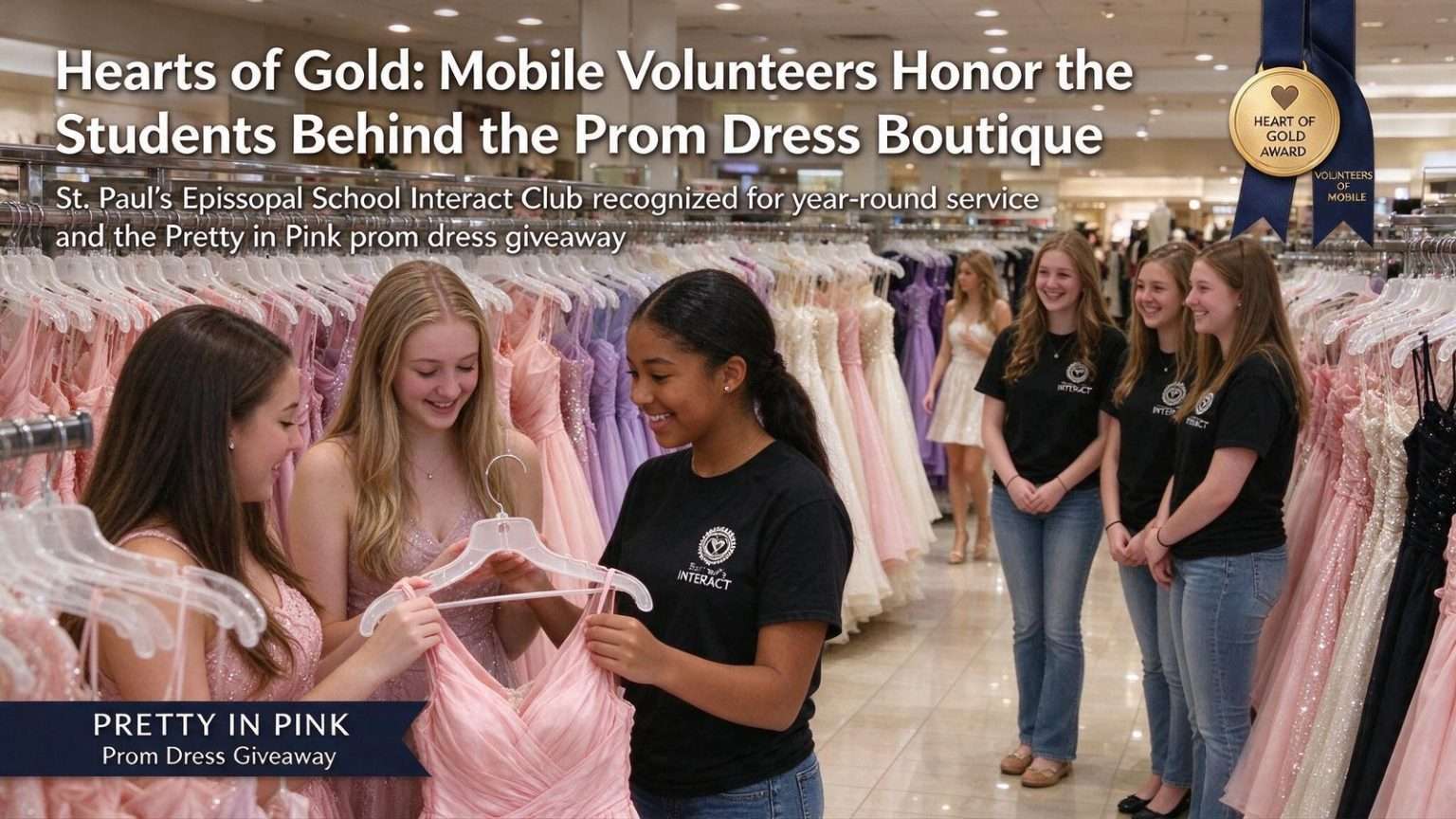
April 23 was a good day for a group of Mobile teenagers who spend their weekends doing work that most adults would call a job. At the Volunteers of Mobile “Heart of Gold Award” luncheon, the St. Paul’s Episcopal School Interact Club was recognized as one of the outstanding youth groups in Mobile County — cited specifically for the “Pretty in Pink” prom dress giveaway that put formal gowns into the hands of some 300 girls at Bel Air Mall in March.
The honor placed the students alongside organizations and individuals that Mobile has been celebrating for years through the Heart of Gold program, which exists to single out volunteer service that might otherwise go unremarked. For a school club whose members are drawn from the same hallways as students worried about exams and athletics, the recognition carried particular weight: the award is not for a single fundraiser or a season of participation, but for a body of work carried out across the entire year.
The Project Behind the Prize
The prom dress boutique is the kind of undertaking that looks effortless on the day and is anything but in the year leading up to it. Volunteers collected, sorted, cleaned and stored roughly 2,000 donated gowns. They negotiated mall space. They arranged the dresses on racks the way a high-end store would, and then worked the floor as personal shoppers for girls who arrived from Mobile, Fairhope, Loxley, Gulf Shores and points beyond.
The line formed at 8 in the morning for a 10 a.m. opening. By the end of the day, only five girls left without a dress. Those numbers tell their own story about the demand that exists across the Gulf Coast for this kind of assistance — a demand that cuts across Baldwin and Mobile counties and reaches families for whom the cost of a prom dress, alterations, shoes and accessories can run into hundreds of dollars at exactly the moment household budgets are already stretched.
The logistics were considerable even before the doors opened. Donated gowns arrive in every condition: some still in garment bags from closets where they hung once and never again, others in need of pressing or minor repair. Sorting them by size, color and style is a job in itself, and storing two thousand dresses requires space most school clubs simply do not have. The volunteers also had to think like retailers, because a giveaway only works if a girl can find something in her size that she actually wants to wear. The rack-by-rack arrangement at Bel Air Mall reflected that thinking.
The mall setting mattered as well. Bel Air Mall, one of the busiest retail centers in the Mobile area, lent the event a sense of occasion that a church basement or school gymnasium could not. Girls arrived not to a charity handout but to something resembling a boutique experience, with student volunteers acting as personal shoppers — listening to preferences, pulling options, and offering the kind of honest feedback that makes a dressing-room decision easier.
The club operates under faculty advisors Heather Normand and Rachel Graham. Interact is Rotary’s service program for high school students, sponsored by local Rotary clubs, and it carries with it an international network and a service ethic that stretches back decades. The St. Paul’s chapter has become one of the more visible youth service organizations in the county, a standing it earned through projects that demand organization and follow-through rather than a one-day commitment.
For Rotary, chapters like St. Paul’s represent the front end of a pipeline that runs from Interact to college service organizations and eventually to the Rotary clubs that fund scholarships and international projects across the Gulf Coast. A club that can execute an event of this scale at the high school level is exactly the sort of chapter that district Rotary leadership watches, and the Heart of Gold recognition is likely to raise the club’s profile when sponsorships and partnerships are handed out next year.
A Second Award, for Quieter Work
The luncheon also recognized the school’s Service Leadership Class, which took the 2008 Heart of Gold Youth Group Merit Winner Award. The students honored — Worth Kittrell, Leighton Silverstein, Sara Thetford and Marissa Gacek — were cited for volunteer service at Augusta Evans School, Prichard Preparatory School, Mulherin Place and the Saint’s Walk for a Cure.
That list deserves a moment’s attention, because it is not a list of glamorous assignments. Augusta Evans serves students with significant disabilities. Mulherin Place provides residential care. Prichard Preparatory operates in a city whose finances have been on the brink for years. These are places where volunteers are needed precisely because the populations they serve have the fewest alternatives, and where the work — reading with a child, helping in a classroom, sitting with a resident — produces no ribbon-cutting and no photograph.
The places the students served
Augusta Evans School has long been part of the public education landscape in Mobile County, educating children and young people with intellectual and physical disabilities that keep them out of the traditional classroom track. Volunteering there means meeting students where they are, often one-on-one, and learning patience that no extracurricular activity can teach. The Service Leadership Class students who spent time there came away with an understanding of special education that most adults in the community have never had occasion to acquire.
Prichard Preparatory School operates in one of the Mobile area’s most financially stressed municipalities. Prichard’s well-documented budget troubles have made it the region’s shorthand for municipal distress, and its schools feel the effects before anyone else does. A preparatory school committed to serving that community depends on outside help to keep its classrooms supplied and its students supported, and volunteer hours from high schoolers translate directly into attention that teachers alone cannot provide.
Mulherin Place offers residential care to people who cannot fully care for themselves, the kind of setting where small acts — a conversation, an outing, help with a meal — carry real weight for residents whose days are otherwise structured and quiet. The Saint’s Walk for a Cure, meanwhile, represents the fundraising side of service work: the walks and runs through which Mobile-area organizations gather the money that pays for research, treatment and patient support.
What the awards say about Mobile
Mobile has a long civic tradition of organized volunteering, from the hurricane-relief networks that took shape along the Gulf Coast after Katrina to the service leagues and church coalitions that staff food pantries and school supply drives across the county. What the Heart of Gold program does is keep that tradition visible, and what the St. Paul’s awards do is demonstrate that the tradition is being handed down. The students recognized on April 23 did not inherit their service commitments from an obligation; they built projects — a prom boutique, a year of weekly visits to classrooms and care facilities — that required them to plan, recruit, transport, and show up repeatedly.
There is also a practical lesson in the prom dress giveaway for other schools and civic groups watching the results. The model is replicable: a collectible, storable donated good; a high-traffic venue; a date timed to the spring formal season; and volunteers organized enough to staff it like a retail operation. The St. Paul’s club proved that a student organization, properly advised, can execute at a scale that rivals established charities, and the Heart of Gold recognition suggests the Mobile volunteer establishment has noticed.
For the girls who found their dresses that March day, the arithmetic was simple — 300 proms made possible, five disappointments at the end of a long line. For the students who ran it, the April 23 luncheon was the kind of public accounting that volunteer work rarely receives, and a signal that the region’s next generation of civic leadership is already at work.
The economics of the giveaway are worth spelling out, because they explain why the project resonated with the Heart of Gold judges. A new formal gown from a department store routinely runs well past a hundred dollars before alterations, shoes, jewelry and a corsage are added, and high school students in Mobile and Baldwin County attend multiple formal events across four years. For a family juggling rent, utilities and groceries, a dress can be the line item that decides whether a daughter goes to prom at all. The Pretty in Pink boutique removed that decision entirely, and the turnout — a line outside the doors an hour before opening — showed how many families had been quietly waiting for exactly that.
The geographic reach of the event also said something about the region. Girls made the trip from Fairhope and Gulf Shores on the Eastern Shore, from Loxley in central Baldwin County, and from neighborhoods across Mobile itself, because word of the giveaway traveled through school counselors, church groups and social media in the weeks before the event. For families on the eastern side of Mobile Bay, the drive to Bel Air Mall is a modest trip up the Causeway or around the Bayway; for the organizers, it meant their planning had to account for crowds arriving in waves all day rather than a single morning rush.
The student volunteers, for their part, worked the event the way experienced event staff would. Greeting at the door, checking sizes against the rack inventory, carrying selections to fitting areas, and helping girls picture complete outfits rather than isolated dresses — the personal-shopper model kept lines moving and kept the experience dignified. Volunteers who do this kind of work describe the same reward: watching a girl who arrived uncertain walk out holding a garment bag, which is precisely the moment the months of sorting and steaming were for.
Faculty advisors Normand and Graham have built the kind of club culture where that follow-through is expected. Service organizations at the high school level often struggle with a familiar lifecycle — a strong founding class graduates, and participation fades. A club that produces both a large public event and a sustained slate of weekly service placements, and that wins countywide recognition in the same spring, has solved that problem, and the credit for institutional habits like these generally sits with the advisors who insist on them.
The Heart of Gold program itself has become one of the ways Mobile measures its own generosity, recognizing volunteers of all ages at an annual luncheon that doubles as a recruitment showcase for the nonprofits represented in the room. High school groups competing for the same honors as adult civic organizations is part of the point: it tells agencies that need reliable volunteers that students can be counted on, and it tells students that their work is being seen by the same community leaders who fund and staff the region’s charitable institutions.