Mobile School Board Considered Student Drug Testing in 2008
In 2008, Mobile County school leaders proposed drug testing for some students at four schools, including participants in extracurricular activities and student drivers.
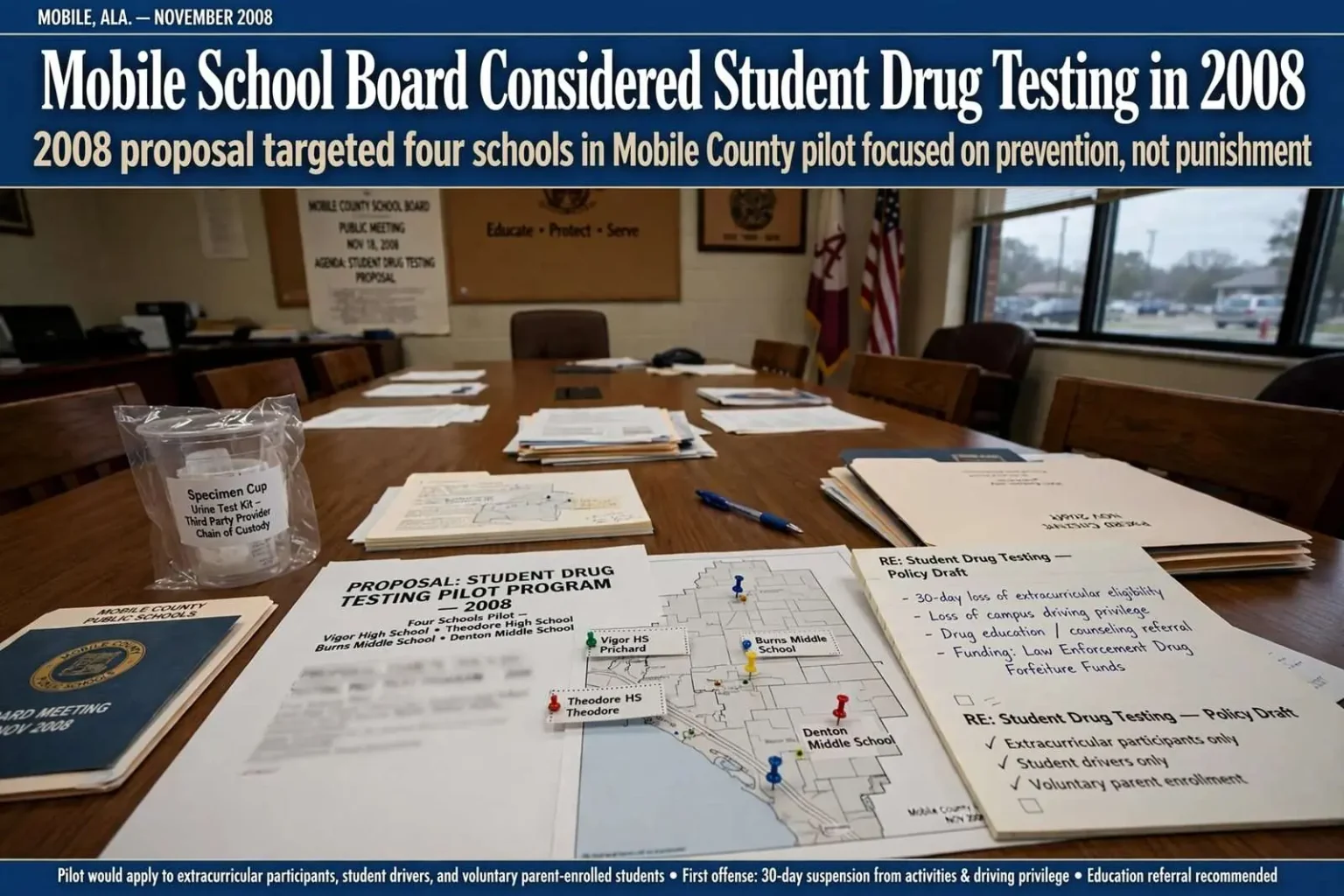
MOBILE, Ala. — In 2008, the Mobile County School Board was scheduled to take up a proposal that would have made it one of the largest school systems in the Southeast to test certain students for drug use. The plan, prepared at the recommendation of then-Superintendent Roy Nichols, targeted four schools in the district: Vigor and Theodore high schools and Burns and Denton middle schools. The proposal was presented as a prevention measure rather than a punitive one, and it arrived at a moment when school systems across Alabama and the Gulf Coast were weighing how far they could — and should — go in screening students for controlled substances.
Under the framework Nichols put forward, testing would not have applied to the general student body. Instead, it would have reached three specific groups of students at the four pilot schools: students who participated in extracurricular activities, students who drove vehicles onto campus, and students whose parents voluntarily enrolled them in the program. That structure mirrored the approach most public school systems had adopted elsewhere in the country, focusing on students who enjoyed special privileges rather than conducting blanket testing of every enrollee.
The choice of the four schools placed the pilot program in two distinct corners of Mobile County. Vigor High School sits in Prichard, serving students from the city’s northern neighborhoods, while Theodore High School anchors one of the largest communities south of Mobile along U.S. Highway 90. Burns Middle School and Denton Middle School served younger students closer to the city core, making the proposed program one of the few in the region to extend drug screening down into the middle school grades, where students are typically between eleven and fourteen years old.
What the penalties would have been
The consequences laid out in the proposal were designed to hit privileges rather than academics. A student’s first positive test would have meant a 30-day loss of extracurricular eligibility, keeping the student off athletic rosters, bands, clubs and other sponsored activities for a month. The same first offense would also have cost the student campus driving privileges, a meaningful penalty in a district where many high school upperclassmen rely on their own cars to get to school.
Alongside the eligibility suspension, the plan called for the student and the student’s parents to be encouraged to participate in drug-education programs. That pairing of a penalty with an educational referral reflected the prevention emphasis board members described, treating a positive result as a signal to intervene early rather than a reason to push a student out of school life entirely. The proposal did not call for suspension, expulsion or referral to law enforcement as a response to a first positive test.
The testing itself was to be handled by an outside firm using urine samples, keeping the process out of the hands of school staff who would have had neither the laboratory training nor the chain-of-custody procedures required for reliable results. Contracting with a third-party provider was the standard model for school districts of Mobile County’s size, since a system serving tens of thousands of students could not feasibly run its own certified testing operation. Using an outside firm also gave districts a buffer on questions of accuracy and confidentiality, with results reported through the vendor rather than handled directly by coaches or administrators.
Board member Ken Megginson spoke to the purpose behind the plan, saying the proposal was intended as prevention. That framing mattered, because the legal footing for student drug testing in public schools rests heavily on the argument that programs exist to deter use and connect students with help, not to hand out criminal penalties. Districts that framed their programs that way had generally fared better in court challenges than those that imposed harsh, academic consequences for positive results.
Where the money would come from
Funding for the initial phase was expected to come from local law-enforcement drug funds, the asset forfeiture money that accumulates from drug-related seizures and is often directed toward anti-drug initiatives. Tapping those funds meant the pilot would not have required a new line in the school system’s operating budget, a politically important detail for a board weighing any new recurring expense. It also tied the program directly to the enforcement side of the county’s anti-drug effort, using money taken out of the drug trade to fund screening aimed at keeping students out of it.
The proposal also sketched a path for growth beyond the pilot. Expansion to the system’s other high schools was planned for the spring semester, which would have extended testing across a district that spans more than a dozen municipalities and unincorporated communities from Citronelle in the north to Dauphin Island in the south. A spring rollout would have given administrators roughly one semester of experience at the four pilot schools — data on testing logistics, parental response and cost per test — before scaling up.
The legal backdrop
Any school board considering such a program in 2008 was working within a legal landscape shaped by two U.S. Supreme Court decisions. In Vernonia School District v. Acton in 1995, the Court upheld random drug testing of student athletes, and in Board of Education v. Earls in 2002 it extended that reasoning to students in all competitive extracurricular activities. Together the cases gave public schools a firm constitutional foundation for testing students who join voluntary activities, while leaving the status of blanket testing of the full student body unsettled — a gap that explains why nearly every district program, including the one proposed in Mobile County, was built around extracurricular participants and student drivers.
Alabama school systems had watched those cases closely, and a handful of districts in the state and along the Gulf Coast had put their own testing policies in place in the years after Earls. For a system the size of Mobile County Public Schools — the largest in Alabama — the administrative weight of a testing program was considerable, involving scheduling across multiple campuses, notifying parents, securing consent forms and coordinating with the testing vendor, all of which factored into how boards approached the decision.
What residents needed to know
For families at the four named schools, the practical reach of the proposal was narrower than headlines might have suggested. A student who played no sport, marched in no band and rode the bus to school would never have come near a test cup unless a parent affirmatively signed the student up. That voluntary track gave parents who wanted outside reinforcement an option without subjecting unwilling families to the program, and it placed the burden of the mandate on the two privilege categories — activities and parking — that courts had already cleared.
The 30-day eligibility window was also calibrated to the school calendar. A month off the roster costs an athlete a chunk of a season but not the year, and it built in a natural checkpoint for retesting and for whatever counseling or education the family pursued in the meantime. Districts with similar policies generally allowed students to regain eligibility after a positive test through a follow-up negative result or completion of a program, an approach consistent with the educational referral built into the Mobile County plan.
A proposal, not a settled policy
Communication with parents would have been central to any rollout as well. Programs of this type typically required signed consent forms at the start of a school year, letters explaining the testing schedule and the confidentiality of results, and clear channels for families to contest a result or report legitimate prescription use that could produce a false positive. For a district spread across urban Prichard, suburban Theodore and the communities between, getting that paperwork and outreach right at four very different campuses was itself a test of whether the program could eventually run system-wide.
It is worth underscoring what the archived record does and does not establish. The report preserves the proposal as it was scheduled to come before the board in 2008 — the schools named, the groups to be tested, the penalties, the funding source and the spring expansion timeline. It does not state whether the board adopted the measure, modified it, tabled it or let it lapse, and it does not indicate whether any version of the program ever took effect in Mobile County schools. Readers should treat it as a snapshot of a policy debate, not a description of an operating program.
That distinction matters for anyone researching how the county’s school system handled drug prevention over the years. The 2008 discussion captures a particular moment: superintendent Roy Nichols recommending, board member Ken Megginson emphasizing prevention, law-enforcement drug funds standing ready to pay, and four campuses — Vigor, Theodore, Burns and Denton — positioned to pioneer the effort. Whatever the board ultimately decided, the proposal remains part of the documented record of how Alabama’s largest school system weighed its options on student drug testing, and of the care districts took to build programs that deterred use without pushing students further away from the classroom.