Historical report, published from archived local news coverage.
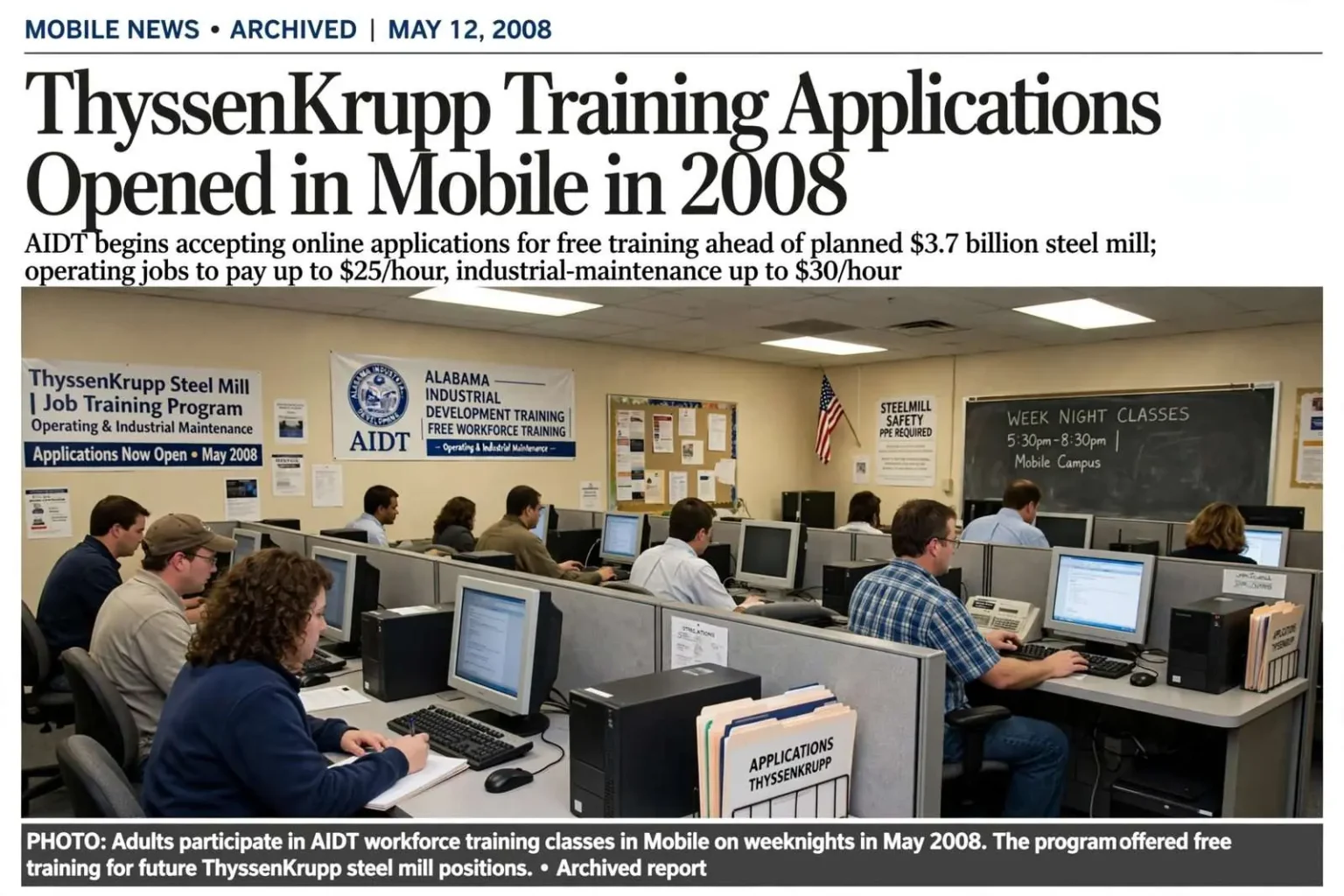
In May 2008, people interested in training for jobs at the planned $3.7 billion ThyssenKrupp steel mill could begin applying online for free training through AIDT, according to an archived local news report. The training, part of Alabama’s two-year college system, was held on weeknights in Mobile, with the possibility of expanding to daytime and weekend sessions if demand warranted. The application window opened as the German steelmaker moved from announcement to construction on what would become one of the largest industrial projects in Alabama history.
The stakes for applicants were concrete. Operating positions at the steel mill were expected to pay up to $25 an hour, while industrial-maintenance positions could pay up to $30 an hour — wages well above the prevailing rates for much of the region’s workforce at the time. For Mobile-area residents without a four-year degree, the training pipeline represented a rare path into heavy-industry pay scales, and the fact that the classes were free removed the tuition barrier that keeps many workers out of skill programs.
Applicants who had already applied for ThyssenKrupp-related AIDT training were being reviewed and did not need to apply again, the report noted. That clarification mattered, because interest in the project had been building since the state won the mill, and training administrators were already working through a backlog of names when the new online application opened.
Why ThyssenKrupp mattered to Mobile
The ThyssenKrupp project, announced in 2007, was among the largest single economic development investments ever made in Alabama. The German industrial conglomerate selected a site at Calvert in north Mobile County, along the Tombigbee River, choosing the region over competing sites after one of the most closely watched site-selection contests in the country. The $3.7 billion price tag attached to the mill at announcement reflected the scale of the operation: a facility capable of producing steel sheet for automotive and other customers across the southeastern United States, a region where auto plants had been multiplying throughout the decade.
The mill’s location put it within commuting range of Mobile’s northern suburbs and Washington County communities, and its workforce needs rippled across the entire metropolitan area. Training classes held in Mobile on weeknights made sense for exactly that reason — they allowed workers who kept day jobs to prepare for mill positions without quitting first, and they concentrated the applicant pool in the population center nearest the site.
How AIDT works
AIDT — the Alabama Industrial Development Training program — had, by 2008, become one of the state’s signature economic development tools. The agency, part of the two-year college system, builds custom training programs for employers that are expanding or locating in Alabama, recruiting and screening applicants and delivering job-specific instruction at no cost to the trainee. The employer gets a workforce trained to its specifications; the trainee gets marketable skills and a shot at the job without paying tuition.
The model had already been proven on the state’s landmark industrial projects of the preceding two decades, including the Mercedes-Benz plant in Tuscaloosa County and the Hyundai plant near Montgomery. Applying it to ThyssenKrupp extended the approach to the largest industrial employer yet, and the Mobile-area weeknight classes were the local expression of a statewide training apparatus.
Industrial-maintenance positions commanded the higher end of the advertised pay range — up to $30 an hour — because they require skills that were already scarce: the ability to keep production equipment, hydraulics, electrical systems and heavy machinery running around the clock. Operating positions, at up to $25 an hour, involved running the mill’s production lines themselves. Both categories required training before hire, which is why the application process ran through AIDT rather than through the company’s own hiring offices.
The training experience
Weeknight classes in Mobile suited the population the program was trying to reach. Many applicants were already employed in construction, shipping, or service work, and could not attend daytime sessions without giving up income. Holding classes on weeknights kept the pipeline open to working people, and administrators kept the daytime and weekend options in reserve in case the pool of available applicants required more room. The training itself focused on the fundamentals a steel mill demands: safety practices, process fundamentals, instrumentation, and the mechanical aptitude assessments that help determine which applicants fit which roles.
The online application process, new for many applicants in 2008, reflected the scale of interest in the project. Rather than routing thousands of candidates through a single office, the program collected applications digitally, sorted them by interest and background, and scheduled assessments accordingly. Applicants who had already put their names in the system were told to stand by; their files were already in the review queue.
What happened to the project
From the vantage of May 2008, the mill represented a transformation on the horizon. Construction at Calvert proceeded through the following years, employing thousands of construction workers before the production workforce came on, and the mill eventually began producing steel at a site that reshaped the economy of north Mobile County. Roads were improved, supporting businesses clustered nearby, and communities from Creola to McIntosh saw activity levels unlike anything in their history.
The project’s later history took turns that were not visible in 2008. The steel business cycle that lifted the mill’s early years eventually turned, global overcapacity pressured prices, and the facility changed hands in the years that followed, continuing to operate under new ownership as a major regional steel producer. For the workers who trained through AIDT in those Mobile classrooms, though, the sequence that began with a free weeknight class led to careers in heavy industry that the region had rarely offered before.
Workforce training as economic strategy
The story of the 2008 application window is worth remembering as a case study in how Alabama courts and keeps major employers. The state’s pitch to industry has long rested on a trio of assets: location, incentives, and a workforce training system that promises a ready supply of prepared workers. AIDT is the third leg, and its free, employer-specific training model has been credited with helping the state land projects that might otherwise have gone to neighboring states competing on the same geography.
For individuals, the lesson of the May 2008 notice is more personal. Wage bands of $25 to $30 an hour, attached to a training program with no tuition, drew applicants from every corner of the regional economy — people coming out of retail, food service, construction, and the military. Those who made it through the assessment and training stages stepped into industrial careers, and many of the region’s current steel and manufacturing workers trace their start to exactly that kind of application window.
This is a historical hiring and training notice; the application period is no longer current. The details above are preserved from archived local news coverage of the May 2008 opening of the AIDT application process for ThyssenKrupp-related training in Mobile. Readers interested in current workforce training opportunities in the region can explore the programs offered today through Alabama’s community and technical colleges and the state’s industrial training agency, which continue to run employer-specific training for industries across Mobile County and beyond.
The region the mill entered
To understand why a training notice drew so much attention, it helps to recall what the Mobile area’s economy looked like in 2008. The port, the shipyards, chemical plants, and papermaking anchored the industrial base, but the region had watched neighboring states — Mississippi with its Toyota plant announcement, Louisiana with its own industrial expansions — compete for the same projects. ThyssenKrupp’s selection of Calvert was the payoff for years of effort, and it signaled that Mobile County could win at the highest level of international site selection.
The announcement also landed in a labor market where good-paying industrial jobs faced steady competition from lower-wage service work. The wage bands attached to the mill — up to $25 an hour for operators, up to $30 for industrial maintenance — were quoted repeatedly in local coverage precisely because they stood so far above typical regional wages. A maintenance job at $30 an hour, with overtime opportunities common in continuous-process industries, could support a household in a way that most available work could not.
Inside the application process
The application process itself required patience from candidates. AIDT’s approach was deliberately staged: applications were collected online, applicants were assessed for basic skills and aptitudes, and those who advanced were placed into training tracks matched to the roles the company expected to fill. Not everyone who applied ended up in a class, and not everyone in a class ended up with a job offer, which administrators were upfront about. The program’s value was that the attempt cost the applicant nothing but time.
For those already in the queue when the May 2008 window opened, the message that they need not reapply prevented a wave of duplicate applications that would have clogged the system. The clarification also signaled how much interest had outpaced expectations — enough that administrators were managing repeat submissions on top of the original flow of names.
Steel country on the Tombigbee
The Calvert site itself was chosen for reasons that trace back decades of industrial geography. The Tombigbee River offered barge access for the raw materials steelmaking consumes — iron ore, coal, and scrap — while the site’s rail connections and proximity to the port of Mobile gave the mill multiple shipping options for finished product. North Mobile County had long hosted heavy industry along its waterways, and the steel mill fit into a corridor that communities there knew how to live alongside, even at a scale no previous project had reached.
The training classes in Mobile were the human-side counterpart to that industrial logic. A mill of that size needed hundreds of trained operators and maintenance technicians before it could produce a single coil of steel, and building that workforce took years of classes, assessments, and on-site instruction. The May 2008 application window was the front door of that process, and the archived notice preserved here marks the moment when the region’s residents could first line up for the chance.