2008 Tanker Selection Prompted Plans for Brookley Construction
Archived WKRG coverage detailed initial plans for construction and jobs at Brookley Field after the 2008 tanker-contract selection.
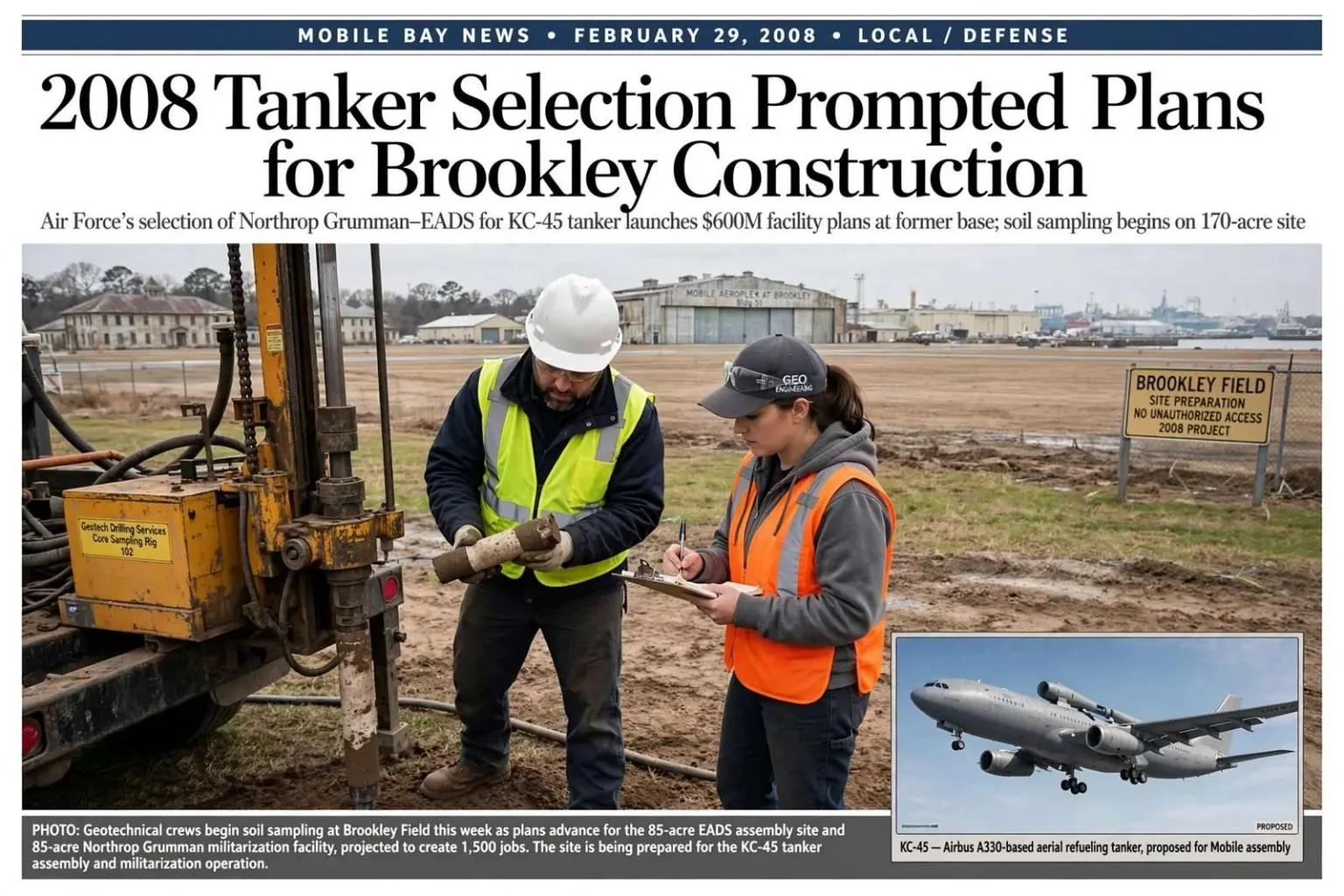
After the Air Force’s 2008 selection of Northrop Grumman and EADS for a tanker project, Brookley Field was preparing for major changes, according to an archived local news report. The station reported that soil sampling had begun and that construction would start as soon as possible on a facility estimated at $600 million to assemble and militarize aircraft. EADS was expected to use 85 acres of the site and Northrop Grumman another 85 acres, with additional property set aside for suppliers. The station said the project was expected to create 1,500 jobs, though the hiring timeline had not yet been determined. This historical report records the plans and expectations at the time, not the project’s later course.
The Tanker Contest Behind the News
The 2008 selection grew out of one of the most consequential defense contracting competitions of the era. The Air Force was seeking a replacement for its aging fleet of aerial refueling tankers, workhorse aircraft that extend the reach of fighters, bombers and cargo planes by transferring fuel in flight. The contest had already stretched across years and two attempts: an earlier lease-and-buy proposal with Boeing had collapsed in scandal, and the restructured competition drew bids from the country’s two largest aerospace players.
Northrop Grumman, teamed with Europe’s EADS — the parent of Airbus — proposed building the tanker, designated the KC-45, on a civil aircraft frame assembled in Mobile. Boeing’s competing bid rested on a smaller 767-based design built in Washington state. When the Air Force announced its selection in early 2008, the choice of the Northrop-EADS team sent shockwaves through the industry and electrified Mobile, which had positioned Brookley as the potential American assembly site for a European-designed military aircraft.
The Mobile bid was a landmark for another reason: it marked the first time a major U.S. combat support aircraft would be assembled in the Deep South, on a field whose Air Force history had ended decades earlier. Local officials described the win as the culmination of years of pursuit, and the archived report captured the immediate practical question — how to ready a site for construction on a demanding timeline.
Brookley Field’s Second Life
Brookley Field carried its own history into the tanker episode. The site served as an Army Air Forces and later Air Force base through World War II and the Cold War, employing tens of thousands at its peak and anchoring Mobile’s south side. The Pentagon closed the base in the 1960s, and the city converted the enormous complex — runways, hangars, aprons and industrial buildings — into what became the Mobile Aeroplex at Brookley, one of the largest urban industrial sites of its kind in the country.
By 2008, the Aeroplex already hosted an established aerospace community. Mobile Aerospace Engineering and its successors performed heavy maintenance and cargo conversions on commercial airliners in the big hangars, and a cluster of aviation firms occupied the former base buildings. The workforce, the runways and the deepwater-adjacent location made Brookley a natural answer when the Air Force selection required an assembly site.
Soil sampling, the first activity the archived report described, is the unglamorous opening act of any major construction program. Geotechnical crews drill and test the ground to determine bearing capacity, drainage and any remediation needs before engineers finalize foundations for hangar-scale structures. That such work had begun signaled that the companies and the city were moving from announcement to construction as quickly as the site would allow.
The Scale of the Planned Facility
The $600 million estimate for the assembly and militarization facility placed it among the largest industrial projects ever proposed for Mobile at that time. Aircraft final assembly lines are specialized plants by any standard: they require hangars tall enough for wide-bodied airframes, floor space for sequential production positions, paint facilities, test infrastructure and the miles of utilities that support all of it. A militarization operation adds secure areas and equipment for installing the tankers’ military systems — the fuel transfer hardware, defensive systems and mission electronics that turn a civil aircraft into a refueling tanker.
The land plan described in the report reflected the same industrial logic. EADS was expected to occupy 85 acres for the assembly operation, with Northrop Grumman, the prime contractor responsible for integrating the military mission systems, holding another 85 acres for its work. Setting aside additional acreage for suppliers anticipated the vendor ecosystem that surrounds any final assembly line, where parts fabrication, subassembly and logistics operations cluster near the point of production to keep the line moving.
The 1,500-job expectation, with no hiring timeline determined, captured the planning stage precisely. Final assembly employment builds gradually as a line ramps up, and at the time of the report neither the companies nor the Air Force had fixed the schedule for that ramp. Local workforce planners nonetheless began preparing, drawing on the state’s training institutions that had supported the automotive plants and the existing Brookley aviation workforce.
What the Region Expected
Anticipation around the project extended well beyond the Aeroplex fences. A final assembly line of the described scale promised not only direct jobs but contracts for Gulf Coast suppliers, demand for skilled trades during construction and a signature that Mobile had joined the ranks of cities where airliners are built, not merely maintained. Civic leaders had spent years courting EADS, and the soil-sampling report was the first tangible sign that the courtship was turning into construction.
Educational institutions also figured in the expectations. The state’s two-year college system had built workforce programs around the automotive plants, and similar training pathways — airframe assembly, avionics, composites — were the obvious preparation for tanker work. South Alabama’s community colleges and universities positioned themselves as the pipeline for the 1,500 positions the project was expected to create, whenever hiring began.
The archived report closed on the uncertainty that defined the moment: construction ready to start as soon as possible, an estimated cost, acreage divided between two corporate giants and supplier reserves, and a jobs figure with no calendar attached. It was a snapshot of preparation, taken between the announcement and whatever came next.
The Aircraft at the Center of the Contest
The KC-45 proposal rested on the Airbus A330 Multi Role Tanker Transport, a wide-body civil airliner adapted for military duty. The design offered the Air Force substantially larger fuel capacity and cargo volume than the competing Boeing entry, one of the central factors in the evaluation. Converting such an airframe into a tanker involved the militarization work the Mobile facility was designed to perform: booms and hoses for transferring fuel, receivers and defensive systems, crew stations and the mission computers that orchestrate refueling operations across an entire battle formation.
Aerial refueling is the quiet backbone of American airpower. Without tankers, long-range bombers cannot reach distant theaters without staging, and fighter deployments across oceans require elaborate stopovers. The fleet the Air Force sought to replace dated to the Eisenhower era, which is why the competition’s outcome carried such weight in both the defense industry and the communities whose economies hung on the decision.
For Mobile, the assembly question was more than symbolic. Final assembly lines concentrate the most visible, highest-value work in aviation manufacturing, and the cities that host them — Seattle, Wichita, Toulouse — built identities around it. The archived report showed Mobile preparing to join that company, acreage staked out and ground tests underway.
Reading the Report in Retrospect
History complicated the plans the report described. The tanker award was immediately protested, and the Government Accountability Office later sustained Boeing’s protest on multiple grounds, forcing a rebid of the competition. The contest stretched on for years before a subsequent award to Boeing ended the KC-45 arrangement as originally structured, and the Mobile assembly plant described in the 2008 report was never built as planned.
The longer arc, however, did not leave Brookley empty. EADS — which became Airbus — later established a genuine airliner final assembly line at the Aeroplex, a project announced years after the tanker contest and one that made Mobile the site of the first Airbus production line on American soil. The earlier tanker episode, including the site work and planning captured in this report, is widely credited with building the relationship and the groundwork that made the later line possible.
That is why this archived report matters as history. It records the exact moment when Mobile believed it was about to become the assembly point for the nation’s next tanker — the soil samples, the $600 million estimate, the two 85-acre parcels, the supplier reservations and the 1,500 expected jobs — at the height of expectations that later events would redirect into a different, but still transformative, aerospace future.
Why Preservation Is the Point
Republishing a report like this one is an act of preservation, not prediction. The station’s original coverage documented what was known and planned in 2008: the beginning of soil sampling, the intent to start construction promptly, the facility estimate, the division of acreage and the jobs expectation. None of that coverage claimed knowledge of how the tanker contest would resolve, and republishing it today carries the same boundaries.
For readers tracing Mobile’s aerospace decade, the report marks a starting line. Everything that followed — the protests, the rebid, the years of uncertainty, and eventually the Airbus assembly line that did rise at Brookley — begins from the plans recorded here, made on the strength of an Air Force selection that once promised to build the next tanker on the shores of Mobile Bay.