He Wanted the Job So He Could Eliminate It: A Candidate Runs to Abolish the County Treasurer’s Office
The chairman of the Mobile County Democratic Party announced a run for county treasurer on a pledge to shut the office down within two years, calling the post an expensive relic of another era.
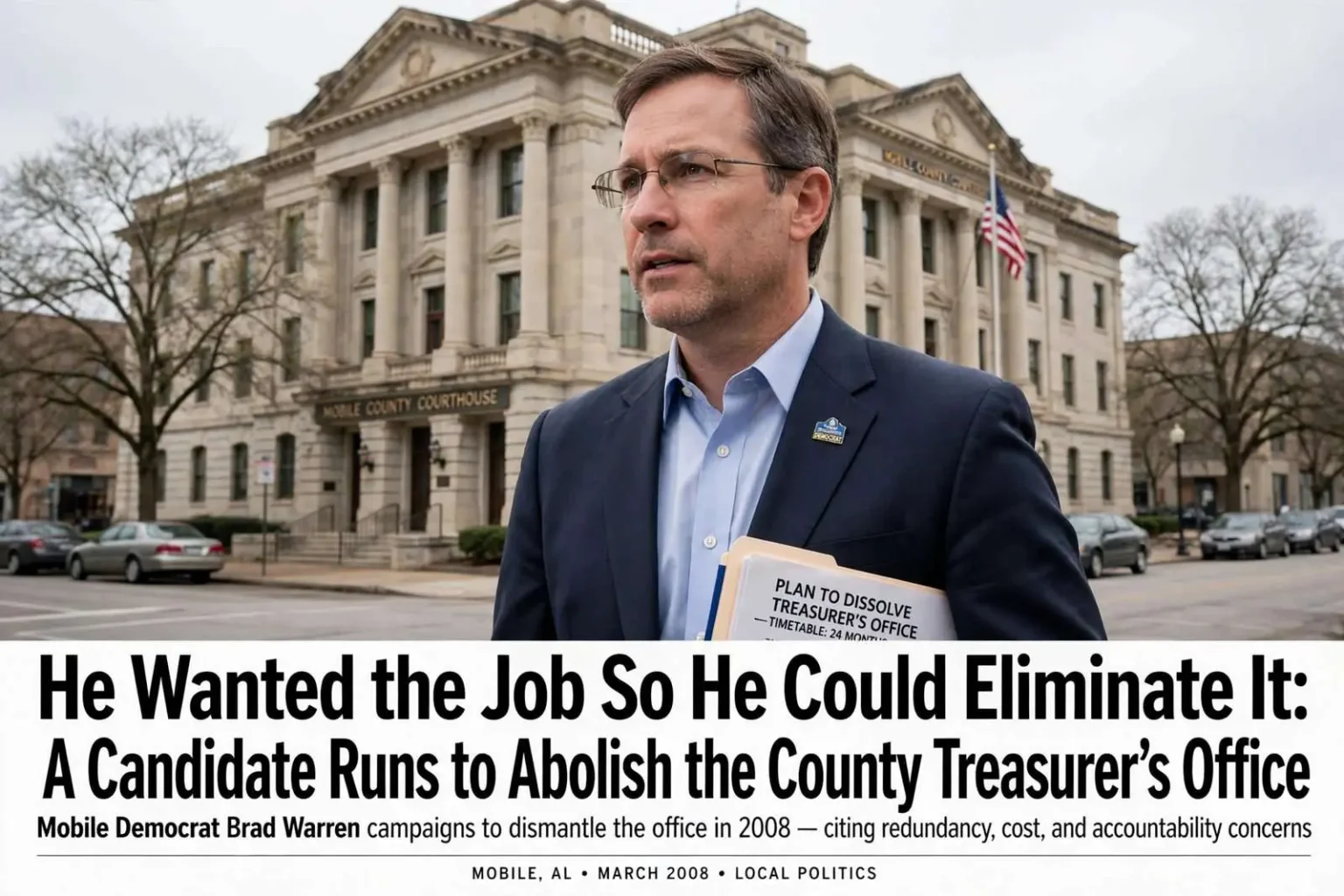
Brad Warren did something in March 2008 that few candidates for public office ever do: he announced that he was running for Mobile County treasurer with the stated intention of putting himself out of a job. Warren, the chairman of the Mobile County Democratic Party, said that if voters sent him to the treasurer’s office that fall, he would spend his term dismantling it — reassigning its employees to other county departments, transferring whatever duties remained, and pressing the Alabama Legislature to strike the office from the county ballot in 2009 or shortly after.
The pledge was not a rhetorical flourish. Warren laid out a concrete timetable: the office would be gone within 24 months of his taking the oath, its staff absorbed elsewhere in county government, and a local bill would be drafted to remove the treasurer’s position from the ballot in the next election cycle. In Alabama, where county government is organized under the state constitution around a fixed set of elected constitutional offices, getting rid of one of them requires an act of the Legislature — and such local bills, tailored to a single county, are a routine part of every legislative session in Montgomery.
The treasurer’s office is one of the older fixtures of Alabama county government. In counties that still elect one, the treasurer is the constitutional custodian of county funds: the officer who receives money collected by other departments, keeps the county’s accounts, and works alongside the governing body on the daily mechanics of deposits, disbursements and reconciliation. Mobile County, governed by a three-member county commission with a professional county administrator handling day-to-day operations, had gradually shifted most of those functions into its own finance apparatus — which was precisely the ground Warren stood on when he made his argument.
“It is an office that’s time has passed,” Warren said. “It serves a duplicating function; it shields the county commissioners from full accountability; technology has rendered it unnecessary; vastly improved audits from the state have made it unneeded; it costs the taxpayers $1 million every election cycle that it remains open.”
Each element of that argument had a real-world anchor. Alabama counties are audited every year by the state Department of Examiners of Public Accounts, an independent agency whose examiners go through county books line by line — a level of outside scrutiny that did not exist when many of the state’s county treasurer posts were first created. Banking software, electronic transfers and centralized accounting had, by 2008, made the manual custody of funds that defined the office a century earlier largely ceremonial in counties where the commission had built a finance staff of its own.
Warren also claimed that Mobile had the only elected county treasurer left in Alabama. That was not quite right. Walker and Jefferson counties also elected treasurers at the time, keeping the office alive outside Mobile even as most of the state’s 67 counties had long since folded the function into their commissions and administrators.
Walker County’s situation gave Warren’s argument an unwanted spotlight. In Jasper, the county seat, the sitting treasurer was under indictment on forgery and theft charges, and legislation had been introduced to abolish the Walker County office as well. The bill’s sponsor, however, was careful to say the indictment was not the reason for his legislation — there simply was no need for the position anymore, he argued, independent of the trouble its current holder was in.
An old argument, revived
Warren was candid that his pitch was not original. A former county administrator had run for the office in 2000 on essentially the same platform — win the job, then end it — and lost to the incumbent, Republican Al Sessions. That earlier campaign had gone nowhere, and Warren believed he understood exactly why.
The political conditions, he argued, were simply better in 2008. His predecessor in the argument, he contended, would have won had it not been for the year: 2004, when George W. Bush carried Mobile County by a wide margin and pulled every Republican on the ballot to victory with him. Mobile County had long leaned Republican in national races even as local offices drew candidates from both parties, and a Democrat running countywide in a Bush landslide faced odds no platform could overcome.
By the time Warren announced, those conditions had shifted. Democrats were energized heading into a presidential election year, and Warren had done his groundwork: he had consulted Mobile Mayor Sam Jones, who had spent 18 years as a Democratic county commissioner before moving to City Hall, and said he had spoken with state legislators about drafting a bill removing the treasurer’s office from the ballot.
The incumbent’s answer
Al Sessions, the two-term Republican incumbent, took the challenge in stride — or at least appeared to. He said he had been busy with the duties of the office and had not yet given much thought to his re-election campaign, though that, he acknowledged, would change the following week.
“I intend to continue the same as always, continue working to manage the monies and keep the office working well with the commission as I’ve always done,” Sessions said. “It is a valuable office and I do not think putting it under the commission would be wise. I have not changed my mind about that. I’m more firmly than ever convinced since I’ve been here.”
The office he defended was not a lucrative one. The treasurer’s position paid $38,096 a year, including a monthly car allowance of $216.67, for a four-year term — a salary modest by the standards of Mobile County’s elected offices, and far below what a private-sector financial manager with comparable responsibility over public money could command. Whoever held the job was unlikely to be in it for the pay, a fact both men could use to frame themselves as public servants rather than career officeholders.
A former treasurer’s warning
The most interesting response came not from Sessions or from party leaders but from a former county treasurer — a Republican who had since become a Democrat, and who was decidedly ambivalent about the whole idea. Her years in the office had left her with a view of county finance that neither the abolitionists nor the defenders quite shared.
The treasurer’s duties, she argued, had been eroded over the years by the county commission itself, as responsibilities migrated to staff members who answered directly to commissioners rather than to any independently elected officer. What remained of the office was a fraction of what the position had once been — a fact that cut both ways in the debate over whether it deserved to survive.
Her own tenure had centered on investing county funds. She developed an investment policy and a standard operating procedure for the office, and she treated maximizing the return on public money as her core obligation, at a time when the county’s idle cash could earn meaningful interest if it was managed deliberately rather than left sitting in a checking account.
Her deeper concern was accountability. An elected treasurer, she contended, is answerable to the public in a way an employee never can be. Abolish the post, and the commission and the county administrator would be free to run the finance office with no independent voice inside it — no elected official whose job, reputation and political future depended on watching the money.
She had concrete reasons for that skepticism. She recounted discovering, during her time in office, a computer consultant who was drawing both a contract payment and a regular salary with benefits — a duplicate arrangement that no one else had caught. She also described trips to conferences that were billed to the public but that the officials in question never actually attended.
“So, maybe they should do away with the Treasurer,” she concluded, “but they should definitely hire an investigator to watch what goes on.”
Her warning framed the question Warren’s campaign raised and never fully answered: if the real problem was not the office but the absence of independent oversight, was the cure to remove the last independent officer — or to replace him with something better?
How it ended
The abolition campaign did not survive the qualifying period. Within weeks of Warren’s announcement, a retired labor leader entered the Democratic race for treasurer on a conventional platform — he would do the job, not end it — and Warren stepped aside, ending the experiment before it ever reached a ballot.
The Mobile County treasurer’s office survived the 2008 election cycle intact. Sessions kept his seat, the office’s employees kept their posts, and the argument Warren had raised — about whether the post still served a purpose in a county with a professional finance staff and aggressive state audits — went back on the shelf, where it had rested since 2000.
What the episode left behind was a lesson about Alabama county government that applies well beyond Mobile. Constitutional offices are easy to criticize and hard to kill: they carry the weight of a century of precedent, they employ people whose livelihoods depend on them, and abolishing one requires convincing 140 legislators to pass a local bill on behalf of a county whose own voters have not clearly demanded the change. Warren’s candidacy was a serious argument dressed up as a campaign. The voters of Mobile County, given the chance to consider it, never actually got the chance to answer it.